Clear The Air News Tobacco Blog Rotating Header Image

September, 2011:

Chronic Disease to Cost $47 Trillion by 2030, WEF Says

http://www.foxnews.com/health/2011/09/19/chronic-disease-to-cost-47-trillion-by-2030-wef-says/

19 Sept 2011

The global economic impact of the five leading chronic diseases—cancer, diabetes, mental illness, heart disease, and respiratory disease, could reach $47 trillion over the next 20 years, according to a study by the World Economic Forum (WEF).

The estimated cumulative output loss caused by the illnesses, which together already kill more than 36 million people a year and are predicted to kill tens of millions more in future, represents around 4 percent of annual global GDP over the coming two decades, the study said.

“This is not a health issue, this is an economic issue, it touches on all sectors of society,” Eva Jane-Llopis, WEF’s head of chronic disease and wellness, said in a telephone interview.

The research was published on Sunday, the eve of a two-day United Nations meeting on chronic, or non-communicable diseases (NCDs), which aims to draw up global action plans to tackle growing levels of death and illness from these costly diseases often linked to diet, tobacco, alcohol and exercise.

According to the World Health Organization (WHO), the worldwide NCD epidemic is expected to accelerate so that by 2030 the number of deaths from NCDs could reach 52 million a year.
While often thought of as diseases of the rich world, often linked to living on fatty, sugary foods, little exercise and too much alcohol and tobacco, NCDs now disproportionately affect those in poorer nations. More than 80 percent of NCD deaths are among people in low and middle income countries.

The WEF study, which was conducted with Harvard School of Public Health, found the cumulative costs of heart diseases, chronic respiratory diseases, cancer and diabetes in these poorer countries are expected to top $7 trillion in 2011-2025, an average of nearly $500 billion a year.

Mental health, which is typically left off lists of leading NCDs, will account for $16 trillion, a third of the overall $47 trillion anticipated costs.

BANKRUPT HEALTH SYSTEMS

Olivier Raynaud, the WEF’s senior director of health, said the study showed how families, countries and economies are losing people in their most productive years.

“Until now, we’ve been unable to put a figure on what the World Health Organization calls the ‘world’s biggest killers’,” he said in a statement. But these numbers suggest NCDs “have the potential to not only bankrupt health systems but to also put a brake on the global economy,” he added.

The U.N. meeting is the only second-ever such high-level meeting to be held on a threat to global health and has been billed as a “once in a generation” opportunity to tackle the predicted wave of these diseases.

But health organizations fear big consumer firms selling processed foods, alcohol and cigarettes could hijack the meeting to protect their own interests and persuade governments away from setting targets or making firm commitments.

The WEF study used three modeling methods to calculate the costs of NCDs, the WHO’s EPIC model, the Value of Statistical Life (VSL) approach and the Cost-Of-Illness (COI) approach.
It found mental illness and heart diseases alone account for almost 70 percent of lost output.
In 2010, the global direct and indirect cost of heart diseases, which currently kill more than 17 million people a year, was around $863 billion and is estimated to rise 22 percent to $1,044 billion by 2030.

Overall, the cost for heart diseases could be as high as $20 trillion over the 20 year period, it said.

“Think of what could be achieved if these resources were productively invested in an area like education,” WEF’s executive chairman Klaus Schwab said. “The need for immediate action is critical to the future of the global economy.”

This material may not be published, broadcast, rewritten, or redistributed. © 2011 FOX News Network, LLC. All rights reserved. All market data delayed 20 minutes.
Read more: http://www.foxnews.com/health/2011/09/19/chronic-disease-to-cost-47-trillion-by-2030-wef-says/#ixzz1YS8VnYkX

Noncommunicable diseases

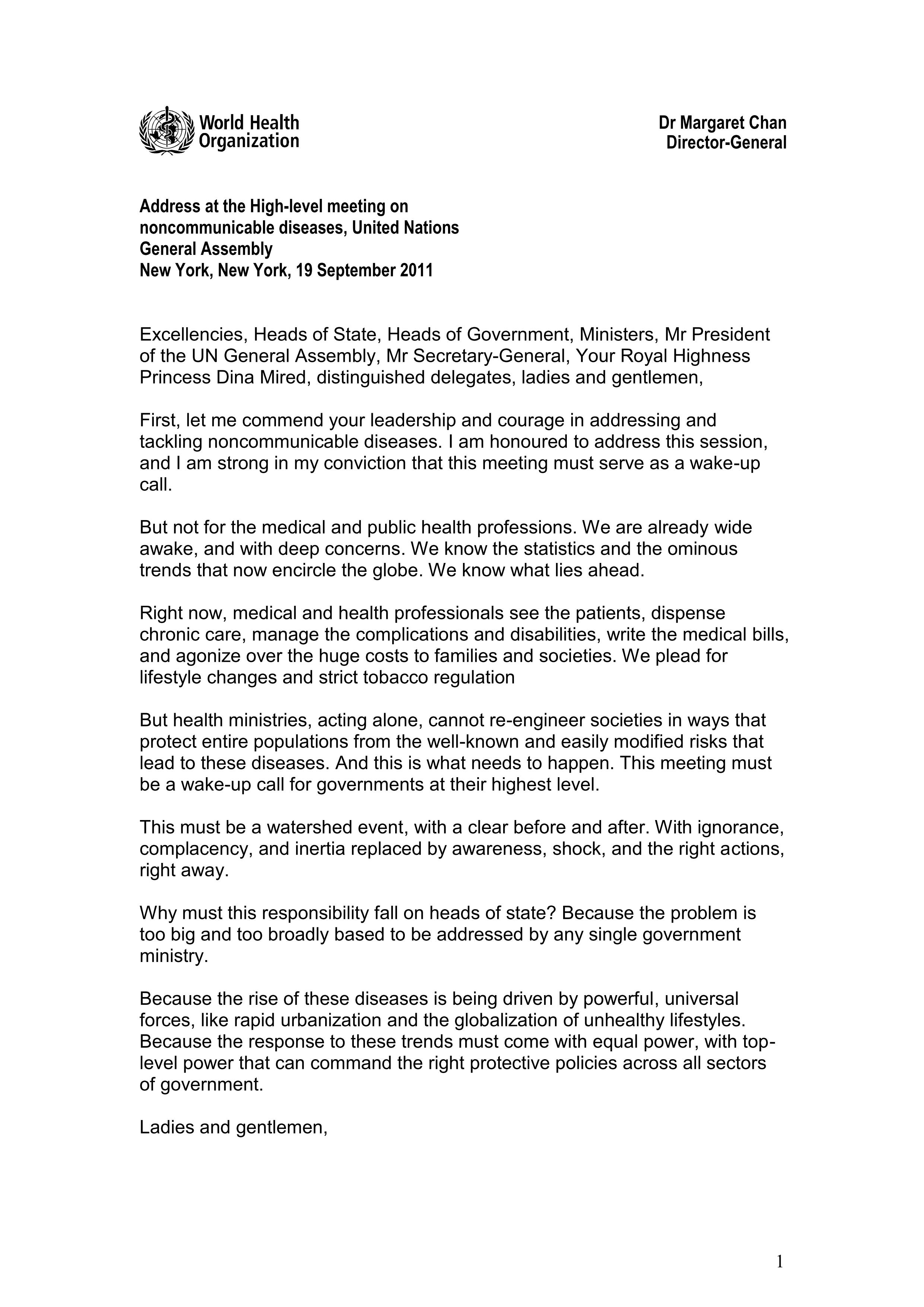
Download full PDF : 11 09 19 UN WHO DG Chan speech

Cigarette Prices Should Rise 75%, Japan’s Health Minister Says

http://www.bloomberg.com/news/2011-09-19/cigarette-prices-should-rise-75-japan-s-health-minister-says.html

Japan’s Health Minister Yoko Komiyama

Japan's Health Minister Yoko Komiyama

Akio Kon/Bloomberg

Yoko Komiyama, Japan’s health, labor and welfare minister.

Japan’s Health Minister Yoko Komiyama

Japan's Health Minister Yoko Komiyama

Tobacco taxes in Japan should be raised until the average price for a pack of cigarettes is about 700 yen, or 75 percent more than the present level, to cut medical costs, Health MinisterYoko Komiyama said.

The ministry, which is participating in a tax panel session, will push for increasing tobacco levies by 100 yen annually for three years, Komiyama said. Most of the members of the panel agreed with the idea last year, she said.

Efforts to raise duties have been complicated by government ownership of a controlling stake inJapan Tobacco Inc. (2914), the world’s third-biggest publicly traded cigarette maker, and concerns that tax revenue may decline for the country facing the world’s largest public debt. Smoking was responsible for at least 4.3 trillion yen in medical costs and economic losses for Japan in 2005, according to a study by Institute for Health Economics and Policy.

“At that level, we can expect people who want to quit smoking to stop, while maintaining the level of tax revenue,” said Komiyama, 63, who became minister on Sept. 2. “It’s also the best way to prevent underage smoking.”

Almost 10 percent of the population under 20 years old had smoked at least once, with 1.2 percent of the age group smoking every day, according to a study funded by the health ministry in 2007.

Japan Tobacco Stake

The average price for a pack of 20 cigarettes in Japan went up by 33 percent in October last year to 400 yen, or about $5.20. That compares with the average price of $10.80 in New York City, when the city raised taxes in July last year.

The proposal to increase taxes is in accordance with the manifesto of the ruling Democratic Partyof Japan, Komiyama said. The manifesto calls for abolishing a law that requires the government to own more than half of Japan Tobacco’s outstanding shares, and that tobacco-related issues be included in the “health agenda,” she said.

The tax panel, led by Finance Minister Jun Azumi, proposes reducing the government’s stake in Japan Tobacco to a third from about half, he said on Sept. 16.

The maker of Mild Seven and Camel cigarettes has gained 16 percent this year in Tokyo trading, giving it a market value of 3.5 trillion yen ($45.5 billion). Japan Tobacco said on Sept. 6 it wants the government to sell its shares and use the funds to finance reconstruction after the March 11 earthquake and tsunami that left more than 20,000 people dead or missing.

Japan Tobacco rose 2 percent to 349,000 yen on Sept. 16. Markets in Japan were closed yesterday for a public holiday.

Alfresco smoking ban push

http://parramatta-advertiser.whereilive.com.au/news/story/alfresco-smoking-ban-push/

19 Sept. 2011

WITH North Sydney Council banning smoking in alfresco dining areas, there are renewed calls for Parramatta Council to bite the bullet on the issue.

Recently, North Sydney councillors voted unanimously to ban smoking in alfresco dining areas on council land – while Parramatta is still in the throes of a 12-month survey of diners and restaurants.

North Sydney conducted a survey over six to eight weeks, on its website and through rate notices.

An overwhelming 92 per cent of the 583 participants voted for the ban.

North Sydney Council will ban smoking in alfresco dining areas and other public areas from October 1.

The council also is pushing for a statewide ban on smoking in public places.

Stafford Sanders from the ASH anti-smoking group said North Sydney’s survey’s findings were consistent with public opinion all over Sydney, including Parramatta.

“We have begun circulating a fact sheet on the effects of smoking in dining areas around venues in Parramatta because we feel that people are not being told the truth,” Mr Sanders told The Parramatta Advertiser.

Cr McDermott said that if a council such as North Sydney – a major CBD like Parramatta – could ban smoking in alfresco dining areas, so could Parramatta.

Mr Sanders said there was no evidence that restaurants suffered long-term damage by banning smoking in outside dining areas.

Lord Mayor John Chedid said Parramatta Council’s decision to implement a 12-month survey was introduced “so that it could better understand any concerns of restaurants and its patrons”.

“Parramatta is home to one of Sydney’s largest dining precincts and council is focused on providing a thorough examination of all of the health, social and economic factors so that we can make an informed decision,” Cr Chedid said.

Survey and research results are expected to go before the council by the end of the year.

U.S. researchers find target for treating smoking, alcoholism

http://news.xinhuanet.com/english2010/health/2011-09/13/c_131134401.htm

WASHINGTON, Sept. 12 (Xinhua) — An enzyme that appears to play a role in controlling the brain’s response to nicotine and alcohol in mice might be a promising target for a drug that simultaneously would treat nicotine addiction and alcohol abuse in people, U.S. researchers find.

Over the course of four weeks, mice genetically engineered to lack the gene for protein kinase C (PKC) epsilon consumed less of a nicotine-containing water solution than normal mice, and were less likely to return to a chamber in which they had been given nicotine. In contrast, normal mice steadily increased their consumption of nicotine solution while the mice lacking PKC epsilon did not.

The study conducted by researchers at the Ernest Gallo Clinic and Research Center, affiliated with the University of California, San Francisco, appeared Monday in the online edition of the Proceedings of the National Academy of Sciences.

In normal mice, as in humans, nicotine binds to a certain class of nicotinic receptors located on dopamine neurons, which causes dopamine to be released in the brain. Dopamine creates a feeling of enjoyment, and thus prompts a sense of reward. Researchers found that mice lacking PKC epsilon are deficient in these nicotinic receptors.

The finding complements earlier research in which researchers found that mice genetically engineered to lack the PKC epsilon enzyme drank less alcohol than normal mice and were disinclined to return to a chamber in which they had been given alcohol.

“This could mean that these mice might not get the same sense of reward from nicotine or alcohol,” said Gallo senior associate director and investigator Robert Messing. “The enzyme looks like it regulates the part of the reward system that involves these nicotinic receptors.”

The reward system is a complex of areas in the brain that affect craving for nicotine, alcohol and other addictive substances.

The next step in the research, said Messing, would be to develop compounds that inhibit PKC epsilon. The ultimate goal, he added, would be medications that could be used “to take the edge off of addiction by helping people get over some of their reward craving.”

Australia Cigarette Pack warning

Japanese Panel Calls for $146 Billion Tax Increase

http://online.wsj.com/article/SB10001424053111904106704576578530729783742.html?mod=googlenews_wsj#printMode

Asian Street Wall Journey

ASIA BUSINESS

SEPTEMBER 18, 2011, 1:38 P.M. ET

Japanese Panel Calls for $146 Billion Tax Increase

By TAKASHI NAKAMICHI

TOKYO—A Japanese government panel on Friday called for temporary tax increases to bring in ¥11.2 trillion (about $146 billion) over a period of up to 10 years to fund post-disaster reconstruction and prevent public finances from worsening.

Charged with coming up with ways to boost government revenue in the face of huge spending requirements after the March 11 earthquake, the Tax Commission also recommended raising ¥5 trillion through non-tax sources, including the sale of government-held shares in Japan Tobacco Inc.

The commission offered three tax-increase options, to be in effect for five to 10 years: a mixture of higher income, corporate and regional taxes; that mix plus higher taxes on specific items such as alcohol or cigarettes; and an increase in the country’s sales tax from the current 5%. But Prime Minister Yoshihiko Noda quickly ruled out the third option, according to Finance Minister Jun Azumi.

Of the projected tax revenue, ¥8 trillion would be used for reconstruction and ¥2.5 trillion for pension programs, among other uses.

Mr. Noda doesn’t want reconstruction spending—estimated at roughly ¥13 trillion over five years—to add to the nation’s public debt, already twice annual economic output.

The government plans to sell bonds to raise much of the ¥13 trillion, then gradually pay back the borrowed money using revenue from the tax increases.

But there is uncertainty over the extent to which the ruling party’s final tax policies will reflect Friday’s proposals. Worried about Japan’s slowing economic recovery, many Democratic Party of Japan lawmakers are opposed to tax increases, though polls suggest many voters consider higher taxes an acceptable way to fund reconstruction.

More importantly, opposition parties, whose backing is vital in getting tax bills through Japan’s split parliament, are growing more combative, stoking doubts over the smooth enactment of any tax plans.

Under the first option proposed by the panel, considered the favorite among tax officials, the government would increase the income tax by either 5.5% for 10 years or 11% for five years, starting next March. Local media reports said Mr. Noda favors a 10-year period for any income-tax increase.

The corporate tax part of the plan is more complex. The government, in line with earlier plans, would cut the 40% corporate tax by five percentage points starting next March 2012. But it would also simultaneously introduce an increase of more than two percentage points over three years, with the proceeds earmarked for reconstruction.

The debate on tax increases to pay for reconstruction is separate from another plan to double the sales tax by the middle of this decade, which is focused on cutting the government’s budget deficit.

Write to Takashi Nakamichi at takashi.nakamichi@dowjones.com

Copyright 2011 Dow Jones & Company, Inc. All Rights Reserved

This copy is for your personal, non-commercial use only. Distribution and use of this material are governed by our Subscriber Agreement and by copyright law. For non-personal use or to order multiple copies, please contact Dow Jones Reprints at 1-800-843-0008

WHO outlines steps to reduce leading causes of death

http://www.cnn.com/2011/09/18/health/who-noncommunicable-diseases/

Deaths from noninfectious diseases are increasing, especially for low- and middle-income countries.

STORY HIGHLIGHTS

  • ·        WHO: Countries should tax tobacco and alcohol, discourage smoking, salt and trans fats
  • ·        They should also emphasize good diet, physical activity, health organization report says
  • ·        Recommendations were released to cut heart disease, cancer, lung disease, diabetes
  • ·        Not implementing interventions could cost countries $7 trillion in 15 years, study says

(CNN) — To decrease deaths from noninfectious diseases, countries should pass excise taxes on tobacco and alcohol, encourage smoke-free public places, reduce salt and trans fat in foods, and increase awareness of diet and physical activity, according to a World Health Organization report.

The report, released Sunday, warned that people in rich and poor countries continue getting noninfectious diseases related to lifestyle and the use of tobacco and alcohol.

These diseases — heart disease, cancer, lung disease and diabetes — are not only the leading killers in the world, with 36 million deaths a year, their economic toll can be devastating.

If these non-communicable diseases flourish at their current rate, low- and middle-income nations could lose about $7 trillion from 2011 to 2025. These estimates are results from a World Economic Forum and Harvard School of Public Health study also released Sunday.

A 2009 survey of business leaders by the World Economic Forum called chronic disease one of the leading threats to global economic growth.

For only the second time in its history, the United Nations General Assembly, which is meeting this week, has put a health issue on its agenda. Nations will meet Monday and Tuesday to develop an international plan for preventing and controlling non-communicable diseases.

The need for action is urgent, said Dr. Ala Alwan, assistant director-general for non-communicable diseases and mental health at the WHO.

“The world is now recognizing the enormous health impact of non-communicable diseases, particularly the four major groups: cardiovascular disease, cancer, chronic lung disease, diabetes. This is now emerging as a major social-economic problem as well,” he said.

Deaths from noninfectious diseases are increasing, especially for low- and middle-income countries, some of which are grappling with other health issues such as malnourishment and infectious diseases.

“We know there are 100 million people who are pushed into poverty every year, because they have to pay directly for health care,” Alwan said. “Most of the health care requirements are for non-communicable diseases: cardiovascular disease, stroke, lung disease, diabetes or cancer.”

These illnesses hurt household income for the affected individuals and their families, but also translate to loss of productivity and physical disability.

“When much of the work force is sick and dies in their productive years, national economies lose billions of dollars in output. And millions of families are pushed into poverty,” Jean Pierre Rosso, managing director at the World Economic Forum, said in a news release.

The diseases also affect the United States, which spends $2 trillion a year on health expenses, according to the WHO report.

CNNMoney: Health care’s big money wasters

WHO grouped heart disease, cancer, lung disease and diabetes because these account for 80% of the deaths from non-communicable diseases, and they share common risk factors. These include tobacco use, harmful use of alcohol, physical inactivity and an unhealthy diet.

It recommended several public health steps to help countries take action such as discouraging smoking, reducing salt in foods and encouraging healthier habits.

The WHO studied 48 low- and middle-income countries all over the world over 10 years. The countries, such as Sri Lanka, Ukraine and Kenya, implemented measures such as salt reduction campaigns and tobacco control.

The measures resulted in a “considerable reduction” in the incidence of non-communicable disease and death, Alwan said. He called these steps “best buys,” because they cost little money and have the potential to “save literally millions of lives over the next 15 years.”

These recommendations also include screening people who are at risk for heart disease, cervical cancer screenings and hepatitis B immunization to prevent liver cancer.

The cost of adopting these interventions in all low- and middle-income countries would be $12 billion per year. Inaction would result in about $7 trillion in losses over the next 15 years for these nations.

Unlike infectious diseases, these chronic diseases have been slow to get attention. The U.N’.s focus on the topic is much needed, said Yanzhong Huang, a senior fellow for global health at the Council on Foreign Relations think tank.

“It’s a difficult thing to do, to frame it as something sexy that mobilized policy makers or society groups,” he said. The pervasive thought is that, “this is a lifestyle disease. It’s because of the lack of exercise, too much high-fat food, you deserve it. It’s your problem.”

The smokeless gun: Athletes using smokeless tobacco for nicotine doping

http://www.separationsnow.com/coi/cda/detail.cda?id=26018&type=Feature&chId=4&page=1

Tobacco is the new sporting stimulant

The World Anti-Doping Agency (WADA) campaigns for global drug-free sport and is supported by funding from national governments and the Olympic Movement. Its key activities include scientific research and the establishment of accredited labs around the world to carry out drug testing on the many thousands of samples provided by athletes each year.

The labs are guided by the WADA Prohibited List, which is the up-to-date bible of banned substances. The list is reviewed annually with new additions published on October 1st and coming into force on the following January 1st.

One of the substances under consideration is nicotine, according to Olivier Rabin, the sporting director of WADA. The growing body of evidence that nicotine can be used to boost performance is behind their deliberations, although it is not cigarettes that are thought to be the problem.

The culprit is smokeless tobacco, which can be chewed, snorted or “dipped”, placing it between the lips and gums. When taken this way, tobacco is not associated with harmful effects on the respiratory tract, which would hinder athletes, but nicotine is still absorbed by the body.

Rabin said recently “it is not our objective to catch athletes who smoke, but those who use nicotine as a means of enhancing their performance,” adding that they would have to find means of distinguishing one from the other.

More support for a smokeless tobacco ban came recently in a study of the urine samples taken from players during the 2009 Ice Hockey World Championships. About 50% of players from 72 tested qualified as consumers of smokeless tobacco products based on threshold levels of nicotine in their system.

Now, a new study published in 2011 supports the widespread use of smokeless tobacco with an extensive study of urine samples from athletes.


Nicotine testing in 2100 urine samples

Francois Marclay, Elia Grata, Laurent Perrenoud and Martial Saugy studied 2185 urine samples that were submitted over a one-year period to their organisation, the Swiss Laboratory for Doping Analyses at the Centre Hospitalier Universitaire Vaudois, in Switzerland.

They adopted a liquid chromatography-mass spectrometry procedure to detect and measure the levels of nicotine and its major and major metabolites cotinine, cotinine N-oxide, trans-3-hydroxycotinine and nicotine N-oxide. The minor tobacco alkaloids anabasine, anatabine and nornicotine were also targeted.

In an effort to speed up sample preparation, they employed a “dilute-and-shoot” approach which is amenable to automation. After adding stable isotope-labelled compounds to act as internal standards, urine samples were diluted 40-fold with acetonitrile and the centrifuged supernatant was retained for analysis.

The degree of dilution was carefully chosen to try and balance out the effects of reduced interference from other compounds in the urine against the reduced sensitivity of the target analytes during mass spectrometric analysis.

One consequence of this strategy was to disregard the phase II glucuronide conjugates of nicotine and its metabolites, which, in some cases, form the major urinary excretion routes. Their inclusion would require a hydrolysis step to be incorporated, slowing down the procedure.

The researchers argued that their primary focus was on the levels of nicotine in the urine of athletes, which would be reflected by the target phase I metabolites that showed good sensitivity in their procedure.

The extracts were injected onto a short hydrophilic interaction chromatography column to separate the analytes. This was accomplished with a high flow rate so that the overall run time was just five minutes without jeopardising the resolution.

The eluting compounds were subjected to electrospray ionisation and analysed by tandem mass spectrometry, yielding detection limits in the region of 1 ng/mL and good analytical characteristics.


Smokeless tobacco doping prevalent in certain sports

The concentrations of the major and minor nicotine metabolites and the other alkaloids across all of the samples ranged from the lower limits of quantitation to 32,223, 6670 and 538 ng/mL, respectively. At least one of the metabolites was detected in 23% of the samples.

Even when accepted threshold levels for active exposure were taken into account (50 ng/mL for nicotine, cotinine and trans-3-hydroxycotinine and 25 ng/mL for the remaining analytes) at least one of the metabolites was present at these levels in more than 15% of cases.

The contribution from secondhand smoke is probably very low, due to increasing legislation for smoke-free environments, and the low likelihood of exposure just before sports practice and subsequent testing. So, these figures are significant.

The World Health Organisation estimates that the proportion of people smoking globally is 25%, so bearing in mind that the Swiss data is for athletes, this “supports the potential use of nicotine in sport with a specific purpose,” announced Marclay.

When the samples were narrowed down from the total of 43 sports to a particular subset, the results were even more startling. For ice hockey, skiing, biathlon, bobsleigh, skating, football, basketball, volleyball, rugby, American football, wrestling and gymnastics, the prevalence ranged from 19-55.6%, far larger than normal recreational use.

This is one of the strongest signs to date that smokeless tobacco is being used routinely in certain sports communities for performance benefits, without the respiratory health problems that accompany smoking.

At this stage, there is no recognised clinical procedure for measuring metabolites to differentiate between different types of nicotine consumption. However, this research team now have a set of quantitative data that is available for retrospective assessment when such a method is developed.

In the meantime, their results add more weight to the argument for adding nicotine to the WADA Prohibited List and they urged the List Expert Group to evaluate its inclusion.

Nicotine enhances performance

http://www.foxsports.com.au/other-sports/wada-to-move-towards-declaring-nicotine-a-performance-enhancing-drug/story-e6frf56c-1226139585832

Nicotine is likely to be classified a performance-enhancing drug after the World Anti-Doping Agency meets on Saturday to update its list of substances prohibited in sport.

WADA is likely to act after receiving a report from its accredited laboratory in Lausanne that noted performance-enhancing effects of nicotine.

The performance-enhancing effects of nicotine included increased “vigilance and cognitive function” and “reduced stress and body weight”, the laboratory reported after a year-long study published by the Forensic Science International journal.

” … nicotine also triggers a significant increase of pulse rate, blood pressure, blood sugar and epinephrine release owing to simultaneous stimulant and relaxant properties,” the laboratory reported.

The laboratory researchers noted that smokeless tobacco was “a very attractive drug from a doping perspective” because it did not damage an athlete’s breathing and respiratory system.

The laboratory established that 15 per cent of athletes actively used nicotine – compared with 25 per cent of the general population – after conducting tests on 2185 urine samples taken from 43 sports.

Athletes in ice hockey, gymnastics, rugby and skiing were “above-average” users of nicotine, the report noted.

And 19 per cent of samples taken from soccer players showed traces of nicotine having been used “before or/and during sport practice”.

“WADA and sport federations should evaluate the inclusion of nicotine to the Prohibited List or/and Monitoring Program,” the laboratory reported .

The WADA ruling panel will meet in Lausanne this weekend to establish changes in the status of doping products and methods.

Changes noted will then come into force in January.

Caffeine and Viagra have also been evaluated for potential doping effects.