Clear The Air News Tobacco Blog Rotating Header Image

Aberdeen shopping centre bans smoking OUTSIDE

https://www.pressandjournal.co.uk/fp/news/aberdeen/597103/shopping-centre-stubs-out-smoking/

An Aberdeen shopping mall has taken action to stub out smoking on its front doorstep.

The ban came into force on the pavement outside the Bon Accord and St Nicholas centre yesterday.

Bosses and health chiefs hailed it a positive step – and said it would improve the retail experience for all shoppers.

However, pro-smoking lobbyists branded the move “heavy handed” and insisted people smoking outside were not putting anyone’s health at risk.

The ban covers the Bon Accord mall’s Schoolhill entrance up to the pedestrian crossing, where new signposts have been placed to inform the public.

Security staff were also on hand yesterday, asking smokers to move away from the area.

It is the first shopping complex in the north-east to outlaw smoking outside its premises. Others said they were ., the scheme but did not e

The management team has joined forces with Aberdeen City Council for the drive, and city wardens will be closely monitoring the area as part of their regular patrols.

Although the law does not permit them to force people to stop smoking, they are able to issue £80 fines to anyone caught throwing cigarette butts – or any other litter – onto the street.

Mall manager Craig Stevenson, said secondhand smoke had been one of the biggest sources of complaints from shoppers and he was certain people would respect the new initiative.

He added: “We are committed to ensuring the experience of shoppers is as enjoyable and pleasant as possible and tackling smoking outside the mall will ensure a better quality environment.

“We are also trying to decrease the amount of littering outside the centre and would like to thank Aberdeen City Council for its support in this endeavour.”

However, one smoker said the ban had resulted in the only bin being removed from the area.

Emma McKenna, 21, a retail worker from Rosemount, said: “They have taken away the bin, which had an ashtray on it, so where are people supposed to put their litter now?

“They are just moving the problem around the corner.”

A spokesman for the centre confirmed a bin had been removed but added: “Litter levels in the courtyard would be monitored by the centre, with necessary action taken if required.”

The ban was more popular with Sheila Duffy, chief executive of anti-smoking charity ASH Scotland, who said: “We are keen to see smoke-free outdoor spaces created where these are supported by local communities, as part of putting tobacco – a lethal, addictive substance – out of sight, out of mind and out of fashion for the next generation.

“I congratulate the centre’s management team for listening to their customers and creating a smoke-free entrance.”

NHS Grampian tobacco control coordinator Derek Petrie said the centre should be congratulated for an “excellent and proactive initiative”.

He added: “We know the 2005 ban on smoking in all public places improved public health by reducing the number of heart attacks and cases of childhood asthma.

“Extending the ban into these busy thoroughfares is likely to lead to further necessary improvements – 13,000 Scots still die each year from tobacco related illness.”

However, Simon Clark, director of pro-smoking lobbyists Forest, blasted the tactic.

He said: “I think it is outrageous that they think public money should be spent enforcing this.

“People smoking outside are not putting anyone’s health at risk.

“If there are concerns about litter then the shopping centre should provide cigarette bins so people have somewhere to put their cigarette out.

“I think to actually ban it and say people will potentially be fined and penalised, seems very heavy handed.

“Bearing in mind that about 20% of the population smokes, it is not sending out a warm welcome to that section of the population who may want to stop and have a smoke after they have done their shopping.”

In the footsteps of Aberdeen hospital…

The Bon Accord and St Nicholas centre’s bid to cut out smoking outside its premises follows the blanket ban on hospital grounds which came into force earlier this year.

The policy means patients, visitors and staff are now asked to leave the site before they light up.

The measure, which applies to the entrances and grounds of health centres, hospitals and other NHS buildings in Scotland, has been adopted by all NHS boards at the request of the Scottish Government – in line with its target of creating a tobacco-free generation by 2034.

NHS Grampian had led the way for a number of years with the introduction of smoke-free sites at the Chalmers Hospital in Banff and Fraserburgh Hospital.

Yesterday Craig Stevenson, manager of the Bon Accord and St Nicholas shopping mall, said: “We have watched from a distance as NHS Grampian has introduced a smoke-free policy across hospital grounds, a policy which has been widely welcomed.

“We have taken the decision to introduce this initiative ourselves after feedback from visitors to the centre showed secondhand smoke to be one of the biggest complaints.”

Is it time to stub out tobacco shares?

Is it time to stub out tobacco shares? As BAT is hit with a £5.5bn fine, we look at the sin stocks loved by income investors

http://www.thisismoney.co.uk/money/investing/article-3108140/With-BAT-hit-5-5bn-fine-time-stub-tobacco-shares.html

UK investors have been given jitters after cigarette maker British American Tobacco was hit with a record fine of £5.5billion.

BAT is a major stock in many investment funds in the UK, as are other major tobacco firms because they tend to produce good profits and dividends.

Shares in BAT, which manufactures Benson & Hedges, Rothmans and Dunhill cigarettes, had fallen 2.4 per cent yesterday, and closed at £35.06 on the day.

The fine follows a lawsuit in Canada in which smokers claimed they were not told smoking was bad for them. It has put a year’s worth of company profits at risk.

British American Tobacco posted profits of £4.5billion in 2014.

Almost a million Canadian smokers say they have been unable to quit the habit or have had cancer or emphysema after failing to be warned of tobacco’s risks.

Tobacco stocks are firm favourites among UK fund managers. These are behemoth businesses, known for paying a steady dividend — currently just over 4 per cent — making them especially popular in income funds.

But the share prices also tend to grow, and this makes them attractive to equity fund managers, too.

BAT has seen its share price rise from £21.43 to £35.06 over the past five years, while Imperial Tobacco’s has shot up from £26.69 to £32.10 a share in the past year.

Some 148 of the funds available to UK investors have BAT in their ten biggest investments, while 121 have large amounts of cash in Imperial Tobacco.

The Woodford Equity Income Fund, run by Neil Woodford, has 16 per cent of its money in tobacco firms including BAT, Imperial Tobacco, the makers of West cigarettes and Golden Virginia rolling tobacco, and Reynolds American, which produces Camel and Pall Mall cigarettes.

Meanwhile, Mark Barnett’s Invesco Perpetual High Income has more than 14 per cent of its £12 billion of assets in these businesses.

Research for Money Mail by ratings firm FundCalibre shows Scottish Widows Multi Manager UK Equity Income has 12.6 per cent of its cash in Imperial Tobacco, while BlackRock UK Focus has 7.6 per cent of its money in BAT.

Tobacco firms rely on loyal, addicted customers who pay top dollar for their fix — despite the number of UK smokers falling.


Latest figures show 19 per cent of Brits are smokers, down from 45 per cent in 1974, but that’s still more than 11 million people.

On top of litigation scares, tobacco firms find themselves facing an increasing amount of regulation and red tape.

July 2007 marked a major challenge for their businesses, when smoking in enclosed public areas, including workplaces, restaurants and bars, was banned.

In October this year, new rules are set to come into force which will fine drivers who are found smoking with a child in the car. Anyone lighting up when travelling with a passenger aged under 18 will face a fine of up to £50.

But fund managers are not concerned about increasing regulation. As red tape in developed nations has increased, these firms have turned their attention to countries with fewer limitations.

BAT markets its products in more than 200 countries across the globe, selling an incredible 667 billion cigarettes every year — or 21,000 every single second.

That’s not to say there are no challenges for these firms. Developing nations are starting to change their attitude to cigarettes.

China recently introduced a ban on smoking in some public areas, for example. Darius McDermott, director at FundCalibre, says: ‘Restrictions are only going to increase in the future, but tobacco companies have survived worse, and you can still make money from these shares even when things look bleak.

‘These firms tend to have a high and growing dividend yield, so for this alone they are still attractive. Good managers such as Mr Woodford and Mr Barnett know these companies and the risks of investing in them, and I would trust them to manage their investments in them over time.’ Stephen Lamacraft, fund manager at Woodford Investment Management, says: ‘Lawsuit risk has been an enduring feature of the tobacco industry for decades, and we do keep a close eye on developments.

‘However, tobacco stocks remain a core part of our portfolio and we don’t expect the latest class action to impact their attractive long-term investment prospects.’

It’s not yet clear whether BAT will pay the fine — it is seeking to appeal — but, even if it does, it seems that losing £5 billion is unlikely to shake its foundations significantly. Ian Forrest, research analyst at The Share Centre, says:

‘It’s a case of wait and see for investors. The fine is potentially significant but BAT seems fairly confident it will be overturned on appeal.

‘Tobacco firms are attractive due to the amount of cash they generate and their focus on paying rising dividends to their investors.

‘While this ruling is a potential problem, there are bright spots on the horizon with loosening trade restrictions between the U.S. and Cuba likely to drive cigar sales.’

How The Tobacco Industry Wins Friends And Influences Policy

http://www.newslaundry.com/2015/06/02/how-the-tobacco-industry-wins-friends-and-influences-policy/

It’s time for the Indian government to protect public health policies from vested interests in the tobacco industry.

Shyama Charan Gupta is one of the members of the parliamentary committee on subordinate legislation that had recently suggested a delay in the implementation of larger pictorial warnings on tobacco products. He owns the Shyam group of companies that produces the brand, Shyam Beedi, which has an annual turnover of around Rs 250 crores from beedis alone.

While the issue of conflict of interest is now entering public discourse, the tobacco industry has been operating more insidiously for some time now to subvert public health policies.

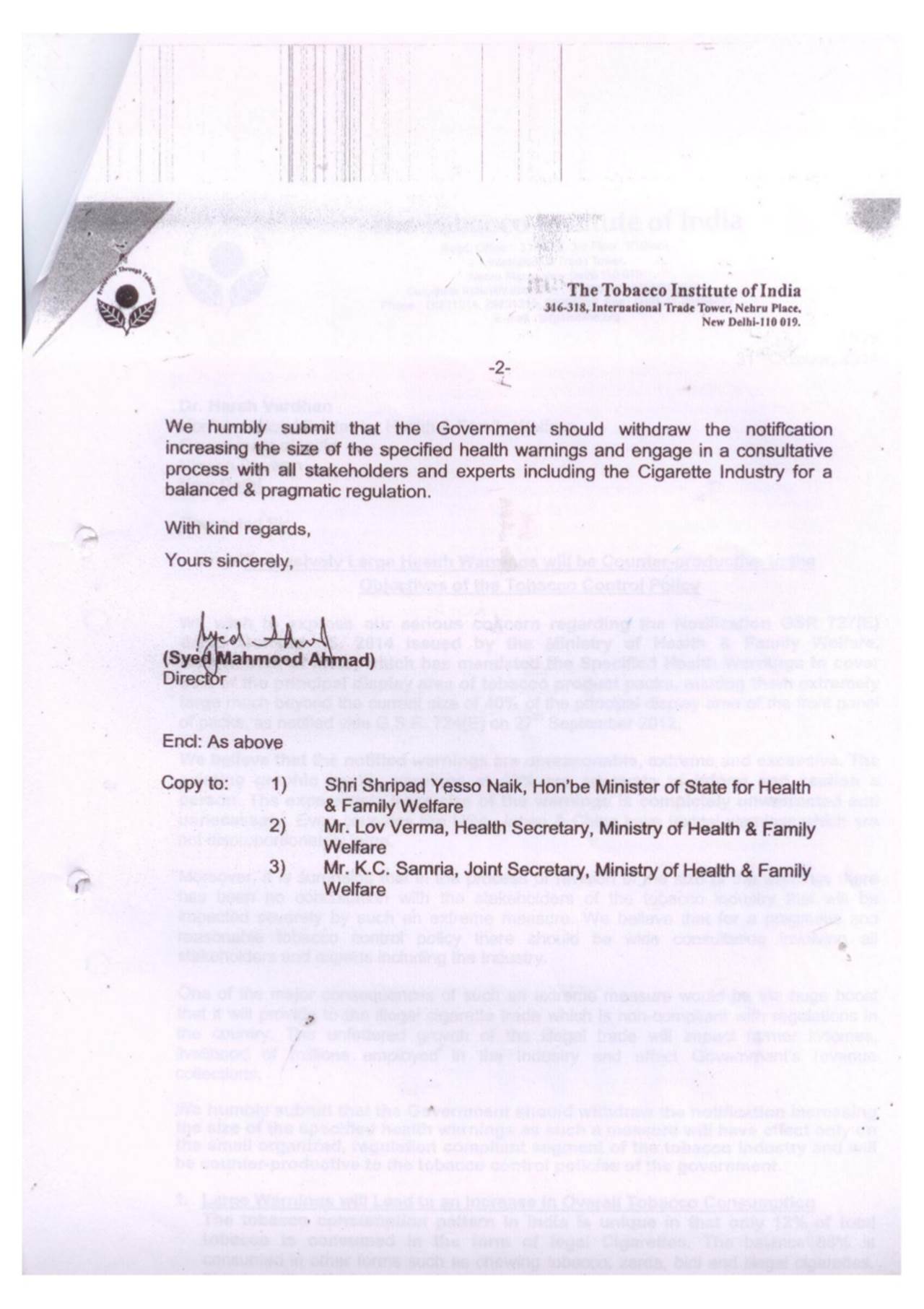
Information received under the Right to Information (RTI) Act has revealed that the Tobacco Institute of India (TII) sent repeated representations to the Union Ministry of Health and Family Welfare asking it to withdraw the notification mandating large-size pictorial health warnings.

TII has, in the past, resisted tobacco-control proposals, taking public positions against those measures in the media. The Federation of Indian Chambers of Commerce and Industry (FICCI) also sent representations to the health ministry as well as the commerce ministry arguing against the proposed amendments to the national tobacco control law, including the notification with regard to the large-size health warnings.

A similar representation was sent by the Associated Chambers of Commerce and Industry of India.

A closer look at some of these organisations might explain their pro-tobacco stand.

The present and the past directors, Sanjiv Puri, Syed Mahmood Ahmad and Udayan Lall, of the TII, which claims to be “a repository of reliable information on the industry and is privileged to be consulted by government, parliamentary committees for information and policy recommendations on tobacco issues” are employed by the ITC.

In the past, Anup Singh held directorship on the board of TII as well as tobacco companies including ITC, Asia Tobacco Company, and Surya Nepal Ltd, at the same time. Similarly, Sai Sankar and Raymond Noronha, who have been directors of TII, were simultaneously on board of the VST Industries, the third-largest cigarette manufacturer in India.

Tobacco industry representatives also hold prominent positions at FICCI. K K Modi, the Chairman of Modi Enterprises, which includes Godfrey Phillips, the second-largest cigarette manufacturer, is a current member of the FICCI steering committee and has served as the past president of FICCI.

Similarly, K K Modi, Samir Modi (Managing Director at Modi Enterprises), Sarthak Beharia (Group President of the Godfrey Phillips) and Deveshwar (Chairman of ITC) are all members of the FICCI executive committee.

FICCI has, in fact, given a corporate social responsibility award to ITC.

According to the World Health Organisation as well as Framework Convention on Tobacco Control, a United Nations treaty on tobacco control, which India ratified in 2004, there is an inherent contradiction in the tobacco industry doing CSR as the core functions of the industry are in conflict with goals of public health policies with regards to tobacco control.

In this context, it is ironical that the Confederation of Indian Industry (CII) in partnership with ITC formed a Centre of Excellence for Sustainable Development with an aim to help companies achieve social and environmental objectives along with economic ones. Chairman of advisory council Deveshwar of the center is the current chairman of ITC, who has also been a past president of CII.

Globally, it is a known tactic of tobacco companies to work through other groups. In fact, last month, the 12th annual Asia Pacific Tax Forum was held in Delhi (May 5 and 7) to discuss tax reforms in the region. Higher taxes on tobacco is a known effective strategy for tobacco control. However, the forum was co-organised by the International Tax and Investment Centre (ITIC). The website of ITIC mentions major tobacco transnationals among its sponsors, like Philip Morris International, British American Tobacco, Imperial Tobacco Limited and so on.

Its board of directors also include representatives of big tobacco companies. It has, in the past, held conferences to influence policy makers and subvert policies in the interest of tobacco industry. For example, on October 12, 2014, the morning before the sixth conference of the parties of the Framework Convention on Tobacco Control in Russia, ITIC hosted an exclusive event in Moscow for representatives of the Ministries of Finance in an attempt to derail the adoption of Article 6 tax guidelines. In a rare gesture, the secretariat of the UN treaty sent a note to all parties, including India, highlighting the link between ITIC and the tobacco industry.

In her opening address to the Conference of the Parties, Margaret Chan, Director-General of the World Health Organization, denounced ITIC’s effort to undermine the adoption of “robust, expert-driven proposed guidelines on tobacco tax and price policy”.

While, in a positive gesture, the World Bank decided to reject ITIC’s request for technical and financial support to the forum, some of the top-level government officers from finance participated in this forum. Interestingly, the manual brought out by ITIC (ASEAN Excise Tax Reform: A Resource Manual) clearly propagates tax measures with regard to tobacco that are of interest to the tobacco industry, like phasing out ear-marked taxes on tobacco.

Globally, over 30 countries have taken domestic measures to protect their policies from vested interests of tobacco industry, ranging from limiting interactions with tobacco industry and making them transparent to divesting from tobacco industry and tobacco cultivation. In our region, the Philippines has adopted a policy that prevents conflict of interests within government officials with regard to tobacco control.

The Karnataka High Court, in 2010-2011 as part of a public interest litigation, had ordered the government to withdraw its participation from a tobacco industry event in Bangalore and to adopt a code of conduct for public officials regulating their interactions with tobacco industry. We are yet to see any concrete measures in this regard.

India is losing one million lives every year from tobacco-related diseases and is duty-bound under the United Nations treaty to safeguard its health policies from tobacco industry interference. It is time the new government’s resolve for “good governance” translates into practice.

image010 image009 image008

Tobacco firms fined billions in Canadian court ruling

http://www.bbc.com/news/world-us-canada-32969338

A Canadian court has ordered three tobacco companies to pay C$15.5bn (£8bn; $12bn) – the largest award for damages in the country’s history.

The plaintiffs were Quebec smokers who said the firms failed to warn them of health risks associated with smoking.

Imperial Tobacco, Rothmans Benson & Hedges and JTI-MacDonald vowed to appeal against the decision.

The class-action lawsuits were filed in 1998, but only recently went to trial in the courts.

The firms argued that Canadians have had a “high awareness” of smoking health risks since the 1950s.

“That awareness has been reinforced by the health warnings printed on every legal cigarette package for more than 40 years,” JTI-Macdonald said in a statement.

But the plaintiffs argued that the companies did not properly warn their customers and failed in their general duty “not to cause injury to another person”, according to the Quebec Superior Court decision.

They represent nearly one million smokers who were unable to quit or who suffer from throat or lung cancer, or emphysema.

British American Tobacco ordered to pay £5.5bn to smokers

http://www.telegraph.co.uk/finance/newsbysector/retailandconsumer/11644961/British-American-Tobacco-ordered-to-pay-5.5bn-to-smokers.html

Court rules that three tobacco makers should pay a total of Can$15.6bn – the largest award in Canadian history

British American Tobacco has been ordered to pay Can$10.5bn (£5.5bn) to nearly 1m smokers who claimed they were never warned about the health risks.

A Canadian court found Imperial Tobacco Canada, which is owned by London-based BAT, Rothmans Benson & Hedges and JTI-MacDonald liable for moral and punitive damages.

The total award of Can$15.6bn is the largest in Canadian history. All three companies said they would appeal.

The two class action lawsuits behind the award were originally filed in 1998, but only went to trial recently. They represent nearly 1m smokers who were unable to quit or who suffer from throat or lung cancer, or emphysema.

The plaintiffs argued that the companies neglected to properly warn their customers about the dangers of smoking, and failed in their general duty “not to cause injury to another person”, according to the Quebec Superior Court.

They also accused the firms of unscrupulous marketing and of destroying documents relevant to the case.

The companies said the court’s decision is not supported by the evidence presented at trial.

“Today’s judgment ignores the reality that both adult consumers and governments have known about the risks associated with smoking for decades, and seeks to relieve adult consumers of any responsibility for their actions,” said Imperial Tobacco Canada.

Meanwhile, BAT, which also makes Lucky Strike and Pall Mall cigarettes, is spending €550m (£394m) on a Croatian tobacco company as it seeks to boost its business in central Europe.

TDR is a cigarette maker with operations in Croatia, Bosnia and Serbia.

The world’s second biggest tobacco company is buying the business from Adris Grupa, a conglomerate whose interests range from tourism to insurance.

BAT plans to merge TDR with its own operations in the region and pledged to keep its factory in Kanfanar open for at least five years following the deal.

The FTSE 100 company’s offer values TDR on 12.5 times €44m in pre-tax earnings generated last year.

“This is an exciting acquisition for BAT, which will provide immediate scale in three core markets of Croatia, Bosnia and Serbia and establishes a sustainable platform to grow our business in central Europe,” said BAT boss Nicandro Durante.

BAT and its rivals are attempting to offset waning demand for tobacco products in the West by tapping growth elsewhere.

At the same time as expanding in central Europe, BAT is seeking to boost its operations in Brazil by buying the 24.7pc of cigarette manufacturer Souza Cruz that it does not already own.

Anti-smoking legislation, the growing popularity of e-cigarettes and higher taxes have all hurt cigarette sales and the profits of the companies that make them.

In April, BAT, which has lifted prices to counteract falling volumes, posted first-quarter revenue growth that was much weaker than expected.

Excluding the impact of foreign exchange movements, BAT sales edged up 1.7pc in the three months to the end of March – missing forecasts of 3.5pc – and volumes slid 3.6pc.

New bill will challenge tobacco control efforts in Indonesia

http://theconversation.com/new-bill-will-challenge-tobacco-control-efforts-in-indonesia-40771

Indonesia is behind other countries in Asia Pacific in tobacco control and seems to be regressing.

In 2010, a video of a smoking toddler in Indonesia went viral, showing the extent of unhealthy addiction to cigarettes that the country has.

Five years after the shocking video surfaced, Indonesia is still behind in tobacco control and seems to be regressing. Indonesia is the only country in the Asia Pacific that has yet to ratify the international Framework Convention on Tobacco Control (FCTC). The Indonesian parliament, intent on pushing tobacco industry interests, is deliberating a bill that will obstruct tobacco control efforts in Indonesia.

A burgeoning health problem

Around 200,000 Indonesians die from tobacco-related illnesses every year. In addition, economic losses caused by smoking, including medical expenses, physical disability, premature death and reduced working hours, reach A$24 billion annually.

More than two-thirds of adult males are smokers in Indonesia. And nearly four million Indonesian children between the ages of ten and 14 pick up smoking every year.

Indonesians smoke 300 billion cigarettes in a year. Only China and India exceed this number. A survey conducted in low-income populations showed that cigarettes comes second after the staple food rice on the list of household monthly consumption.

Tobacco bill

Indonesia has tried to set up regulations for tobacco control by introducing a Tobacco Control Bill in 2010, the year the toddler smoking video went viral, as priority legislation. Yet neither the parliament nor the government has discussed the bill to this day.

Instead, in February the parliament has included in this year’s list of priority bills new draft legislation on tobacco. This bill is completely different from the 2010 Tobacco Control Bill.

The Tobacco Control Bill was proposed by the House’s Health Committee, while the new Tobacco Bill is submitted by the House’s Industrial Committee.

Based on the final version of the draft bill, health issues caused by smoking were not a main consideration.

The provisions are dominated by legal arrangements regarding tobacco production and the tobacco industry. Although it includes a minor provision on the protection of public health from the negative impacts of tobacco, the structure of this bill shows that health issues are not the core of the bill.

Article 3 of the bill mentions five objectives of tobacco management. The first four objective are to increase tobacco production, improve community welfare, develop the national tobacco industry and to increase state revenues.

Public health protection purposes is mentioned only last.

Industry over public health

Enacting legislation that prioritises tobacco management issues will only favour tobacco industry interests. It also gives unnecessary special treatment to tobacco farming compared to other agricultural plants.

Whenever there are efforts at tobacco control in Indonesia, the industry pits public health concerns against the welfare of tobacco farmers. Because smoking is so ubiquitous in Indonesia, there is a perception that tobacco control would jeopardise Indonesia’s tobacco farmers.

But Indonesia actually imports more tobacco than it exports to meet local demands for cigarettes. In 2011 Indonesia imported US$507 million worth of tobacco and exported tobacco worth US$146 million.

Indonesia does not need a dedicated bill for tobacco. Compared to other agricultural plants, tobacco plantations are not spread out in Indonesia’s 34 provinces. They are concentrated in only East and West Java, as well as West Nusa Tenggara.

Rice, in contrast, is evenly distributed throughout Java and other islands, with a total production of more than 70 million tonnes in 2013.

Forget the Tobacco Bill, adopt the FCTC

The Indonesian government should scrap the Tobacco Bill. The substance of the bill is not in line with the government’s efforts in protecting public health.

Indonesia has a 2009 Health Law that classifies tobacco as an addictive substance of which the production, distribution and use needs to be controlled. In 2012, Indonesia enacted a government regulation to control the health impact of tobacco products. This regulation, among other things, requires cigarette manufacturers to include pictorial health warnings on 40% of the space on every tobacco product’s packaging.

The government should accede to the Framework Convention on Tobacco Control (FCTC) and ratify it into national law.

If Indonesia continues to delay FCTC accession, the country will become a dumping ground for cigarette industries as more and more countries become parties to the FCTC. Even China, the world’s largest tobacco producer, has ratified the FCTC.

As Indonesia has rolled out its health-care system, in the long term the government will have to deal with the high health costs of smoking.

President Joko Widodo can improve his declining popularity by scrapping the tobacco bill and ratifying the FCTC. More importantly, this move will save future generations of Indonesians from the grip of tobacco industries.

No place for ITIC at World Customs Organisation

Download (PDF, 242KB)

AUSTRALIA – CERTAIN MEASURES CONCERNING TRADEMARKS AND OTHER PLAIN PACKAGING REQUIREMENTS

http://tinyurl.com/ppp7kl3

AUSTRALIA – CERTAIN MEASURES CONCERNING TRADEMARKS AND OTHER PLAIN PACKAGING REQUIREMENTS APPLICABLE TO TOBACCO PRODUCTS AND PACKAGING

COMMUNICATION FROM THE CHAIRPERSON OF THE PANEL

The following communication, dated 2 June 2015, addressed to the Dispute Settlement Body (DSB), is circulated in accordance with Article 12.12 of the Dispute Settlement Understanding (DSU) .

On 28 May 2015, the Panel received a request from Ukraine to suspend the proceedings in Australia – Certain Measures concerning Trademarks and other Plain Packaging Requirements Applicable to Tobacco Products and Packaging (WT/DS434) pursuant to Article 12.12 of the Understanding on Rules and Procedures Governing the Settlement of Disputes (DSU) . In a letter dated 29 May 2015, Australia indicated that it “supports the request by Ukraine to suspend proceedings, on the basis that, as Ukraine has said in its letter, the suspension will be ‘with a view to finding a mutually agreed solution'”.

Article 12.12 of the DSU provides that the Panel may suspend its work at any time at the request of the complaining party for a period not exceeding 12 months. This provision also indicates that if the work of the Panel has been suspended for more than 12 months, the authority for establishment of the Panel shall lapse.

The Panel hereby informs the Dispute Settlement Body of its decision of 29 May 2015 to grant Ukraine’s request and suspend its work and requests that this communication be circulated to Members.

Tobacco companies ordered to pay $15B in damages

Quebec Superior Court rules against 3 tobacco companies in historic class-action lawsuit

http://www.cbc.ca/news/canada/montreal/tobacco-companies-ordered-to-pay-15b-in-damages-1.3095963

Three tobacco companies have been ordered to pay $15 billion in damages after losing a historic court case.

Judge Brian Riordan on Monday ruled in favour of two groups representing Quebec smokers, ordering Imperial Tobacco, Rothmans Benson & Hedges and JTI-MacDonald to pay for punitive and moral damages.

“It’s a big day for victims of tobacco, who have been waiting for about 17 years for this decision. It was a long process — but arrived at the destination and it’s a big victory,” said Mario Bujold, executive director of the Quebec Council on Tobacco and Health.

The legal proceedings began in March 2012, 13 years after two class-action lawsuits were initiated by groups comprising about one million people. The lawsuits, which sought $27 billion in damages, were heard together in what was touted as the biggest civil case in Canadian history.

One suit, known as the Blais File, involves individuals who became seriously ill from smoking. The other, the Létourneau File, was launched by a group whose members say they are unable to quit smoking.

The groups alleged the companies:

Failed to properly warn their customers about the dangers of smoking.
Underestimated evidence relating to the harmful effects of tobacco.
Engaged in unscrupulous marketing.
Destroyed documents.
Payment distribution

The plaintiffs with cancer who began smoking before January 1976 will get $100,000 each. Those who first lit up after that date are entitled to $90,000.

Those with emphysema will receive $30,000 in moral damages if they began smoking before Jan. 1, 1976, and $24,000 if they started smoking after that date.

For the almost one million Quebec smokers who were unable to quit, the breakdown comes out to about $130 per person.

“I am so relieved with what has happened,” Lise Blais, whose husband Jean-Yves Blais initiated one of the lawsuits, told a crowd at a news conference.

“Did you stop to think what a cigarette is? It destroys you — your health is totally destroyed,” she said, holding up two photos of her late husband, who died in the summer of 2012 from lung cancer at the age of 68.

“He would be very happy. He is a winner. He likes to win — the same as I do,” Blais said. “Seventeen years is long, but I had my hope that we were going to win — and we did,” Blais said.

Bruce Johnston, a lawyer for the plaintiffs, said tobacco companies “lied for 50 years.”

“They lied to everyone … but they didn’t just lie. They colluded to lie,” he said.

Tobacco companies will appeal

JTI-Macdonald Corp. issued a statement minutes after the 4 p.m. ET ruling came down, saying it will appeal the judgment.

“The company strongly believes that the evidence presented at trial does not justify the court’s conclusions,” the statement said.

“Since the 1950s, Canadians have had a very high awareness of the health risks of smoking. That awareness has been reinforced by the health warnings printed on every legal cigarette package for more than 40 years.”

Imperial Tobacco Canada said it was extremely disappointed and will also challenge the ruling.

“Today’s judgment ignores the reality that both adult consumers and governments have known about the risks associated with smoking for decades, and seeks to relieve adult consumers of any responsibility for their actions,” said Tamara Gitto, vice-president of Imperial Tobacco Canada.

“We believe there are strong grounds for appeal and we will continue to defend our rights as a legal company.”

Gitto said a Gallup poll in 1963 confirmed that 96 per cent of Canadians were aware that smoking may cause lung cancer.

“Even though the judge expressly found that the public knew of the material risks associated with smoking for decades, he nonetheless holds Imperial Tobacco Canada and the two other tobacco manufacturers responsible.”

Rothmans Benson & Hedges also announced it will appeal the Quebec Superior Court’s decision.

In spite of an appeal, the judgment says that $1 billion must be paid out.

“The Court orders the provisional execution of the judgment notwithstanding appeal with respect to the initial deposit of one billion dollars of moral damages, plus all punitive damages awarded,” said the 276-page ruling.

World No Tobacco Day: Marching to Big Tobacco’s tune?

http://www.taxjustice.net/2015/06/01/world-no-tobacco-day-marching-to-big-tobaccos-tune/

Has World No Tobacco Day 2015 – this Sunday – been manipulated by Big Tobacco’s lobbying agenda? Where the tobacco lobby is concerned, it would be naive to think there’s smoke without fire.

One of the dirtier secrets of the international tax world – and yes, the bar is quite high – is the role of tobacco companies in seeking to manipulate policies that might reduce the number of people smoking dying because they consume tobacco.

The main angle taken by the lobby has been to direct attention towards ‘illicit’ tobacco, where customs duties and tax may not have been paid.

Now I care a lot about tax, but even I can see that whether tobacco was taxed before being consumed is barely even a second-order issue, when compared to the question of whether people are dying because of their consumption – which they are, and will continue to do, in their millions.

But the thematic focus of the World Health Organisation’s World No Tobacco Day 2015 is not directly on stopping tobacco consumption, as the name might suggest.

Instead it turns out to be… ‘Stop the illicit trade in tobacco products‘.

This is a long post, looking at the human impact of tobacco consumption, the role of the tobacco lobby, and the substantive basis for arguments to address ‘illicit’ tobacco trade.

The conclusion is two-fold:

· First, while the WHO has sought to resist Big Tobacco, it seems that the focus of World No Tobacco Day is nonetheless a reflection of the lobby’s concerted efforts to shift policy attention away from measures that cut consumption (and death).
· Second, the tobacco lobby benefits from the effective support – inadvertent or otherwise – of some major players (corporate and individual) in international tax, who should be taking a long, hard look at their role.

Human impact of tobacco

Tobacco kills. And overwhelmingly, it kills poorer rather than richer people; and as time goes by, it kills people in poorer rather than richer countries.

My former Center for Global Development colleague Bill Savedoff has been doing great work highlighting the human and development cost of tobacco – see e.g. his latest blog and a great podcast, from which this section draws.

In a rich country like the United States, leading researcher Prabhat Jha and colleagues find that:

“the rate of death from any cause among current smokers was about three times that among those who had never smoked… The probability of surviving from 25 to 79 years of age was about twice as great in those who had never smoked as in current smokers (70% vs. 38% among women and 61% vs. 26% among men). Life expectancy was shortened by more than 10 years among the current smokers, as compared with those who had never smoked.”

Overall, the study suggests that smoking may be responsible for a quarter of deaths of those aged 25-69.

But it is in lower-income countries where most smokers and other tobacco consumers are, and will be – and the same for tobacco-related deaths (data from Tobacco Atlas, figure from CGD). Over 4 million a year, more than TB, malaria and HIV/AIDS combined.

unnamed (1)

And the costs are likely only to rise, since the number of daily smokers continues to grow, from 721 million in 1980 to 967 million in 2012 (despite a drop in smoking prevalence).

So call it a billion daily smokers. That’s a big market, for something expensive and addictive, where most people who start are unlikely to cease. (Well, not until they themselves do.)

The role of the tobacco lobby…

The most visible activity of the tobacco lobby is that carried out by the International Tax and Investment Center. The Financial Times covered the ITIC in October, under the headline ‘Tobacco lobby aims to derail WHO on tax increases‘:

“A tobacco-industry funded lobby group will attempt to derail a World Health Organisation summit aimed at agreeing increased taxes on smoking, according to leaked documents seen by the Financial Times.

The International Tax and Investment Center, which is sponsored by all four major tobacco groups, will meet on the eve of the WHO’s global summit on tobacco policy in Moscow later this month in a bid to head off unwanted duty increases.”

The article goes on to identify the four tobacco groups: “British American Tobacco, Philip Morris International, Japan Tobacco and Imperial Tobacco are sponsors of the ITIC and have representatives on its board of directors, along with other large multinationals.”

The WHO sees the ITIC’s actions as so extreme that it has called for governments not even to engage with them:

“Itic have used their international conferences, such as in Moscow in 2014 and in New Delhi earlier this month, to lobby government officials against tobacco taxation. This is despite tobacco taxation being the most effective and efficient measure to reduce demand for tobacco products. Parties to the WHO framework convention on tobacco control are obliged to protect their public health policies from interference by the tobacco industry and its allies. In this light, WHO urges all countries to follow a non-engagement policy with Itic.”

This is damning. With such a position taken by a major UN body, the ITIC cannot be seen as legitimate in its claim to provide objective analysis to governments around the world.

…and the international tax arena

But within the tax sphere, many leading actors work with the ITIC.

As the Observer highlighted, the former permanent secretary of HM Revenue and Customs (head of the UK tax authority) became a director of ITIC just a year after stepping down. His justification, given to the paper, was that he is not an executive director and is unpaid; and that around 50 other “leading figures in taxation” are involved in the same way.

The ITIC’s ‘Senior Advisors‘ list is certainly an impressive one from the tax perspective, including a number of respected researchers and tax officials, with Jeffrey Owens – former head of the OECD’s tax arm, the Centre for Tax Policy and Administration – singled out as a ‘Distinguished Fellow’.

I haven’t spoken with any of these people about ITIC, and can only imagine (and hope) that they simply haven’t registered that the ITIC is a tobacco lobby group. The ITIC certainly doesn’t present itself as such.

Similarly, it’s unclear why non-tobacco multinationals like Goldman Sachs or ExxonMobil would want to associate themselves with this lobby, not to mention the professional services firms which include big 4 accounting firms, and lawyers such as Pinsent Masons.

The ITIC explains it this way: “Sponsors recognize the tremendous value added by ITIC in the countries in which they operate, through the promotion of an environment that welcomes business.”

But commercial organisations of this size can surely promote such an environment without the taint of tobacco lobbying.

There could hardly be a clearer message for the sponsors and fellows to find an alternative to the ITIC, than for a major UN organisation like the WHO actively warning governments not even to engage with it.

The ‘illicit’ tobacco argument

So far you might say I’ve played the man, rather than the ball. What about the substantive basis for the arguments made by the ITIC?

The main claim made is that taxing tobacco creates incentives for illegal tobacco trade. This in turn reduces the revenue benefits of the tax, and also encourages criminal activity:

“This growing and dangerous problem is not just a tax issue – beyond substantial government revenue losses, the impact of illegal trade constrains economic development and raises barriers and costs for international trade,” said Daniel Witt, President of the International Tax and Investment Center (ITIC). “It also poses significant health risks, and presents numerous challenges for law enforcement, from violations of intellectual property rights to money laundering and organized crime activity.”

I’m all for development, and the curtailing of illicit financial flows. But does this position stand up to scrutiny?

Arguments along these lines have been used in seeking to influence tax policy – that is, against higher tobacco taxes – from Ukraine to the Philippines, with critics arguing that the estimates provided tend to systematically overstate the case.

A recent study published in the British Medical Journal’s Tobacco Control, for example, looks at estimates produced for Hong Kong, and finds that “The industry-funded estimate was inflated by 133–337% of the probable true value.”

And as Bill Savedoff highlights in this CGD podcast, the broader evidence simply does not support the claim that higher tobacco taxes lead to illicit tobacco trade. Significant tax rises over the last 10-15 years have not been associated with any increase in the proportion of tobacco that is illicit (about 9%-11%). Other factors like enforcement and effective tax administration seem much more important.

In addition, as Bill puts it:

“What’s particularly ironic about this argument from the tobacco companies is that they are the ones that have been responsible for most smuggling…

Essentially, to get the magnitude of smuggling that you would need, to have an impact on the tobacco tax, or consumption, you have to have the complicity, if not the actual responsibility, of the tobacco companies themselves.

The EU, UK, other countries had huge settlements with tobacco companies about their responsibility for smuggling in the 90s, and now they’re turning around and saying ‘Smuggling is the reason you shouldn’t tax our industry’? I don’t think they have much credibility on that score.”

Bill also shreds the claim that tobacco taxation is regressive. In fact the majority of tobacco tax revenues will come from richer, not poorer people. And the behavioural responses mean that poorer people benefit disproportionately in health terms. So this is that rare thing, a sales tax which is progressive – and powerfully so.

Finally Bill, and also Michal Stoklosa of the American Cancer Society in this great Tobacco Atlas piece, argue that tobacco taxation has been shown to be the most effective tool to reduce tobacco consumption.

Stoklosa puts the overall point: “most importantly, it is clear that the measures that aim at reducing demand for cigarettes more generally are crucial in reducing the illicit trade problem.”

“So even if we buy the importance of the illicit trade here, we should keep doing what we’re doing, including higher taxes.”

Conclusions

There is no doubt that illicit trade in tobacco exists; and nobody argues it’s a good thing. But it’s clearly not the big issue about tobacco consumption – that would be, er, tobacco consumption.

Illicitness, in this case, is not associated with any greater health damage. And overall tax revenues losses do not seem to result from well-administered rises in tobacco taxation that cuts consumption, because illicit trade has tended not to increase. (As an aside: unlike some taxes, revenue is not the prime reason for ‘sin’ taxes – in this case the aim is, explicitly, to reduce the tax base and eventually the revenues, by curtailing damaging behaviour.)

Should the WHO then use their biggest awareness-raising moment of the year to focus on illicit trade? From the outside, it seems clear that ‘No Tobacco’ would have found a stronger expression in a theme that sought to reduce all tobacco consumption.

I don’t mean to suggest anything illicit in the WHO’s adoption of this theme. Clearly they have taken a very direct stance against the well-funded lobbying of the ITIC.

But if we ask whether this theme would have been chosen, absent ITIC lobbying over recent years, it seems likely the answer is no. I hope the WTO can stick to the mission of the day – that is, of No Tobacco.

For now, chalk one up for the ITIC.

But then ask: Of the many individuals; the chairmen, co-chairmen and directors; and the professional services firms and non-tobacco multinationals that are working with the ITIC, how many would see this as a win?

Do they each mean to lend their names and reputation to an organisation that has consistently lobbied individual governments, especially in developing countries, and international organisations, against tax measures that are proven to reduce tobacco consumption, and all the health damage and needless death that results?

If not – and I very much hope not – then World No Tobacco Day 2015 seems like a fine time to step away from the ITIC.