
China has ordered films and television producers to limit the amount of
smoking depicted on-screen, the latest effort to curb rampant tobacco use in
the country with the largest number of smokers in the world.
The order from the State Administration of Radio, Film and Television
ordered producers to minimise plot lines and scenes involving tobacco and
show smoking only when necessary for artistic purposes or character
development.
Under the guidelines, minors under age 18 cannot be shown smoking or buying
cigarettes, and characters may not smoke in public buildings or other places
where smoking is banned.
Tobacco use is linked to the deaths of at least 1 million people every year
in China, where 300 million people, or nearly 30 per cent of adults, smoke.
While numbers of smokers have remained flat for the past decade, mortality
rates among them are rising fast. If trends continue, by 2030 an estimated
3.5 million Chinese will die from smoking each year, according to a report
issued last month by a group of prominent Chinese public health experts and
economists.
October, 2011:
China announces new limits on smoking in film and television
Smoking in the movies
Germany
Studies have linked exposure to movie smoking and smoking initiation among
U.S. adolescents, but there has been only one published study of adolescents
outside the U.S.
Method
Cross sectional survey of 5586 schoolchildren aged 10-17 with a mean of 12.8
(SD=1.2) years from randomly selected secondary schools in
Schleswig-Holstein, Germany, in October/November 2005. In August 2006, using
previously validated methods, exposure to movie smoking was estimated from
398 internationally distributed films (98% produced and distributed by U.S.
studios) released in Germany, and examined its relation with ever and
current (30 day) smoking.
Conclusions
Smoking in internationally distributed movies is associated with ever and
current smoking among German adolescents. This suggests the need for
prospective studies of this association in countries other than the U.S. and
research into the potential impact of countrywide policies that would limit
exposure of young adolescents to movie smoking.

Smokefree Movies Europe
http://www.smokefreemovies-europe.eu/en/proj
http://www.smokefreemovies-europe.eu/en/proj
The project Smoking in Movies is co-funded by the European Commission.
Participating Countries:
. Participating countries:
. Germany
. Iceland
. Italy
. The Netherlands
. Poland
. United Kingdom
In many cases movies produced in one country are not only distributed in the
origin country, but distributed internationally and presented to a broad
audience in many countries. Distribution channels internationally include
DVD’s, cinema and TV delivery. Sometimes movies are delivered worldwide
through the internet. To really address this problem and to contribute to
solve it, activities on an European level are necessary.
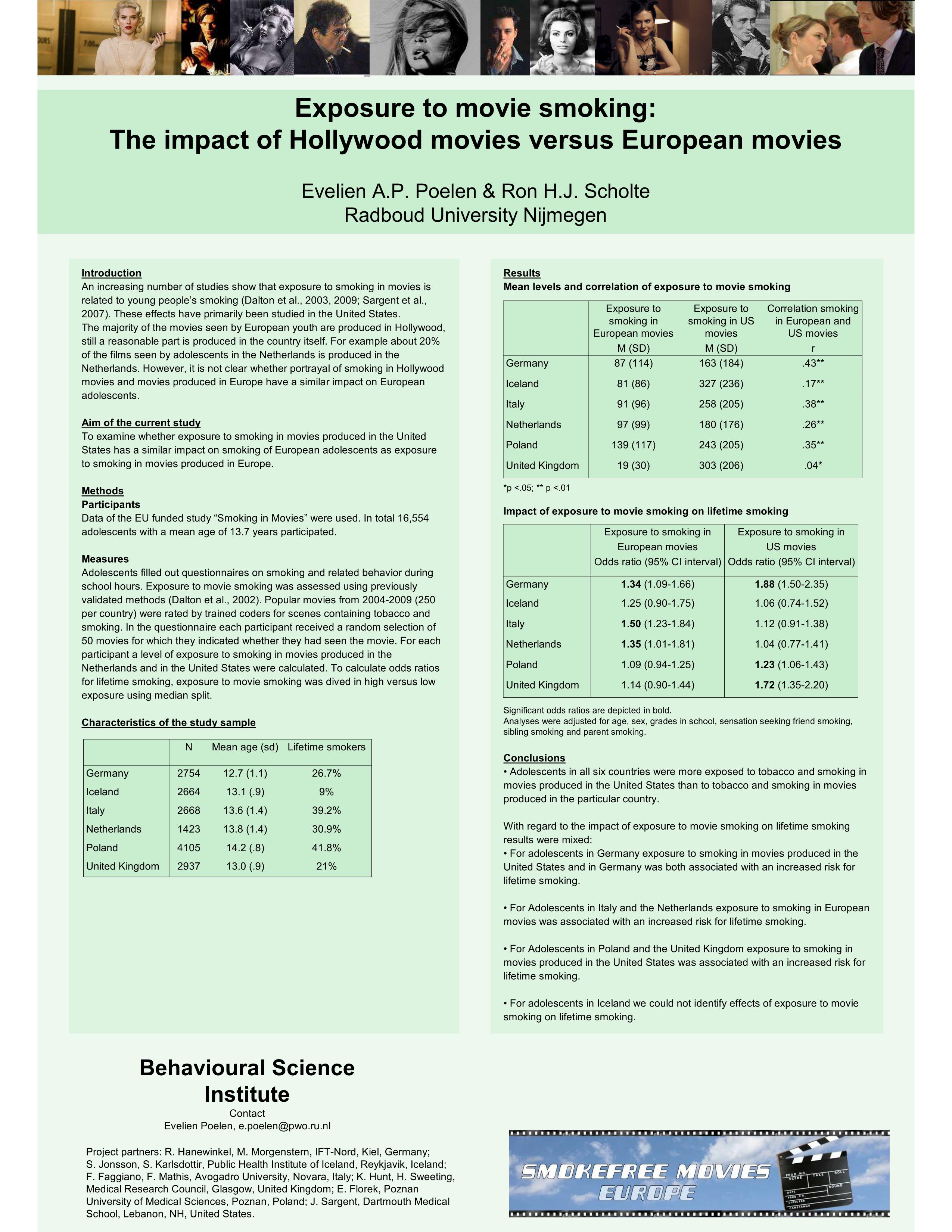
The present project “Smoking in movies: Impact on European youth and policy
options” tries to approach the issue of smoking in movies from an European
perspective. It contains three main project parts:
1.The assessment of smoking in movies released in European countries
2.The study of the impact of exposure to smoking in movies on European
adolescents
3.The formulation of European policy options
European Commission provides € 5.2 million to help lower income countries in tobacco control
UCLA study claims tobacco firms aware of dangers of cigarette smoke, but hid evidence
The research, which covered 25 years, traced the deaths of 120 to 138 people for every 1,000 regular smokers to the radioactivity. The finding belies common belief that only the chemicals in the cigarette cause lung cancer.
A study by UCLA researchers released on Wednesday claims that tobacco companies had known for decades that cigarette smoke was bad for the health, but continues to hide that information from the public.
The claim is based on a UCLA analysis of previously unexamined industry documents. Although the industry initiated investigations into the possible effects of polonium-210 or the radioactive particles from cigarette smoke back into the 1960s, there was no single document that showed the results of the probe which found that sufficient levels of polonium-210 can cause cancer.
The research, which covered 25 years, traced the deaths of 120 to 138 people for every 1,000 regular smokers to the radioactivity. The finding belies common belief that only the chemicals in the cigarette cause lung cancer, said Hrayr Karageuzian, lead author of the study.
Karageuzian said that the tobacco firms rejected methods that would help remove polonium-210 from tobacco because of fears that smokers may lost the instant nicotine rush that causes their addiction to the vice.
David Sutton, spokesman of Philip Morris USA, said the firm does not add polonium-210 to its products but insisted it is a naturally occurring element in the air that had been widely tackled by the public health community for years.
Greg Connolly, director of Harvard University’s Center for Global Tobacco Control, agreed that polonium-210 has long been identified. He said the research shows there is a need for the U.S. Food and Drug Administration to further regulate the tobacco industry.
The study, published in the Nicotine & Tobacco Research journal, pushed the FDA to make removal of the radioactive particles from tobacco product its top priority. The call is timely since the FDA started this week to mandate tobacco firms to disclose detailed information about new products and changes to existing ones.
The disclosure is part of the 2009 law that granted the FDA regulatory power over tobacco products. The FDA issued on Wednesday the draft guidance that stipulates every change made by tobacco firms must be disclosed which would be an opportunity for the regulator to stop the companies from making their products even more harmful, addictive or appealing to smokers.
The FDA would require results of research about the health risks of the products, information about components, ingredients, addictives and properties of the products and full description of manufacturing and processing methods. New or changed products, before they could be put out in the market, must be substantially equivalent to the tobacco companies’ existing products on or before Feb. 15, 2007.