Clear The Air News Tobacco Blog Rotating Header Image

June, 2011:

Japan Tobacco Urges Serbia to Align Excise Taxes With EU – Bloomberg

Tobacco company promotes health measure – excise tax increases

http://www.bloomberg.com/news/2011-06-17/japan-tobacco-urges-serbia-to-align-excise-taxes-with-eu-1-.html

Japan Tobacco Urges Serbia to Align Excise Taxes With EU

By Gordana Filipovic – Jun 17, 2011 10:45 PM GMT+0800 .

.Serbia and other nations in the Western Balkans should increase excise duties on cigarettes and other tobacco goods to bring them closer to European Union levels, said Cristian Cring, Adriatic representative for Japan Tobacco Inc. (2914)

Excise duties in Serbia now are 28 euros ($39 dollar) per 1,000 cigarettes, compared with EU taxes of 90 euros.

“That is the target which will be imposed for the countries of the region. That is a huge difference, even if Serbia becomes an EU member in 2020,” Cring said today at a conference in Becici, Montenegro. “We are not here to ask for an increase in taxes, but for an increase in predictable and stable way.”

The duty of 114 euros in Italy compares with 22.3 euros per 1,000 cigarettes in Albania, Cring said, adding that differences between EU and the Western Balkans meant that “a pack of Winston costs 1.25 euros in Serbia and 5.25 euros in Italy.”

An excise duty calendar would determine the pace of an increase in excise duties over a three- to five-year period, while securing stable budget revenue and a predictable business environment for the tobacco industry.

Excise duties on tobacco in Serbia generated 9.1 percent of its budget in 2010, 5.3 percent of the Romanian budget and 6.3 percent of the Bulgarian budget, Cring said.

Japan Tobacco, the world’s third-largest publicly traded cigarette maker, is the manufacturer of brands such as Camel and Winston.

To contact the reporter on this story: Gordana Filipovic in Belgrade atgfilipovic@bloomberg.net

Tobacco tax passes after bumpy ride

http://www.chinadaily.com.cn/hkedition/2011-06/16/content_12707812.htm

The government on Wednesday saw its controversial bill to raise the tobacco duty by 41.5 percent (or HK$0.50 a cigarette) pass through third reading in the Legislative Council after heated debate.

Thirty-three voted for, 8 against the bill, with 12 abstentions.

The major supporting votes came from the Democratic Party and the Civic Party.

Pro-establishment parties – Democratic Alliance for the Betterment and Progress of Hong Kong (DAB) and Hong Kong Federation of Trade Unions – abstained from voting.

This increase came after a massive 50 percent rise in tobacco duty in 2009.

The tobacco duty took effect by virtue of a public revenue protection order on Feb 23, the same day when the tax increase was announced.

Had the tax increase been vetoed, the government would have had to refund to cigarette importers and distributors.

Defending the government’s case, Secretary for Food and Health York Chow said the purpose of the tobacco duty increase was to protect public health.

Apart from tax the increase, Chow said the government will increase tobacco control, enhance rehabilitation services and public education to encourage people, especially young people, to smoke less or quit smoking.

The government will subsidize agencies to run for rehabilitation services, while the Hospital Authority will also provide drugs for rehabilitation for free, he said.

Despite the current tax increase, tax only constitutes 70 percent of the cigarette price, which is still a distance from 75 percent advised by the World Health Organization, he said.

Quoting government statistics, he said the number of young smokers decreased by 10 percent after the 2009 tax increase, while the demand for rehabilitation services was also on the rise.

Chow rejected the suggestion that tobacco duty increase would prompt smokers to buy illicit cigarettes, saying the government is determined to crack down on illicit cigarettes.

As to the proposal for a phased tax increase, he argued that a higher increase is a bigger incentive than a phased increase for smokers to smoke less or quit smoking.

DAB lawmaker Wong Ting-kwong, a smoker for over 40 years, said the tax increase will place a heavy financial burden on the poor smokers.

He also worried the tax increase may affect the livelihoods of over 30,000 newsstand operators.

Albert Chan from the People’s Power said elderly, low-income smokers will have financial difficulty buying cigarettes after the tax increase, slamming the government for neglecting the needs of the underprivileged.

But health services constituency lawmaker Joseph Lee Kok-long said the tax increase will help people to quit smoking.

China Daily

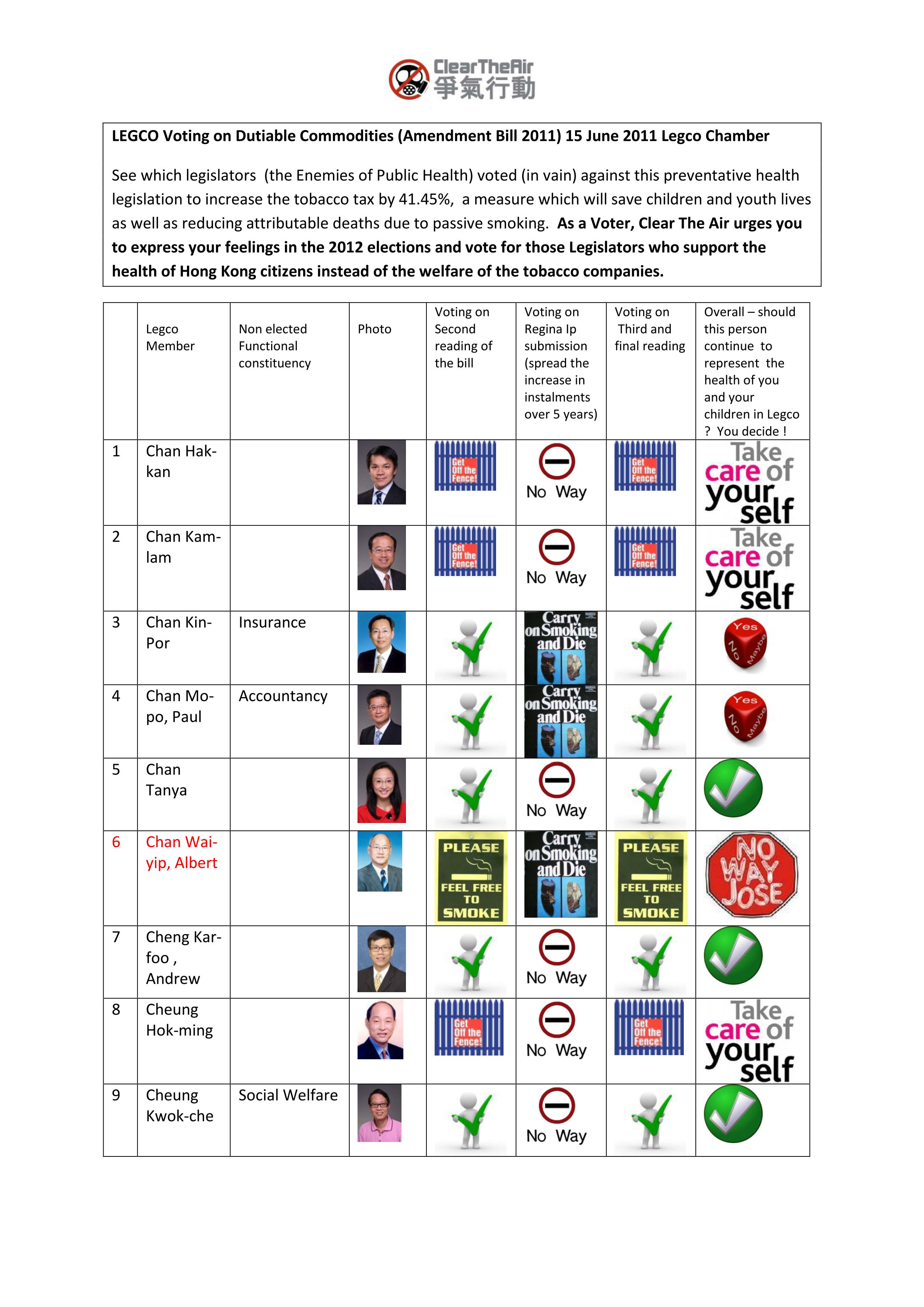
LEGCO Voting on Dutiable Commodities (Amendment Bill 2011) 15 June 2011 Legco Chamber

See who opposed the preventative health measure tobacco tax increase legislation

Download PDF : Legco15June2011Taxcfm

Tobacco industry targets our children

CLEAR THE AIR SUPPORTS THE AUSTRALIAN GOVERNMENT’S INCENTIVE AS THE FIRST COUNTRY WORLDWIDE TO MANDATE GENERIC TOBACCO PACKAGING
(‘THE SILENT SALESMAN’ WILL SOON BECOME THE ’DRAB UNAPPEALING TURNOFF’)
To: Letters to the Editor, The Australian letters@theaustralian.com.au
Subject: Response to Imperial Tobacco “Nanny State” ads
Date: 16/6/11
Tobacco industry targets our children
“Nanny State”? Give us a break, tobacco industry.
You know children are your main target for “recruitment” (= addiction).
You know 140,000 Australian schoolchildren smoke at least weekly, thousands taking it up each year – and that typically they start just before turning 16.
You know the “new smokers” referred to as marketing targets in thousands of your industry’s own documents are essentially a euphemism for children. After all, when you kill over half your long-term customers, you have to find new ones.
You know the independent research evidence points strongly to plain packaging making your deadly product less appealing to teenagers – taking some of the glam out of it, drawing their attention more towards to those uncool health warnings.
You know all this. But you go on associating your product with pop music, sport and fashion – just the things you know will appeal to teens.
And you try to bully and deceive our governments out of adopting any health policy – tax rises, display bans, plain packs – that might reduce “new smoker” uptake.
Tobacco industry, we sincerely hope your expensive campaigns are a waste of your money. It will mean you have a bit less to spend on targeting our children.
Stafford Sanders
Protecting Children from Tobacco coalition (42 organisations)
June 16, 2011
tel.(02) 9334-1823; m. 0412-070-194
153 Dowling Street, Woolloomooloo 2011
email staffords@ashaust.org.au
Protecting Children from Tobacco coalition, 42 NGOs at www.ashaust.org.au/lv4/ProtectChildrenEndorsements.htm
Action on Smoking and Health Australia
Alcohol and other Drugs Council of Australia
Association for the Wellbeing of Children in Healthcare
Association of Children’s Welfare Agencies Australian and New Zealand Head and Neck Cancer Society Australian and New Zealand Society of Respiratory Science Australian Childhood Foundation
Australian Council of Social Service
Australian Council of State School Organisations
Australian Council on Smoking and Health
Australian Education Union
Australian Foster Care Association
Australian General Practice Network
Australian Lions Drug Awareness Foundation
Australian Lung Foundation
Australian Medical Association (NSW)
Australian National Council on Drugs
Australian Parents’ Council
Australian Youth Affairs Coalition
Baptist Union of NSW
Cancer Council Australia
Catholic Health Australia
Centre for Excellence in Indigenous Tobacco Control
Children’s Cancer Institute Australia for Medical Research
Cystic Fibrosis Australia
Early Childhood Australia
Families Australia
Heart Foundation
Murdoch Children’s Research Institute
National Association for Prevention of Child Abuse and Neglect
National Asthma Council Australia
NSW Council of Churches
Public Affairs Commission of the Anglican Church of Australia
Public Health Association of Australia
Royal Australasian College of Physicians
Royal Australian College of General Practitioners
Rural Doctors Association of Australia
Save the Children Australia
SIDS and Kids
Smarter than Smoking
Telethon Institute for Child Health Research
Thoracic Society of Australia and New Zealand
http://www.nonannystate.com.au/

`Poor hit hardest’ as tobacco tax passed

Hong Kong Standard – 16 June 2011

Legislators yesterday endorsed a controversial government proposal to increase the tax on tobacco by 41.56 percent.

After a debate lasting seven hours, most pan- democrats sided with the government to pass the bill by 33 votes to eight with 12 abstentions.

The pro-government Democratic Alliance for the Betterment and Progress of Hong Kong decided to sit on the fence. There were 54 legislators in the chamber.

The vote means a packet of cigarettes will now cost HK$50, 70 percent of which is tax.

While the government insists the tax is a public health issue, the lawmakers who voted against it – including the three People Power and League of Social Democrats radicals – said it deprives the poor from enjoying the only luxury they can afford.

“It is discriminatory against the poor,” People Power lawmaker Albert Chan Wai-yip said.

His ally, Raymond Wong Yuk-man, agreed. “It’s a regressive tax and only increases the wealth gap. If you insist on harassing the poor people, why don’t you just shoot all the smokers?” Wong asked.

Tourism lawmaker Paul Tse Wai-chun said smoking is part of our freedom and the government should not intervene.

Industrial lawmaker Lam Tai-fai, who has a secondary school in his name, said he is against smoking but it was wrong to use taxation to control it.

“When you catch a student smoking, you should provide counseling, instead of giving a fine equivalent to three times the school fee.”

Vincent Fang Kang of the Liberal Party, which voted against it, said the move will only encourage smokers to buy illegal cigarettes.

DAB lawmaker Wong Ting-kwong, a smoker for 40 years, said the tax will jeopardize the livelihoods of newspaper vendors and the 30,000 people who rely on the business.

An amendment moved by Regina Ip Lau Suk-yee of the New People’s Party, and former secretary for security, to impose the tax gradually over five years, was vetoed.

Secretary for Food and Health York Chow Yat-ngok said the tobacco tax has already had a positive effect in discouraging smoking, with the number of young smokers down 10 percent since the last tobacco tax adjustment in 2009.

He said the government is using a multi- pronged, progressive approach to minimize the harmful effects of tobacco on young people.

Lawmakers approve tobacco tax increase

South China Morning Post – 16 June 2011

Controversial 41.5 per cent rise ratified in Legco after a seven-hour debate, with health minister suggesting the city could go entirely smoke-free eventually

In a vote hailed for helping Hong Kong shake the smoking habit, a divided Legislative Council has approved the controversial 41.5 per cent tobacco tax rise.

Thirty-three lawmakers voted for the tax increase, eight opposed it and 12 abstained. Those who voted in favour included members of the Democratic Party and Civic Party. Lawmakers from the Democratic Alliance for the Betterment and Progress of Hong Kong abstained. The Liberal Party voted no.

Secretary for Food and Health Dr York Chow Yat-ngok said it was a “big step for tobacco control”. “I don’t see why we can’t go entirely smoke-free eventually,” Chow said.

Legislators also passed a bill last night to increase the first-registration tax for private cars, with 25 lawmakers voting for it and 13 against.

Chow said a recent poll showed more than 60 per cent of Hongkongers supported the tobacco tax rise. But in a seven-hour debate before the vote, lawmakers were deeply divided on the issue.

Although he voted for the tax, medical sector lawmaker Dr Leung Ka-lau doubted whether increasing it would be useful, saying only a tiny fraction of tobacco taxes collected each year were spent on smoking cessation. “Hong Kong’s smoking rate is already very low,” he said. “I suspect that with such a low rate, taxation is no longer effective in making people quit.”

Neighbourhood Workers Service Centre lawmaker Leung Yiu-chung said education would be more effective than raising cigarette prices in encouraging smokers to give up, noting that elderly people often found it harder to quit.

Wong Ting-kwong, of the Democratic Alliance for the Betterment and Progress of Hong Kong, said raising the tax would lead to more cigarette smuggling and hurt newspaper vendors’ business.

But pan-democrat lawmaker Andrew Cheng Kar-foo said the higher tax was a good way to protect smokers’ health. “The government should set a goal for when Hong Kong will be entirely smoke-free,” Cheng said, adding he was confident it could be done in 10 to 20 years. He said he doubted whether it would send newspaper vendors out of business.

Democratic Party lawmaker Cheung Man-kwong said if elderly people found it harder to quit smoking, young people should all the more be prevented from starting.

The Civic Party’s Ronny Tong Ka-wah said young people were rarely determined enough to quit, and the only way to push them to stop was to make cigarettes more expensive.

New People’s Party lawmaker Regina Ip Lau Suk-yee proposed an amendment that was voted down – staggering the tax rise over five years in smaller increments. By 2015 the tax would form 75 per cent of the price of a pack of cigarettes under that plan.

The tobacco tax was raised 41.5 per cent in the budget in late February. Legco’s vote yesterday ratified that increase.

yukhang.ng@scmp.com

Activists show their support for the tobacco tax rise in a rally organised by the Council on Smoking and Health before lawmakers ratified the increase yesterday.

LEGCO endorses tobacco tax rise

15-06-2011 RTHK
Legislative councillors have endorsed a controversial government proposal to raise tobacco tax by 41.5 percent. The vote was thirty-three members in favour, with eight against and twelve abstaining.

Members earlier rejected an amendment proposed by the chairwoman of the New People’s Party, Regina Ip, seeking to introduce the rise in phases. Most pan-democrat legislators backed the increase in tobacco duty. The pro-business Liberal Party opposed it, while the DAB abstained in the vote.

http://rthk.hk/rthk/news/englishnews/news.htm?main&20110615&56&762755

Beware of tobacco in sheep’s clothing

http://helenair.com/lifestyles/health-med-fit/article_706064f4-970c-11e0-beaf-001cc4c002e0.html?print=1

Melanie Reynolds, Public Health | Posted: Wednesday, June 15, 2011 12:00 am

You’ve gotta give the tobacco industry credit: It’s innovative and persistent. Unfortunately, it’s devious, too.

With the success of public health efforts to discourage smoking, tobacco manufacturers — always eager to hook new customers — are developing smokeless and spitless products that can provide addicts with their nicotine fix even where smoking is banned.

The latest group of novel tobacco products isn’t yet readily available in Montana, but you may have seen them advertised in popular magazines. Disturbingly, they come in forms, flavors and packages that are hard to distinguish from candy or breath fresheners. Here are some of the products that may be coming soon to a convenience store near you:

Orbs: Small pellets that look a lot like breath mints. Made from finely milled tobacco, they dissolve in the mouth within a few minutes. They come in sweet “Mellow” and minty “Fresh.”

Sticks: Nicotine-laced tobacco sticks about the size of a toothpick. They dissolve in the mouth in about five to 20 minutes and deliver almost three times as much nicotine as a cigarette.

Strips: Look and feel like dissolvable breath strips but are made of tobacco.

Snus: A spitless modification of chew, snuff and other smokeless tobacco. Snus (pronounced “snoose”) comes in small teabag-like pouches to be placed between the lip and gum. The harsh flavor of tobacco is masked by flavors like “Frost,” “Mellow,” “Winterchill” and “Peppermint.”

Sound enticing, don’t they? The tobacco companies sure hope so.

What’s the harm?

While these products don’t produce the cancer-causing smoke that cigarettes do, that doesn’t mean they’re harmless. Many are so new that their full impacts on health have yet to be scientifically established.

Still, all of them contain nicotine, the highly addictive substance that makes cigarettes so hard to quit. By itself, nicotine can raise cholesterol rates, increase blood pressure, and accelerate or aggravate heart disease. It also can cause reproductive disorders.

Because the nicotine in these products is in a form more rapidly absorbed in the mouth, it may be even more toxic than the nicotine contained in cigarettes. A researcher with the Harvard School of Public Health has estimated that the nicotine in 10 to 17 orbs could kill an infant. Obviously, they create a serious threat of accidental poisoning among children.

“Nicotine is a highly addictive drug,” the Harvard official told The New York Times, “and to make it look like a piece of candy is recklessly playing with the health of children.”

Physicians with the Center for Tobacco Products at the U.S. Food and Drug Administration have also expressed concern that “the candy-like appearance, added flavors, and easily concealable size of many of these products may be particularly appealing to children and adolescents.”

Potential gateway drug

Perhaps the biggest threat from these novel tobacco products may prove to be their “gateway effect,” the craving they create for cigarettes.

The Campaign for Tobacco-Free Kids has warned that “smokeless tobacco use during youth can lead to a lifetime of addiction to smokeless tobacco or, frequently, to cigarettes, as the nicotine addiction created by smokeless use ultimately leads to habitual smoking.”

The group cited a 2010 study that found that adolescent boys who use smokeless tobacco products have a higher risk of becoming cigarette smokers within four years.

The Campaign also fears that the novel tobacco products will lead to increased tobacco use in current smokers, relapse in former smokers and initiation in those who never smoked, as well as “dual use” of both cigarettes and smokeless products.

The U.S. Surgeon General, too, has expressed concern about the new tobacco products.

“Products designed or marketed to be used in places where smoking is not allowed may defeat public health efforts to reduce smoking rates,” he said in a 2010 report. “The overall health of the public could be harmed if the introduction of novel tobacco products encourages tobacco use among people who would otherwise be unlikely to use a tobacco product or delays cessation among persons who would otherwise quit using tobacco altogether.”

A dangerous gamble

Because of their novel configuration, packaging and flavoring, Congress has asked the Food and Drug Administration to fast-track its research into these dissolvable products. Depending on the outcome of the review, the FDA could require the tobacco industry to change the products or pull them from the shelves.

Until we know more about their impacts on individual and public health, novel tobacco products seem like a dangerous gamble, especially among young people who are the most vulnerable to nicotine addiction.

We in public health recommend avoiding all tobacco products, and we support efforts to determine how these new products affect health and health behaviors.

If you already use tobacco products, the healthiest choice is to quit. Help is available from the toll-free Montana Tobacco Quit Line, 1-800-QUIT-NOW. To learn more about the services offered by the quit line, visit http://tobaccofree.mt.gov/quitlinefactsheet

.shtml.

More information about tobacco use prevention and cessation is also available on the health department website atwww.lewisandclarkhealth.org. Click on Community and Family Health in the left navigation menu.

Melanie Reynolds is the health officer at the Lewis and Clark City-County Health Department. The mission of the Health Department is to improve and protect the health of all Lewis and Clark County residents.

Big tobacco donations banned under bill

http://www.heraldsun.com.au/news/breaking-news/big-tobacco-donations-banned-under-bill/story-e6frf7jx-1226075859597

From: AAP June 15, 2011

AUSTRALIAN Greens Leader Bob Brown has introduced a bill to parliament calling for a ban on political donations from big tobacco companies.

Senator Brown said his draft laws would make it illegal for political parties or candidates to accept a gift from manufacturers or wholesalers of tobacco products.

It would also introduce new, related offences.

“There should be public funding of elections to eliminate corporate funding, with the exception of small donations by individuals,” he said today.

“Donations by tobacco companies are particularly insidious, peddling death.

“Public health is at risk if we continue to allow big tobacco to exert influence over our policy making.”

Debate on the Commonwealth Electoral Amendment (Tobacco Industry Donations) Bill 2011 was adjourned.

Dentists urge smokers to quit

http://rthk.hk/rthk/news/elocal/news.htm?elocal&20110615&56&762489

Dentists urge smokers to quit
15-06-2011
One day before legislative councillors vote on whether or not to increase tobacco tax by 41.5 percent, dentists have urged people to quit smoking. They say the habit is linked to cancerous ulcers in the mouth and can increase the severity of other gum diseases such as periodontitis – an inflammatory infection of the tissue and bone surrounding the tooth. Smoking also causes teeth to stain and bad breath.