Clear The Air News Tobacco Blog Rotating Header Image

June, 2011:

Banning “light” from cigarette packs falls short

http://www.reuters.com/article/2011/06/23/us-banning-falls-short-idUSTRE75M7UA20110623

NEW YORK (Reuters Health) – More and more countries are banning the words “light” and “mild” from cigarette packs, but a new study suggests that may not be enough to dispel smokers’ misbeliefs that the products are safer.

Researchers found that after the UK, Australia and Canada banned the terms as deceptive, there was a dip in the number of people who mistakenly believed that cigarettes marketed as “light” or “mild” carried fewer health risks.

However, the decline was temporary, the investigators report in the journal Addiction.

And in the UK, misperceptions were consistently higher versus the other two countries, as well as the U.S. — where, at the time of the study, no such ban was in place.

“The findings from this study confirm our earlier work showing that merely removing the terms ‘light’ and ‘mild’ from cigarette packs is insufficient to change people’s beliefs that those products are safer,” lead researcher Dr. Hua-Hie Yong said in an email.

To really clear up misperceptions, more steps are needed, according to Yong, of the Cancer Council Victoria in Melbourne, Australia.

“Light” cigarettes are designated as such because they deliver less nicotine and lower levels of toxic chemicals — or “tar” — when the smoke is measured by a machine.

In real life, though, studies show that smokers inhale comparable amounts of nicotine and chemicals regardless of the brand. And critics have long charged that tobacco products dubbed “light” or “mild” confuse people into thinking there are fewer health risks.

In response, the European Union and Brazil put bans on those terms in 2003, and other countries have since followed suit.

A U.S. law that bars the words “light,” “low tar” and “mild” from tobacco products went into effect almost exactly one year ago.

For the new study, Yong’s team looked at results from an international survey done annually between 2002 and 2009 in Australia, Canada, the UK and the U.S.

The surveys involved a total of 21,600 smokers who were asked the extent to which they agreed with statements like, “Light cigarettes are less harmful than regular cigarettes.”

Overall, the study found that shortly after “light” bans went into effect, misperceptions about the cigarettes generally dipped in Australia, Canada and the UK.

However, the false beliefs began to creep back in within a couple years.

In the UK, which banned the terms in 2003, misperceptions remained persistently higher than in other countries, including the U.S. On average, UK smokers had a higher level of agreement with statements extolling the advantages of light cigarettes over regulars.

It’s not clear why that is, according to Yong.

But one reason, the researchers speculate, could be a UK law of the same time period that forced tobacco makers to lower the tar “yield” in cigarettes. That, Yong said, might have drawn smokers’ attention to the tar issue, and reinforced the belief that lower tar means a safer cigarette.

After the U.S. ban went into effect last year, some health advocates, including the American Lung Association (ALA), applauded the move but said that deceptive packaging remains a problem.

Some manufacturers sell light and regular cigarettes in packages of different colors. And allowable terms like “smooth” and “silver,” critics say, may still mislead consumers.

The current findings underscore the fact that no single step is enough to combat years of misleading tobacco marketing, according to Erika Sward, director of national policy and advocacy at the ALA.

“This is one more piece of information that points to a need for a big-picture, comprehensive solution,” Sward said in an interview.

One change that could help, according to Sward, would be an end to the “color-coding” of cigarette packs that lets smokers know which ones are “light” or regular.

She said the ALA hopes that the Food and Drug Administration — only recently given the power to regulate tobacco products — will conduct research to see whether package coloring affects consumers’ choices.

Australia recently introduced legislation to become the first country in the world to require all tobacco products to be sold in “plain packaging.” The tobacco industry has come out against such a move, saying there’s no evidence it would make a dent in smoking rates.

Both Yong and Sward pointed to a need for ongoing public education.

Many smokers, Yong said, “continue to believe that some cigarettes are safer than others based on the fact that they taste ‘milder’ or it has a lower tar yield, and this false belief will keep them smoking instead of quitting.”

“There is no safe cigarette on the market,” Sward said. And if smokers want to do something for their health, she added, they can seek help in quitting — from their doctors, the ALA, or the government-sponsored quitline 1-800-QUIT-NOW.

SOURCE: bit.ly/jjb6J0 Addiction, online June 9, 2011
Chandy seeks countrywide ban on tobacco products

PTI | 08:06 PM,Jun 23,2011

Thiruvananthapuram, Jun 23 (PTI) Kerala Chief Minister Oommen Chandy today sought Prime Minister Manmohan Singh’s intervention in imposing a countrywide ban on tobacco products saying they posed a grim health threat to the people, especially the youth. In a letter to Singh, he said free availability of tobacco products in every nook and cranny of the country has become a serious threat to health of the people, especially youth and students. The viable option to fight the menace was to impose a total ban on them through legal means, he said. Such a step was essential to control incidence of cancer, heart ailments and other related health hazards, he said. Chandy recalled that the World Health Organisation had called for ban on advertisement on tobacco products.

http://ibnlive.in.com/generalnewsfeed/news/chandy-seeks-countrywide-ban-on-tobacco-products/735957.html

Shire bans smoking in outdoor dining areas

http://news.ninemsn.com.au/health/8264495/shire-bans-smoking-in-outdoor-dining-areas

23 June 2011

A local council in Victoria’s south-east has become the first in the state to put a blanket ban on smoking in outdoor dining areas.

Baw Baw Shire councillors voted in favour of the ban on Wednesday, and it also stretches to playgrounds, sporting fields and some pedestrian areas.

Quit director Fiona Sharkie says the ban reflects shifting community values on smoking.

“Cancer Council Victoria research shows over three-quarters (77 per cent) of Victorians believe smoking shouldn’t be allowed in outdoor areas where children are present while seven out of 10 Victorians believe smoking shouldn’t be allowed in outdoor restaurant dining areas,” Ms Sharkie said.

“The majority of Victorians want smoke-free outdoor areas so it’s only natural they should become more commonplace.”

Heart Foundation Victoria chief executive Kathy Bell believes the ban has the potential to lower smoking take-up rates among children raised in the shire.

“Smoke-free environments de-normalise smoking so children are less likely to see smoking, less likely to start smoking and therefore less likely to suffer from the negative effects of tobacco use.”

Smoking is already banned in playgrounds and beaches of some local government areas in Victoria

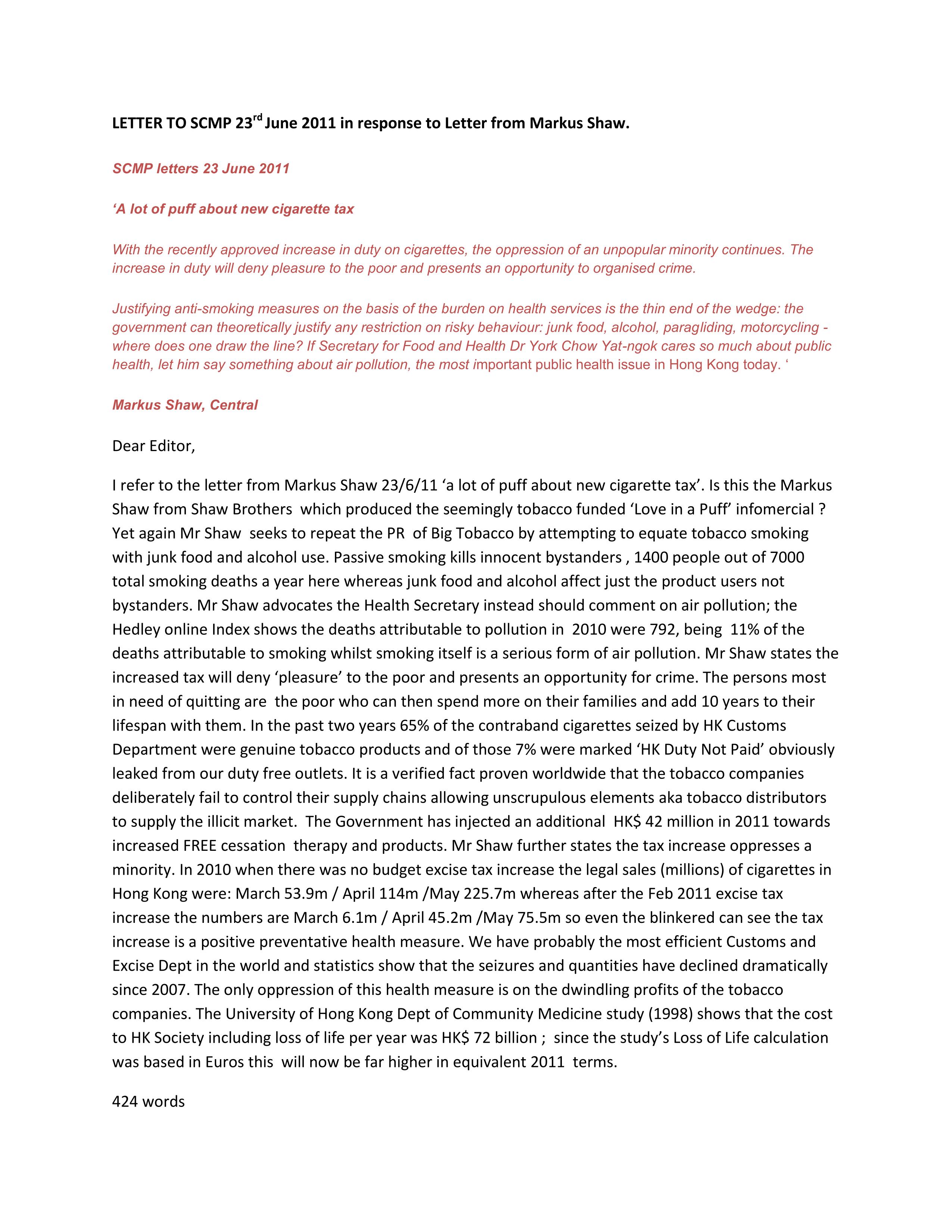
LETTER TO SCMP 23rd June 2011 in response to Letter from Markus Shaw

Time to ban smoking in cars

22ND JUNE 2011

British Lung Foundation chief executive Dame Helena Shovelton argues that it is time to ban smoking in cars.

http://www.hc2d.co.uk/content.php?contentId=18889

Every year more than 300,000 children in the UK present passive smoking-related illnesses to their family doctor.

This is a preventable statistic and a preventable cost to the NHS, with £10 million worth of primary care visits and asthma treatments, and £12 million in hospital admission costs, caused directly by passive smoking.

In the confines of a car, children are exposed to concentrations of passive smoke, equivalent, according to Aberdeen University research, of levels in a smoke-filled pub.

Smoking indoors in public places is banned so why should children suffer because smoking is not banned in cars?

British Lung Foundation research found 51% of 8-15-year-olds surveyed had been exposed to cigarette smoke in cars but were too scared or embarrassed to ask the adult smoker to stop. Some 86% of children want smoking made illegal in cars.

Steps have been taken elsewhere, notably in Canada, where a national media programme was supported by legislation in some states. Areas where legislation on smoking in cars when children are present was implemented saw a dramatic drop in exposure to smoke compared with states that just focussed on education and awareness campaigns.

In America, concern over the dangers to children of smoking in cars has been raised in California, Arkansas and Louisiana.

In Wales, similar concerns have been raised, while the Health Department of Jersey is already considering passing the ban and Stockton North MP Alex Cunningham has raised the issue in the UK Parliament.

It is now time for Westminster to take the lead in enacting legislative change in this vital aspect of child health.

MP’s links to tobacco industry is of concern

http://www.harboroughmail.co.uk/community/letters-emails/mp_s_links_to_tobac
co_industry_is_of_concern_1_2819721

YESTERDAY (June 22), The Telegraph exposed five Tory MPs, two of them very
senior MPs and one of those our very own MP, Edward Garnier (current
Solicitor General) of accepting hospitality in excess of £1,000 from Japan
Tobacco International (JTI). It turns out that this was for morning coffee
and lunch for Garnier and his wife at this year’s Chelsea Flower Show and
totalled £1,132.80. JTI owns Benson & Hedges and Silk Cut cigarettes.

Last year, Garnier backed a legal challenge to the ban on the display of
tobacco by shopkeepers. It now emerges that JTI, the company from which
Garnier has accepted substantial hospitality, is currently pursuing an
application for judicial review of the ban on the display of tobacco by
shopkeepers.

This isn’t the first time Garnier has accepted hospitality from the tobacco
industry – there is a trend. In 2003 he received a day’s shooting in
Bedfordshire as a guest of the Tobacco Manufacturers’ Association. 2001 and
2002 were particularly rich years in terms of link-ups between Garnier and
the tobacco industry – in 2002, he and his wife were guests of Imperial
Tobacco at the Men’s Finals at Wimbledon and later that year, he accepted a
day’s shooting in Bedfordshire as the guest of the Tobacco Manufacturers’
Association. In 2001, Garnier and his wife enjoyed a day’s shooting and
overnight accommodation, near Kelso, as the guest of the Tobacco
Manufacturers’ Association. Later that year, he accepted another day’s
shooting in Bedfordshire as the guest of the Tobacco Manufacturers’
Association. In 1999, Garnier undertook a day’s shooting at Luton Hoo as a
guest of the Tobacco Manufacturers’ Association.

In the World Health Organisation Framework Convention on Tobacco Control, a
UN ratified treaty to which the UK is signed up, there is agreement to
“prohibit, or ….restrict, tobacco sponsorship of international events,
activities and/or participants…”. It states that it is “Seriously concerned
about the impact of all forms of advertising, promotion and sponsorship
aimed at encouraging the use of tobacco products”. “Tobacco sponsorship”
covers “any event, activity or individual with the aim, effect or likely
effect of promoting a tobacco product or tobacco use either directly or
indirectly”, whilst “tobacco advertising and promotion” applies to “any form
of commercial communication, recommendation or action with the aim, effect
or likely effect of promoting a tobacco product or tobacco use either
directly or indirectly”.

Both seemingly apply to Garnier’s links with the tobacco industry.

It is an obligation of this international treaty that “in setting and
implementing their public health policies with respect to tobacco control,
Parties shall act to protect these policies from commercial and other vested
interests of the tobacco industry in accordance with national law.”

Given the seniority of Garnier and his links therefore with other
governmental policy makers, one has to wonder of the probability of transfer
of interests.

The treaty recommends a complete ban on tobacco industry advertising,
promotion and sponsorship and calls for a minimum requirement of disclosure
of such (as Garnier has had to do).

We consider it an indictment of the British government that in the face of
overwhelming evidence of the deadly effects of tobacco, it does not apply a
total ban on such. Furthermore, we question the moral values of those who
fraternise with, and accept hospitality from an industry whose products so
blatantly kill its users.

When used as intended, it has been scientifically established that tobacco
kills up to one in two of its users and kills more people every year than
alcohol, Aids, car accidents, illegal drugs, murders and suicides combined.

That our MP and the Solicitor General is so strongly tied to the tobacco
industry, is an issue of grave concern to us, his constituents.

To further explore the links between our politicians and the tobacco
industry, please visit: http://www.ash.org.uk/

Sandie Harwood and Oasim Chowdary

Philip Morris Asia Limited (Hong Kong) v. The Commonwealth of Australia

http://www.pcacases.com/web/view/5
http://www.pca-cpa.org/showpage3619.html?pag_id=1494

Case description
This arbitration is conducted under the UNCITRAL Arbitration Rules of 2010 pursuant to the Agreement between the Government of Hong Kong and the Government of Australia for the Promotion and Protection of Investments.

Name(s) of claimant(s) Philip Morris Asia Limited (Hong Kong) ( Private entity )
Name(s) of respondent(s) The Commonwealth of Australia ( State )

Case number 2012-12

Administering institution Permanent Court of Arbitration (PCA)

Case status Pending

Type of case Investment arbitration

Subject matter or economic sector Manufacturing

Rules used in arbitral proceedings UNCITRAL Arbitration Rules 2010

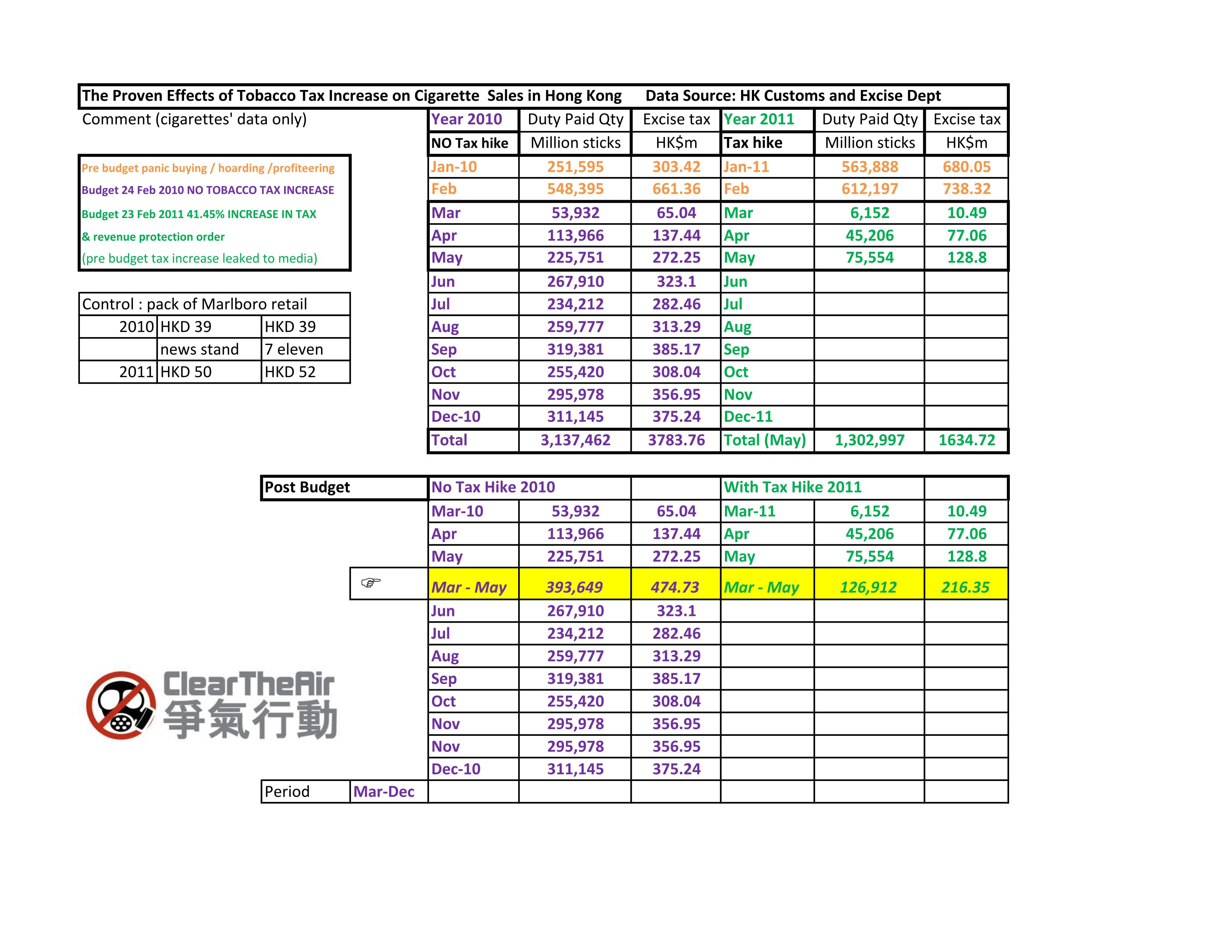
Hong Kong Tobacco tax by year

FDA reveals bigger, graphic warning labels for cigarette packages

http://edition.cnn.com/2011/HEALTH/06/21/cigarette.labels/

Under the World Health Organization's global treaty on tobacco, 35% of a cigarette pack must have warnings and pictures.

Under the World Health Organization’s global treaty on tobacco, 35% of a cigarette pack must have warnings and pictures.

STORY HIGHLIGHTS

  • ·        Labels include warnings such as “Cigarettes are addictive” and “Cigarettes cause cancer”
  • ·        The new graphic labels must cover half of the area on cigarette packages
  • ·        Old warning labels have been easy to ignore, an American Cancer Society official says
  • ·        Tobacco company R.J. Reynolds says new requirements violate the First and Fifth Amendments

Washington (CNN) — Nine new graphic cigarette warning labels were unveiled Tuesday by the Food and Drug Administration, part of the agency’s sweeping new powers to regulate tobacco and tobacco products.

Cigarette packages will now carry one vivid color image and one of these warnings about the consequences of smoking: “Cigarettes are addictive”; “Tobacco smoke can harm your children”; “Cigarettes cause fatal lung disease”; “Cigarettes cause cancer”; “Cigarettes cause strokes and heart disease”; “Smoking during pregnancy can harm your baby”; “Smoking can kill you”; “Tobacco smoke causes fatal lung disease in nonsmokers”; and “Quitting smoking now greatly reduces serious risks to your health.”

The warnings will cover the upper portion of the pack both front and back. Fifty percent of the package must be covered. The warnings must also cover at least 20% of a cigarette ad.

Small ads less than 12 inches don’t have to cover as much, but must still have a warning. Each warning will also have a phone number — 1-800-QUIT-NOW — that smokers can call to get help if they want to quit.

See all the new labels

“President Obama is committed to protecting our nation’s children and the American people from the dangers of tobacco use. These labels are frank, honest and powerful depictions of the health risks of smoking and they will help,” Health and Human Services Secretary Kathleen Sebelius said in an FDA statement. “These labels will encourage smokers to quit and prevent children from smoking. President Obama wants to make tobacco-related death and disease part of the nation’s past, and not our future.”

The new packaging and ads must be in place by September 2012.

The move is a result of the Family Smoking Prevention and Tobacco Control Act (FSPTCA), which mandates cigarette packs and advertisements have larger and “more visible graphic health warnings” as part of an effort to educate the public about the health risks associated with smoking.

“The Tobacco Control Act requires FDA to provide current and potential smokers with clear and truthful information about the risks of smoking — these warnings do that,” Commissioner of Food and Drugs Margaret A. Hamburg said in the FDA statement.

Thomas Glynn, director of cancer science and trends for the the American Cancer Society, said the old labels have been virtually invisible because they’re small and have been around for so long. He said people have become immune and don’t really “see” them anymore, but the new labels will be hard to ignore and will help focus attention on the problem.

“It’s the first change we’ve had in 25 years. This is going to be a very important element in the tobacco control tool box, but it’s not a panacea,” Glynn said. “For smokers, it’s a new and very visible reminder that smoking can harm them, harm people around them, including children. For nonsmokers, it’s a reminder that smokers need their help and concern as far as quitting. The labels are not just for smokers, the labels are for anyone interested in public health.”

Glynn says about 20% of the population still smokes, a number that has been pretty steady over the past five years. He hopes the new labels will jump start a downward trend and re-ignite discussions about tobacco use.

http://edition.cnn.com/video/bestoftv/2011/06/21/exp.am.cohen.tobacco.warnings.cnn.640x360.jpg

According to the Centers for Disease Control and Prevention, about 443,000 people in the U.S. die from smoking or exposure to secondhand smoke annually and more than 8 million are living with a disease that’s directly tied to smoking. The CDC says smoking is responsible for 90% of all lung cancer deaths in men and 80% in women. It estimates smoking causes 90% of all chronic obstructive lung disease deaths such as bronchitis and emphysema.

But both R.J. Reynolds and Philip Morris, the two largest tobacco companies in the U.S., responded in January to the required warnings in letters to the FDA.

R.J. Reynolds, maker of some the country’s best-selling brands like Camel, Kool, Winston and Salem, said the new requirements violate the First and Fifth Amendments. The company said, in part, “The anti-smoking message is not intended to provide information that smokers and potential smokers can consider rationally in weighing the risks and perceived benefits from smoking. Rather, it plainly conveys — through graphic images and designs intended to elicit loathing, disgust, and repulsion — the Government’s viewpoint that the risks associated with smoking cigarettes outweigh the pleasure that smokers derive from them and, therefore, that no one should use these lawful products.”

R.J. Reynolds said “by confiscating” the top 50% of the package and 20% of the ads, the government is not warning consumers about smoking risks — it is telling consumers, “Don’t buy or use this product.” The company is asking the FDA to withdraw the new rule, which it says is flawed, and issue a new one.

Philip Morris, the country’s largest tobacco company, supported the FSPTCA. But in its letter, the company also raised questions about the constitutionality of the labels.

“Any government requirement that compels a private entity to carry a message not of its own choosing raises constitutional concerns … To the extent that FDA were to select warnings based on their ability to evoke negative or cognitive reactions –not their ability to objectively inform consumers about the health risks of smoking — such warnings would not pass constitutional muster,” the company wrote.

It said the sheer size of the warnings violates the First Amendment.

The tobacco companies are footing the bill for the new labels. But Glynn said with $95 billion a year being spent on tobacco-related disease and health problems, it’s money well spent.

“It’s not an expensive intervention,” Glynn said. “The cost of putting the pictures on is at the expense of the tobacco industry; there is no cost to the government. So this is not the government spending money, and yet what we are going to gain from it is less death and less disease — and that’s going to save the government money.”

With this new move, the United States will be the 40th country to have picture warnings on our cigarette packs, making the country compliant with the World Health Organization’s global treaty on tobacco. Under the treaty, 35% of a cigarette pack must have warnings and pictures.

The treaty has already been ratified by 173 of 192 member nations of the United Nations. The United States is one of 19 countries that has not ratified the treaty, but with the new labels, will be compliant.

Countries such as Canada, Brazil and Australia have long been leaders in tobacco control and have had very graphic art on their packaging for years.

The effect of the Tobacco Taxation increase in Hong Kong