Clear The Air News Tobacco Blog Rotating Header Image

June, 2011:

Time to Quit Big Tobacco Dividends

http://www.fool.com/investing/dividends-income/2011/06/27/time-to-quit-big-tobacco-dividends.aspx

Riding the U.S. tobacco gravy train has been one of the most reliable ways for an investor to get rich over the past century. Wharton’s Jeremy Siegel reports that Altria (NYSE: MO ) , formerly Philip Morris, was the best performing stock in the S&P 500 from 1957 to 2003. I believe him: They’ve been some of my best buys on CAPS.

But all good things — or bad depending on your perspective — must eventually draw to a close. Such is the case with U.S. tobacco stocks today. I think we are at a crossroads and it’s finally time to call ’em quits.

Quit your tobacco dividend addiction
U.S. tobacco stocks have historically appealed to investors because of their dividend yields of 5% or more coupled with reliable dividend increases. But now there is reason to think those dividends are — or soon will be — under pressure, and simply aren’t worth the risk anymore.

For the first time in the last decade, Altria’s free cash flow could not cover its dividend payments last year. America’s largest domestic tobacco company paid out $2.96 billion in dividends while only generating $2.6 billion in free cash flow. The gap was made up by the issuance of equity and debt.

Now, I’m sure an observant reader will point out that 2010’s result was an aberration due to a one-time $945 million Internal Revenue Service payment and that Altria’s continuing profitability cannot be judged by it.

I totally get that (and good for you for knowing that), but even if we add back the IRS payment, the free cash flow yield is a paltry 6.3%. That provides a dangerously thin margin to be supporting a 5.7% dividend yieldReynolds American (NYSE:RAI ) is in a similar pickle, supporting its own dividend yield of 5.7% with a free cash flow yield of 3.6%. Lorillard(NYSE: LO ) has more headroom.

There are better alternatives
Besides, a 5.7% yield (what Altria and Reynolds both offer, and Lorillard 4.7%) simply doesn’t cut it anymore. I can get that from safer telcos like Verizon Communications (NYSE: VZ ) or AT&T (NYSE: T ) , which sell their own form of addictive product. And unlike big tobacco, those two companies have ample free cash flow yields (a whopping 16.6% for Verizon and 8.1% for AT&T) to cover their dividend yields of 5.4% and 5.7%, respectively, while funding future growth.

Another alternative is junk bonds. Don’t laugh. Altria, Reynolds, and Lorillard are practically junk bonds themselves, since they have a risky future, pay out most of their expected return, and have, dare I say, a finite lifetime. Junk bond ETFs like the SDPR Barclays Capital High Yield (NYSE: JNK ) offer yields of around 8%. And they’re more diversified to boot.

Last but not least, what about Coca-Cola (NYSE: KO ) or PepsiCo (NYSE: PEP ) ? They’re trading at nearly identical free cash flow ratios as the tobacco companies (4.9% and 4.8%, respectively), which I’ve argued matters more than dividend yields. Why would I buy a moribund Altria or Reynolds when I can buy a Coke or Pepsi at a similar valuation? Plus you still get a roughly equal payout when you factor in share buybacks.

A picture is worth a thousand words
But there is another reason to stay away from U.S. tobacco dividends. Starting in fall 2012, tobacco companies will have to start putting horrific pictures on every cigarette carton. While I personally doubt this will have an effect on pre-existing smokers, I do think this will discourage a great many kids from taking it up. And without new customers, big tobacco and their big dividends eventually bite the dust.

The Campaign for Tobacco-Free Kids — an interest group that lobbies against tobacco companies — has put together an informative factsheet detailing the effectiveness of pictorial labeling requirements in the 35 countries that already have them.

More than 90% of Canadian youths report that pictorial labels make smoking seem less attractive. When a second set of pictorial labels was introduced in Thailand in 2006, 53% of smokers said it made them think “a lot” about the health risks, and 44% of smokers said they were “a lot” more likely to quit over the next month. When Brazil introduced new picture warnings, 67% of smokers said it made them want to quit. When pictorial labels were introduced in Australia, the number of smokers who called the quit line doubled.

Just Say NO
Like their products, big tobacco’s stocks are just too expensive and just too dangerous. These companies pay out most everything in a dividend, retaining almost nothing for growth, and 4.7% to 5.7% just isn’t a high enough return given the risk. There are better alternatives for your money

Factoids and legal bollocks in war against plain packaging

by Simon Chapman

With the passage of the government’s bill on plain packaging now assured by the support of the opposition, the Greens and all but one of the independents, an ever-desperate tobacco industry is now  concentrating on the legal apocalypse that they say will descend on Australia through the courts.

These arguments are all a paper-thin house of cards, starting with the central problem that plain packaging will not extinguish brand identities. All brands will still carry brand names allowing smokers to clearly exercise their freedom of choice to select between the much-vaunted but mostly non-existent differences in brands. This is critical, because in the highly unlikely event of a ruling by the High Court in favour of the industry, all calculations of compensation will need to take account that branding differences have only been diminished, not extinguished.

Given that some 30-40 nations now have appropriated massive sections of packs with graphic warnings and that not a cent has been claimed or awarded in brand damage  anywhere in the world for this egregious assault on brand identity, the prospects of any claim for huge compensation even in the unlikely event of a favourable ruling are vanishingly small. The companies would need to demonstrate with precision that sales losses arose from losing colours, logos and different pack shapes, not brand names.

Given that consumption is falling every year, this task would be like unraveling gossamer while wearing boxing gloves.

Few of those megaphoning this legal Armageddon appear to have even read the draft Bill itself. Section 11  makes it clear that plain packaging won’t apply if it were to be determined (by a court) that its operation would result in an acquisition of property otherwise than on just terms. So in the unlikely event that the High Court says there is an acquisition of property (more on this below), the legislation would revert to a fallback position in the regulations under which “the trade mark may be used on the packaging of tobacco products, or on a tobacco product, in accordance with any requirements prescribed in the regulations”.

In other words, the bill has been drafted with a get-out-of-jail-free card under which plain packaging will not proceed if the court said it was an unjust acquisition. So massive damages or compensation will simply not arise.

Moreover, Monash University’s Prof Mark Davison has explained “As for the Constitutional argument that the legislation acquires property on other than just terms, Professor Craven, a noted Constitutional expert, has since observed on Radio National’s Background Briefing that the tobacco industry’s prospects of success are about the same as a three-legged horse has of winning the Melbourne Cup. The reason for his view is simply explained. The extinction of rights or the reduction of rights is not relevant. The government or a third party must acquire property as a consequence of the legislation.

“The government does not wish to use the tobacco trade marks. Nor does it want third parties to do so. It does not desire to or intend to acquire any property. The proposition that prohibitions on the use of property do not constitute an acquisition of property was confirmed by the High Court as recently as 2009. In that case, the High Court held that the government was entitled to extinguish property rights in licences of farmers to take bore water.”

But the industry and its errand boys, such as those at the Institute of Public Affairs, nonetheless know that the threat of a massive legal penalty will get them headlines. A big number is required and the number that has been selected is $3 billion … per year. So where did this satisfyingly large number come from? It started circulating in May 2010 and has been repeated countless times since by frothing shock-jocks and some who should have known better.

Step forward Tim Wilson, the director of intellectual property and the Free Trade Unit and the IPA. Wilson sent asubmission to Senator Steve Fielding’s inquiry into plain packaging where we can examine his prowess with the numbers.

At page four in his executive summary he says plain packs would lead to a court order to award the tobacco industry  between $378 million and $3027 million per year. Table 2 (page 13) in his submission shows two lines of numbers for the total value of tobacco sales in Australia in 2006: one for the value including excise tax (which goes to the government) and one for the sales value ex-tax (in other words the returns to manufacturers and retailers combined). By taking the trouble to differentiate the two, Wilson must know that no court would order the return of the tobacco tax component to the companies: it’s the ex-tax value that fuels such a pipe-dream.

Wilson then calculates the ex-tax value on two assumptions: a 10% and a 30% fall in sales  each year that might follow the introduction of plain packs. He calculates these two figures at $378 million and $1.135 billion. So where does the $3 billion factoid come from? Are you ready for this? The tax-included sales value of a 30% fall is $3.027 billion.

So how reasonable are Wilson’s assumptions that plain packs will cause a fall of a minimum 10% through to 30% a year? Between 1999 and 2003 the average annual fall in total dutied cigarettes was just 2.6%. The most sales haveever fallen in one year was just shy of 10% in 1999 after the combined impact of a change in the way  cigarettes were taxed (from weight to per stick) and a big boost to the national quit campaign by health minister Michael Wooldridge.

Most analysts of the likely impact of plain packaging believe that its main impact will be on children over the next generations. Just as no Australian aged under 19 today has ever seen a local tobacco ad or tobacco sponsored sporting event, no child growing up after 2010 will ever see carcinogenic  tobacco products packaged in carefully market researched attractive boxes. Smoking rates by kids today are the lowest ever recorded. Plain packs are expected to continue that downward momentum, starving the industry of new generations of new smokers as older smokers quit and die early. Plain packs will probably not influence long-term, older smokers much.

Wilson’s $3 billion number is thus based on a projected decline, which is so far off the planet of declines ever recorded, that it is dreamland stuff. Worse, it appears to be a willful selection of the tax-included biggest number he could sight in his own table. To the delight of the industry, it has now become a virulent factoid with Google showing more than 7000 hits for “plain packs cigarettes” and “$3 billion”.  Tim, you are a true contributor to informed public debate.

*Simon Chapman is professor of public health at the University of Sydney.

Moves by Big Tobacco to use Australia / HKG bilateral investment agreement in its favour against incoming Plain Packaging legislation – Huff and Puff threats

http://www.abc.net.au/am/content/2011/s3253997.htm

Tobacco giant ready to launch legal action against Govt

Alexandra Kirk reported this story on Monday, June 27, 2011 08:04:00

Listen to MP3 of this story ( minutes)

Alternate WMA version | MP3 download

TONY EASTLEY: The Federal Health Minister, Nicola Roxon says the Government is on “very strong legal ground” and can withstand a legal challenge to its plain packaging legislation from tobacco giant, Philip Morris.

Philip Morris says it will begin the process today – serving a “notice of claim” on the Government, which triggers a three-month negotiating period.

The cigarette manufacturer says if there’s no resolution, the matter will then go to international arbitration, arguing the Government is breaching a bilateral investment treaty between Australia and Hong Kong, where Philip Morris’s parent company is based.

It says if it wins the compensation bill it may run into billions.

The Federal Health Minister, Nicola Roxon spoke to Alexandra Kirk in Canberra.

NICOLA ROXON: We believe that we are on very strong legal ground. We are breaking new ground around the world. This is the first time any country has taken this step and of course our Government would take proper advice to ensure that we can do that.

ALEXANDRA KIRK: Did you take advice on this bilateral investment treaty that Australia has with Hong Kong which Philip Morris maintains your plain packaging legislation would breach?

NICOLA ROXON: Well, I’m not going to go through the details of all of our legal advice in the media. Suffice to say we are very confident that we are on strong ground and I do need to point out to the public that I think they would expect that their own government, Australians expect the Australian Government to be able to take action which are in the community’s interests and in the interest of public health.

The World Health Organization recommends that states consider taking this action. We believe that it will be an effective part of our fight against tobacco and our determination to reduce the harm caused from smoking. But obviously big tobacco is going to fight this tooth and nail and we said from day one that we expected they would.

ALEXANDRA KIRK: And how much are you willing to spend defending your position? Presumably big tobacco has very deep pockets.

NICOLA ROXON: Well, they do because they make very large profits out of a lot of misery and death caused to thousands of Australians every year. So we already spend billions of dollars dealing with the harms caused from tobacco. Of course, we can’t stop tobacco companies taking legal action. We’ll defend our determination to protect public health and try to reduce the harms of smoking and ultimately I am confident that we are on very strong ground.

ALEXANDRA KIRK: Do health reasons though, which you cite, override a company’s ability to use a brand to differentiate itself from its competitors?

NICOLA ROXON: Well, I believe that it is in the public interest for us to be able to take this step. Tobacco is unlike any other product, any other legal product in the world. We know so much about the harm it causes. We know that there is not a single safe cigarette or amount of smoking that can be done in a way which may not lead to very severe health outcomes.

So in those unusual circumstances, taking steps as we have already done in Australia to severely restrict advertising, has not been able to be challenged and similarly we think this next sensible, logical step will not be successfully challenged either.

ALEXANDRA KIRK: The notice of claim that Philip Morris is lodging today triggers a period of three months for negotiation. Will you negotiate with Philip Morris?

NICOLA ROXON: Well, I’m not going to make comments on a claim that has not even been provided to me. It is in the media and I’m happy to make general comments in the media and when these materials are served on us, we will deal with them appropriately.

TONY EASTLEY: The Federal Health Minister, Nicola Roxon speaking there with Alexandra Kirk in Canberra.

http://www.unctad.org/sections/dite/iia/docs/bits/hongkong_australia.pdf

Customs cracks down on an illicit cigarette syndicate

http://7thspace.com/headlines/387309/customs_cracks_down_on_an_illicit_cigarette_syndicate.html

Hong Kong (HKSAR) – Customs has mounted a large-scale anti-illicit cigarette operation, code-named “Sky-Eye” since last month. During the operation, Customs officers raided 41 peddlers, cracked 41 warehouses, including 30 residential storages, six mini-storage warehouses and five warehouses in factory buildings, detained 10 light goods vehicles, and arrested 63 persons, including 48 men and 15 women, aged between 21 and 78. The officers also seized about 10 million sticks of duty-not-paid cigarettes, 760 kg of duty-not-paid tobacco, worth about $23 million, with the duty potential of about $17 million. Customs believed that this operation has smashed an active illicit cigarette smuggling syndicate in the territory and its distribution network.

Customs has been closely monitoring the illicit cigarette activities.

Since the upsurge of tobacco duty rate in February, Customs has strengthened its manpower through internal deployment to take vigorous actions against illicit cigarette activities.

Under vigorous Customs actions, the large-scale smuggling activities became inactive. Customs later found the syndicate had changed the modus operandi and adopted the ‘swift distribution’ method to reduce the risk of being detected. Once a small amount of illicit cigarettes was smuggled into Hong Kong by cross boundary vehicles, then they would be dispatched to the peddlers in various districts without delay.

About a month ago, Customs targeted at a territory-wide illicit cigarette smuggling syndicate. After in-depth investigation, Customs found the syndicate smuggled the illicit cigarettes into Hong Kong by making false declaration. Once the illicit cigarettes were smuggled into the territory, they would be transported to peddlers in different districts by light goods vehicles without delay. The majority of the peddlers would sell the illicit cigarettes through telephone order and they would immediately dispatch to the buyers once an order was received.

Customs took follow-up action yesterday afternoon (June 24) and arrested the mastermind while he was receiving the seized 72 cartons of illicit cigarettes (about 870,000 sticks). Later, another 70,000 sticks of illicit cigarettes, 610kg of illicit tobacco and some packing material were seized from the syndicate’s packing and storage centre. It was believed that the syndicate not only smuggled the illicit cigarettes for the local market, but also smuggled some of the illicit cigarettes and tobacco to the overseas markets, including the United Kingdom by express couriers after repacking.

Customs believed that the result of the operation reflected the effectiveness of the enforcement strategy. Customs will continuously make stringent effort to monitor the illicit cigarette situation and combat any illicit cigarette activities.

Under the Dutiable Commodities Ordinance, anyone involved in dealing with, possession, selling and buying illicit cigarettes commits an offence. The maximum penalty on conviction is imprisonment for two years and a fine of $1 million.

Members of the public are urged to report any suspected illicit cigarettes activities to the Customs’ 24-hour hotline 2545 6182.

Source: HKSAR Government

The Illicit Trade in Tobacco Products and How to Tackle It

Download PDF : The Illicit Trade in%0d%0aTobacco Products and%0d%0aHow to Tackle It by the International Tax and Investment Center[1]

Tax Stamp Market from China

www.hgimage.com

Wuhan Huagong Image Technology & Development Co. Ltd (HG Image) is a wholly-owned subsidiary of Huagong Tech Co Ltd, which was founded in1999. Based in Wuhan, the capital of Hubei province and the most populous city in central China, the company went public in 2000 on the Shenzhen Stock Exchange.

It has the backing of the Huazhong University of Science and Technology (HUST), a renowned university able to provide strong R&D support. The company is accredited to ISO 9001:14001 and its core businesses include laser technology, opto-electronics and holography. The main products are thermistors, optical communication modules, laser and processing equipment, laser welded diamond tools and other related products.

It also produces holographic anticounterfeiting and packaging products for tobacco, food and wine. Its main market is the former, and long-standing customers include Baisha Tobacco, producers of China’s leading cigarette brand. Annual holographic output is around 5 billion labels and 50 million sq m of holographic packaging films. And for more than two years now, the company has also been manufacturing and supplying tax stamps to export markets, according to Jin Yong, Assistant General Manager. In the company’s display area, a bottle of vodka had a sophisticated tax stamp with 2D barcode, alphanumeric code and demetalised holographic stripe. The cyrillic script indicated a Russian product but Mr Jin could not grant permission to photograph the bottle on grounds of client confidentiality. It was mentioned that HG Image supplies a tax stamp to Azerbaijan. As has been previously reported in Tax Stamp News, along with several other companies, HG Image is interested in the possibility of a tobacco stamp for the Philippines and has visited that country with a proposal but, so far, no contract has been awarded.

When asked if HG Image could supply more than just the tax stamps, Mr Jin replied that they were in a position to supply the complete fulfillment and track and trace systems to accompany the stamps.

It appears that HG Image has only started producing tax stamps recently, but the technical support available to it from the government-sponsored university implies that through this channel, China could soon become a significant player in the world tax stamp market.

HG Image is a member of the IHMA (International Hologram Manufacturer’s Association), the China National Anti-Counterfeit Engineering Research Center and the FSEA (Foil Stamping and Embossing Association).

Contact: www.hgimage.com;

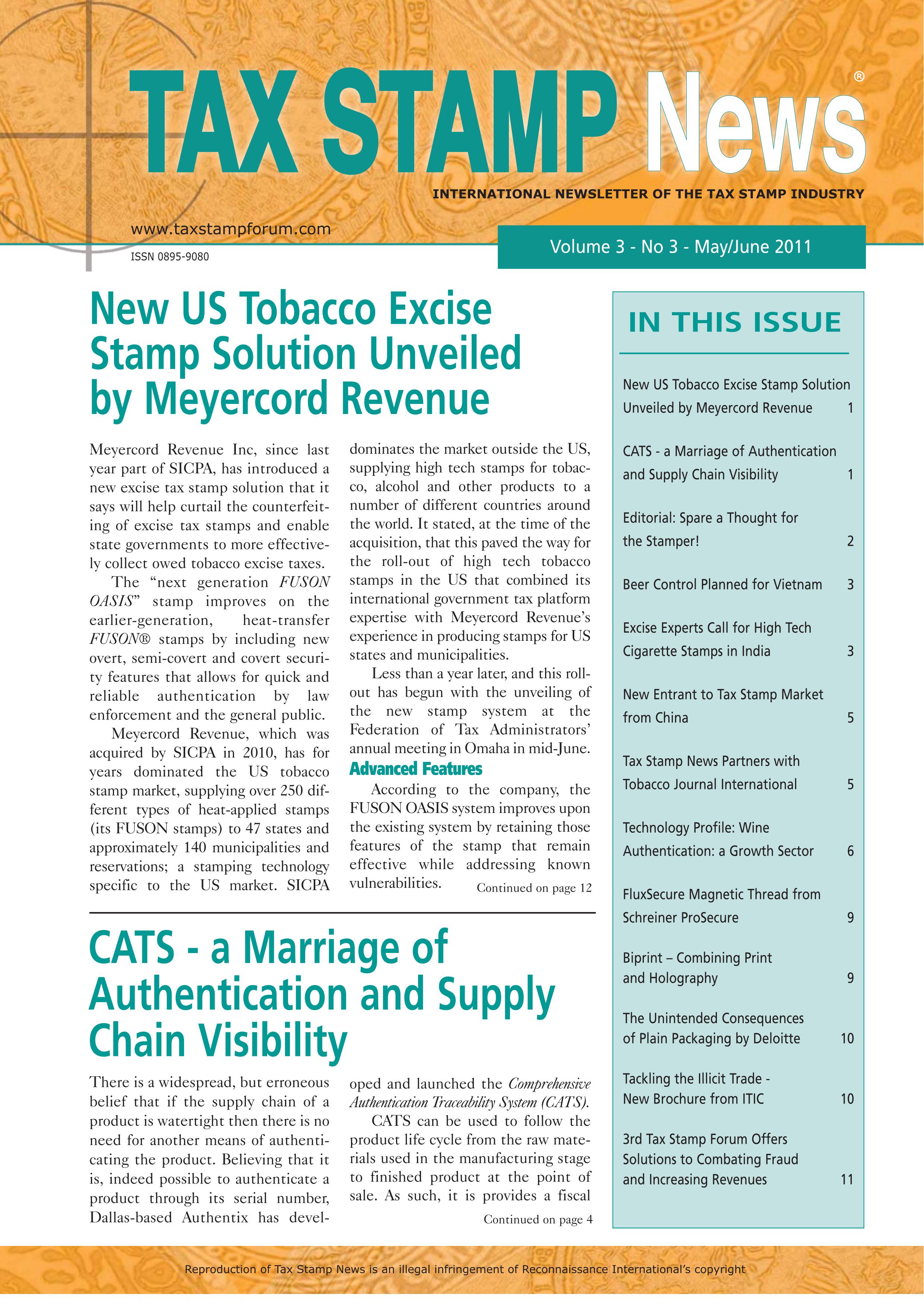
New US Tobacco Excise Stamp Solution Unveiled by Meyercord Revenue

www.taxstampforum.com – May/June 2011

Download PDF : tsn_may-jun_ 2011

Sixty-three held in smuggling probe

http://rthk.hk/rthk/news/englishnews/news.htm?main&20110625&56&765137

25-06-2011
Customs officers have arrested 63 people during a major operation against the cigarette smuggling.

They have also seized illicit cigarettes worth about 23-million dollars during raids on 41 warehouses. The head of the smuggling operation is said to be among those detained. Officers said the syndicate delivered the cigarettes to dealers by courier, and buyers would place orders with the dealers over the phone.

A federal Liberal backbencher has queried whether his party should accept donations from tobacco companies.

http://news.ninemsn.com.au/national/8263110/lib-mp-anti-tobacco-company-donations

West Australian MP Dennis Jensen told reporters an “implied conflict of interest” for governments making health policy relating to tobacco was a problem.

The federal government has criticised the opposition for accepting donations from British American Tobacco, worth $170,000 in 2010.

Labor, which is pushing ahead with the plain packaging of cigarettes, banned donations from tobacco companies in 2004.

Tobacco control and the epidemiological framework

http://tobaccocontrol.bmj.com/content/20/4/318.2.full.html

Download PDF : Illicit loss revenue, 2nd article 12 countries. TC 11 07