Clear The Air News Tobacco Blog Rotating Header Image

Cigarette Smuggling

Smugglers cash in big on ‘British’ tobacco

Monday, 08 April, 2013, 12:00am

News›Hong Kong

CRIME

Clifford Lo clifford.lo@scmp.com

With Hong Kong logistics firms as the unwitting conduit, gangs move tonnes from the mainland to Britain, where it’s passed off as a top brand

Criminal syndicates are reaping huge profits by smuggling mainland tobacco through Hong Kong into Britain, where it is sold at a 5,000 per cent mark-up, a government source says.

https://www.scmp.com/sites/default/files/styles/486w/public/2013/04/08/n4.jpg?itok=hvXsJoOJ

With the lure of such profit margins, the racket is thriving despite stringent enforcement action over the past two years, prompting Hong Kong customs to join forces with British and mainland agencies in an effort to stop it.

“The low delivery cost in Hong Kong is one of the main reasons the illicit tobacco is smuggled from the mainland to Britain through Hong Kong,” the source said.

Intelligence shows the tobacco, made on the mainland, costs as little as HK$50 per kg on the wholesale market but commands HK$2,600 a kg in Britain.

It is packaged as the British brand Golden Virginia, a rolling tobacco, and sells for about 30 to 40 per cent less than the genuine product.

In an attempt to evade Hong Kong surveillance, counterfeiters have now turned to logistics companies to smuggle the parcels. They are stamped on the mainland with an address in Britain, smuggled into Hong Kong, where they are sent straight to the offices of the logistics companies.

“The logistics companies are then ordered to mail the parcels out of Hong Kong within three hours to avoid being detected by local law enforcement,” said Wan Hing-chuen, who heads customs’ investigation division combating illicit tobacco.

Previously, counterfeiters had to find places in the city where they could store the tobacco and package it in bags bearing the Golden Virginia name before mailing it to Britain through the postal service.

Last month, customs officers confiscated scores of Britain-bound parcels containing 1.3 tonnes of the tobacco. The haul had an estimated street value of HK$5 million.

In the first two months of the year, about 200kg of the rolling tobacco was seized. Customs officers confiscated nearly 1.3 tonnes in the first three months of last year.

The parcels were declared as containing litter bins, clothes or household products.

Wan said that most of the cases recorded last month were detected after receiving information from logistics companies.

Customs officers at the airport’s airmail centre seized more than 10 tonnes between December 2011 and January last year and smashed a major syndicate.

Wan said counterfeiters usually laid low after a seizure then came back with new tactics to evade detection. “It’s just a game of cat and mouse,” he said.

Topics:

Smuggling

Tobacco

Logistics

Counterfeit

Organised crime


Source URL (retrieved on Apr 8th 2013, 5:46am): http://www.scmp.com/news/hong-kong/article/1209378/smugglers-cash-big-british-tobacco

Tobacco smugglers losing UK market share

http://www.guardian.co.uk/business/2013/mar/25/tobacco-smugglers-losing-uk-market-share/print

Traffickers’ share of cigarette market has slumped to 9% amid joint efforts by HMRC and UK Border Agency to disrupt supply

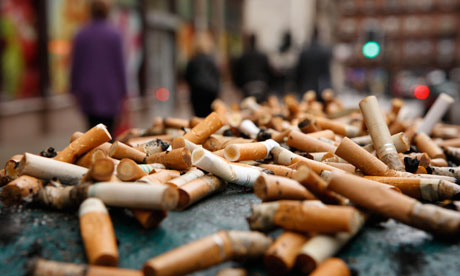
Cigarette butts

Tobacco smugglers have been thwarted by tougher legal agreements between the EU and cigarette companies. Photograph: Murdo Macleod for the Guardian

Britain is winning the war against tobacco smugglers who target cheap cigarettes at poor smokers and children and deny the Treasury revenue, according to a parliamentary report.

In 2000, one in five of cigarettes smoked came from the black market. But by 2010-11 traffickers’ share of the cigarette market had fallen to 9%, according to the report on the illicit tobacco trade by the all parliamentary group on smoking and health.

Over the same period, the share of the UK’s hand-rolled tobacco market originating with smugglers fell from 60% to 38%, an inquiry by the group of MPs and peers found.

Joint action by HM Revenue & Customs and the UK Border Agency has disrupted smugglers’ efforts to bring in and distribute their products, as have partnerships involving local police forces, councils and NHS organisations, the report says.

Stephen Williams, the Liberal Democrat MP who chairs the group, said the success disproved the industry’s claims that high taxes on their products in the UK boosted the supply of illegal tobacco.

He said manufacturers’ claims that forcing cigarettes to be sold in standardised packaging would increase the illicit trade were “self-interested and at times seemingly disingenuous industry lobbying”.

Legal agreements the EU has concluded with the big cigarette firms to reduce trafficking has also helped make fewer available, the parliamentarians say.

Their report highlights how the previously easy availability of black market tobacco in the UK was partly due to producers deliberately exporting more cigarettes than were wanted to other countries, knowing that many would be smuggled back into Britain.

Sarah Woolnough, Cancer Research UK’s policy director, said: “This report is further evidence that the tobacco industry should not be listened to when developing health policies aimed at reducing the devastating impact of smoking.”

The Tobacco Manufacturers Association claimed that more recent data showed that “the level of cigarettes consumed that are not UK tax paid has risen from 17% in 2011 to 21% in 2012″ and that figures from the Office of Budget Responsibility last week showed the government expected to receive £200m less in tobacco revenue in 2012-13.

A spokesman for the association claimed the inquiry was biased because it had not given a fair hearing to the industry and did not mention firms’ contributions to reducing smuggling.

Illicit cigarette trade to cost Rs100 billion to exchequer – thenews.com.pk

http://www.thenews.com.pk/Todays-News-3-166025-Illicit-cigarette-trade-to-cost-Rs100-billion-to-exchequer

Tobacco smugglers thrive on EU’s eastern border

http://www.euractiv.com/print/europes-east/experts-seek-ways-curb-smuggling-news-517716

Published on EurActiv (http://www.euractiv.com)

Source URL: http://www.euractiv.com/europes-east/experts-seek-ways-curb-smuggling-news-517716


Tobacco smugglers thrive on EU’s eastern border

Published: 12 February 2013

Prohibitive prices of cigarettes and alcohol encourage smuggling, according to participants at a recent conference in Warsaw on smuggling across the EU’s eastern border. EurActiv Poland reports.

Background

The conference ‘Smuggling of goods across the EU eastern border’ took place on 30 January at the European Parliament Information Office in Warsaw.

The event was organised by EurActiv Poland with the support of Philip Morris Poland. It gathered experts from EU and national institutions, think tanks, universities and businesses.

The conference, organised by EurAcitv Poland with the support of the Philip Morris tobacco company, took a look at the draft update of the EU Tobacco Products Directive but expanded the debate to look at wider smuggling issues.

The European Commission proposed larger health warnings on cigarette packets and a total ban on flavourings such as menthol, as part of proposal to update the directive, presented in December. Industry representatives have balked at the draft rules, saying they were illegal.

>> Read: Draft EU rules open door to plain cigarette packs

Cigarette sales in the 27-nation EU have fallen sharply in recent years but – at about 33% – Europe still has a higher proportion of smokers than any other region of the globe, according to data from the World Health Organization.

Speaking at the Warsaw conference, Tadeusz Zwiefka, a Polish MEP from the centre-right European People’s Party (EPP), said the updated directive should be carefully prepared to avoid a further increase in smuggling.

“Instead of contributing to better health of Europeans, the possible rise in smuggling or production of illegal cigarettes from tobacco of unknown origin means that they will be more harmful to health,” he told the participants at the conference.

Moving cigarettes across the eastern border

The EU’s eastern border is the place of choice for cigarette smugglers, who can make easy profits from the price differences with Ukraine, Russia and other Eastern countries. A pack of premium cigarettes costs €5.26 in Belgium, €3.41 in Poland, €1.33 in Ukraine and less than €1.74 in in Russia, and less than €1 in Belarus.

According to data presented by Waldemar Micewicz, head of the Customs Office in Biała Podlaska, in 2010 Polish authorities seized over 700 million illegal cigarettes, the biggest number in the EU.

In the next year Poland was also ranked high in the EU statistics, being surpassed only by UK and Greece.

Micewicz identified many reasons why smuggling is such a common activity. One of the most important is its profitability.

A telling example is also a wholesale price of 500,000 packs, that is, the number that an international road transport, or TIR, vehicle can haul. “In Belarus it stands at €150,000, in eastern Poland – €500,000, in Germany – €1.25 million and in Scandinavia even at €2.5 million,” Micewicz said.

But cigarettes are not smuggled only in trucks. Tomas Kucirek, of the Directorate General for Taxation and Customs Union, said that 50% of smuggling took place via ports and maritime transport.

He added that smuggling of cigarettes brings huge losses to member states. In 2011 they were estimated at €10 billion. ”Smuggling causes losses of revenue and is harmful for producers, retailers and customers,” he said, adding that profits coming from smuggling can be used to finance terrorism.

Antonio Saccone from Department of Risk Analysis at the European border agency Frontex stressed that the scale of the problem is on the rise, giving Latvia as an example. In March-April 2011, 600,000 cigarettes were seized, while in November-December the same year this number rose to 9 million.

Higher prices boost smuggling

According to Marcin Kraszewski of the Polish Chamber of Commerce, the reason behind the increasing smuggling is the prohibitive pricing policy of European states which may lead to the expansion of the black market. That is why this problem should not be considered from the supply side only, but also from the demand side.

This view was supported by Professor Wiesław Czyżowicz from the Warsaw School of Economics. He made reference to the Laffer curve which explains why the prices cannot grow endlessly – at some point the customers will switch to cheaper, smuggled or counterfeited goods.

He also pointed out at another important aspect of the problem, namely the social acceptance of the phenomenon.

New trends in illicit trade

Panellists pointed out that smuggling is not a static activity – it evolves and develops.

Micewicz drew attention to the growing fragmentation of the smuggled quantities. While earlier the average seizure was of 200 packs of cigarettes, now it has dropped to 50 packs.

This was explained by the increasing profitability.

Saccone added also that smugglers are better organised. He described the discovery of a 700-metre tunnel on a Slovak-Ukrainian border. He estimated its ‘cost’ at €1 million.

Not only cigarettes are smuggled

According to speakers, cigarettes are not the only products that are smuggled across the eastern border. Gasoline, alcoholic beverages and stolen cars are all being smuggled into the EU.

Smuggling is not limited to the eastern border. Other European states are also challenged by their leaky borders, speakers said.

Spain and France were named as the countries that are most vulnerable to drug trafficking. Illegal weapons are detected most frequently in Italy, Netherlands, France and Finland.

Bulgaria and Greece were named as the top two countries in terms of smuggling of counterfeited products. Reportedly, the Bulgarian-Turkish border is also the place where the biggest number of attempts of luxury car smuggling was detected.

Panelists pointed out at the need of cooperation and dialogue with third countries – mostly EU’s eastern neighbours – to exchange information about the entities and regulations.

Positions

Vygantas Paigozinas, representing the Department of Customs Policy of Lithuanian Ministry of Finance, said his country was increasingly seeking international cooperation to fight smuggling. Task forces were being established, comprising representatives of both national institutions and neighbouring countries. Those helped the exchange of information as well as the cooperation on a regional level.

Another method described by Paigozinas was the installation of automatic number plate recognition systems and scanning equipment. Such equipment was placed not only on the EU external borders but also on the internal ones, aiming at curbing the transit of illegal goods.

Paigozinas called for setting up a special EU fund to help such cooperation, as well as for simple rules for granting such support.

MEP Tadeusz Zwiefka (EPP, Poland) presented legislation currently being prepared by the European institutions.

The first one is the Directive on the Freezing and Confiscation of Proceeds of Crime. It envisages the possibility of freezing assets before the final judgement of the court is issued.

”It is a very bold approach but it seems to be inevitable” – Zwiefka commented. He added that such a solution has been introduced in some countries, e.g. Serbia, and is very effective.

The second project presented by the Polish MEP is the European Investigation Order in Criminal Matters. In Zwiefka’s words, it should simplify the rules of collecting evidence, limit the grounds for refusal of issue and set deadlines for them to be carried out.

Professor Wiesław Czyżowicz from the Warsaw School of Economics suggested a technical solution to fight counterfeit cigarettes– placing signs indicating the legality of the products which would allow tracing the chain form the producer to the consumer.

South Africa: Govt Signs WHO Treaty Against Tobacco Smuggling

http://allafrica.com/stories/printable/201301150264.html

Health-e (Cape Town)

South Africa: Govt Signs WHO Treaty Against Tobacco Smuggling

14 January 2013

Last week South Africa became the first country to sign a new international treaty aimed at combating tobacco smuggling.

Minister of Health, Dr Aaron Motsoaledi, signed the Protocol to Eliminate Illicit Trade in Tobacco Products at a ceremony held at the WHO headquarters in Geneva on Thursday. Eleven other countries including China, France, Panama, Turkey and Uruguay have also signed the treaty, which is now open for signature by other countries.

The aim of the treaty is to reduce tobacco smuggling worldwide. It promotes measures that governments can adopt to eliminate smuggling and encourages international co-operation between countries in identifying tobacco smuggling routes and trends, and in apprehending smugglers.

Tobacco smuggling is big business for both the tobacco manufacturers and criminal organisations. Once-secret industry documents reveal that the major tobacco companies have actively participated in smuggling worldwide. They have knowingly supplied tobacco products to criminals involved in smuggling.

Stopping smugglers from obtaining tobacco products by controlling the supply chain is an important aspect of the treaty. The treaty recommends that the supply chain be controlled through licensing of manufacturers; requiring them to verify the bona fides of their customers; tracking the movement of tobacco products across borders as well as tracing the origins of seized goods; better border controls and stronger penalties for smuggling.

The National Council Against Smoking (NCAS) commended the Minister for being the first to sign the treaty. “Reducing the illicit trade in tobacco is an important public health measure,” said Dr Yussuf Saloojee, executive director of the NCAS. “Smuggling makes cigarettes cheaper and so increases sales. It encourages adults to keep smoking instead of quitting after tax increases, and makes tobacco affordable to youth. Higher tobacco sales in turn mean more sickness and death,” he added.

“The level of cigarette smuggling in South Africa is highly over-estimated by the tobacco industry, as this creates pressure on the Treasury to keep excise taxes low. Nonetheless we do not need to combat smuggling and the way to do so is not by lowering taxes but by adopting the measures proposed by the protocol,” Saloojee said.

At the signing ceremony, WHO Director-General Dr Margaret Chan said: “The protocol gives the world a unique legal instrument for countering and eventually eliminating a sophisticated international criminal activity that costs a lot, especially for health.”

The new treaty is the first protocol to the WHO Framework Convention on Tobacco Control. The protocol will enter into force 90 days after the 40th government has ratified it.

The Protocol will help to protect people across the globe from the health risks of tobacco. In SA 44 000 are killed every year due to tobacco – that is three times as many as are killed in road accidents.

– NCAS

Protocol to Eliminate Illicit Trade in Tobacco Products opened for signature

http://www.who.int/fctc/en/

·       The Protocol to Eliminate Illicit Trade in Tobacco Products, adopted by the Parties to the WHO Framework Convention on Tobacco Control (WHO FCTC) in November 2012 in Seoul, was opened for signature by the Parties in a ceremony at WHO Headquarters on 10 January 2013.

·

·       http://www.who.int/entity/fctc/cop/sessions/WHO_FCTC_10JAN2013_300_1.jpg

·

·       More than 50 Parties participated in the event and 12 Parties representing all six regions signed the Protocol on this occasion. These countries are China, France, Gabon, Libya, Myanmar, Nicaragua, Panama, Republic of Korea, South Africa, Syrian Arab Republic, Turkey and Uruguay. In addition, Tunisia signed the Protocol on Friday, 11 January, while the treaty was still open for signature in Geneva.

·

·       After the initial two days in Geneva, the Protocol will remain open for signature at the United Nations Headquarters in New York until 9 January 2014 and will enter into force 90 days after the 40th Party has ratified it.

·       http://www.who.int/entity/fctc/cop/sessions/WHO_FCTC_10JAN2013_042_1.jpg

·       The Parties who took the floor expressed their strong commitment and support to the Protocol, some of them declaring their intention to sign it in the near future.

·       The WHO Director-General also attended and addressed the ceremony. Amongst the speakers were the Permanent Representatives of the Republic of Korea and Uruguay to the UN in Geneva, representing the current and the preceding Presidencies of the Conference of the Parties (COP).

·       http://www.who.int/entity/fctc/cop/sessions/WHO_FCTC_10JAN2013_089_1.jpg

·       The new international treaty is aimed at combating illegal trade in tobacco products through control of the supply chain and international cooperation. As a key measure, Parties commit to establishing a global tracking and tracing system to reduce and eventually eradicate illicit trade.

·       All photos credit: WHO/Pierre Albouy

Millions of cigarettes seized

Ewa Kretowicz
Published: January 13, 2013 – 3:00AM

CUSTOMS and Border Protection seized more than 125 million cigarettes being illegally brought into the country in 2012.

Laid end to end the cigarettes would stretch from Canberra to Perth and back again.

Combined with loose leaf, more than 134 tonnes of smuggled tobacco was seized at ports all round the country, which potentially would have cost the Australian government more than $128 million in unpaid taxes.

While China has traditionally been the biggest source of illicit cigarettes entering Australia, more recently large shipments have started to arrive from the United Arab Emirates.

Despite last year’s hefty haul, the figures also show there has been a 32 per cent drop in the amount of illegally imported tobacco seized.

But general smoking trends may also be contributing to a decline in demand, with 2012 figures showing an ever shrinking number of people taking up the smoking habit.

Customs and Border Protection said increases in penalties, fines and jail time as well as a number of arrests in 2011 and 2012 had contributed to the decrease.

But Cancer Council Victoria manager Kylie Lindorff said prices made illegal cigarettes attractive to smokers.

With government tariffs, a packet of 25 cigarettes costs about A$16, while an illegal packet of cigarettes sells for about $10, Ms Lindorff said.

”The main issue with smuggled tobacco is that it’s cheaper than in a store. The cheaper the tobacco, the less likely people are to give up and the more they will buy,” she said.

”Less cheap tobacco is a great thing … as every cigarette is killing you.”

Even so, only about 2 per cent of smokers buy smuggled tobacco and there were fewer Australians smoking last year than ever before in the country’s history.

”About 15 per cent of Australians 14 years and over are smoking and that’s dropping. And among young people smoking is at its lowest point ever,” Ms Lindorff said.

She said the decrease showed government programs were working.

”There are increased penalties, there are increased fines so it’s not worth people trying to import [tobacco] and demand is less as well because there are less people smoking.

”When people are caught they now face up to 10 years in prison.”

She said an 18-year-old today would not have been alive when smoking was outlawed in workplaces and cinemas.

”Young people today have never been exposed to ads on television or ads on billboards.”

This story was found at: http://www.canberratimes.com.au/act-news/millions-of-cigarettes-seized-20130112-2cn1q.html

Illicit cigarettes and hand-rolled tobacco in 18 European countries: a cross-sectional survey

1. Luk Joossens1,

2. Alessandra Lugo2,

3. Carlo La Vecchia2,3,

4. Anna B Gilmore4,

5. Luke Clancy5,

6. Silvano Gallus2

+ Author Affiliations

1. 1Association of European Cancer Leagues, Foundation against Cancer, Brussels, Belgium

2. 2Department of Epidemiology, Istituto di Ricerche Farmacologiche Mario Negri, Milan, Italy

3. 3Department of Clinical Sciences and Community Health, Università degli Studi di Milano, Milan, Italy

4. 4Department for Health, University of Bath, Bath, UK

5. 5TobaccoFree Research Institute Ireland, Dublin, Ireland

1.     Correspondence to Luk Joossens, Foundation against Cancer, Chaussée de Louvain 479, Brussels B-1030, Belgium; LJoossens@stichtingtegenkanker.be

Received 18 June 2012

Accepted 10 October 2012

Published Online First 10 December 2012

Abstract

Objective Little evidence, other than that commissioned by the tobacco industry, exists on the size of the illicit tobacco trade. This study addresses this gap by examining the level and nature of illicit cigarettes and hand-rolled tobacco in 18 European countries.

Design Face-to-face cross-sectional survey on smoking.

Setting 18 European countries.

Participants For each country, around 1000 subjects representative of the population aged 15 and over were enrolled. Current cigarette smokers were asked to show their latest purchased pack of cigarettes or hand-rolled tobacco.

Main outcome measure A comprehensive measure called an Identification of an Illicit Pack (IIP) was used to study the extent of illicit trade, defining a pack as illicit if it had at least one of the following tax evasion indicators: (1) it was bought from illicit sources, as reported by smokers, (2) it had an inappropriate tax stamp, (3) it had an inappropriate health warning or (4) its price was substantially below the known price in their market.

Results Overall, the proportion of illicit packs was 6.5%. The highest prevalence of IIP was observed in Latvia (37.8%). Illicit packs were more frequent among less educated smokers and among those living in a country which shared a land or sea border with Ukraine, Russia, Moldova or Belarus. No significant association was found with price of cigarettes.

Conclusions This study indicates that IIP is less than 7% in Europe and suggests that the supply of illicit tobacco, rather than its price, is a key factor contributing to tax evasion

Tobacco smuggling in Europe lower than industry figures suggest

http://www.healthcanal.com/substance-abuse/34729-Tobacco-smuggling-Europe-lower-than-industry-figures-suggest.html

The prevalence of tobacco smuggling in Europe is lower than industry figures suggest, reveals the largest study of its kind, published online in Tobacco Control.

Significantly, it is availability, rather than price, that seems to determine the level of illicit trade, the research suggests a finding that runs directly counter to the arguments proffered by the tobacco industry say the authors, including Professor Anna Gilmore from the University’s Tobacco Control Research Group in the Department for Health.

They base their findings on a representative population sample of 1000 people from each of 18 European countries: Albania; Austria; Bulgaria; Czech Republic; Croatia; England; Finland; France; Greece; Hungary; Ireland; Italy; Latvia; Poland; Portugal; Romania; Spain, and Sweden.

Only tobacco purchased from unauthorised sources or sold at very heavily discounted prices from legitimate retailers was defined as having been illicitly traded.

Health warnings and / or tax stamps that were either absent / inappropriate / tampered with, or clearly those of a duty free outlet were deemed the hallmarks of smuggled products.

Among the 18,056 participants, some 5,268 (27 per cent of the sample) classified themselves as current smokers; the final analysis was based on the responses of 5,114.

When quizzed about the provenance of their tobacco products, most respondents said they had bought them from a legal source. Just four per cent said that they had purchased their tobacco illegally, amounting to 296 packs.

The only distinguishing feature of the purchasers of illicitly traded products was their educational attainment: those with low levels were significantly more likely to buy them.

Two thirds (65.5 per cent) of illicitly traded packs had an inappropriate health warning; half had an inappropriate tax stamp; and just over one in four (27 per cent) had been bought at a knock down price.

The prevalence of illicit manufactured packs of 10 and 20 cigarettes was 5.9%, and 11.7% for hand rolled tobacco, with an overall prevalence of illicitly traded products of 6.5 per cent. Industry commissioned reports put the overall figure at just below 10 per cent.

Hand rolled tobacco was twice as likely to have been illicitly traded as manufactured cigarettes.

The availability of illicit tobacco was four times as high in countries bordering Ukraine, Russia, Moldova, and Belarus than it was elsewhere.

Almost four out of 10 tobacco products (37.8 per cent) purchased in Latvia came from an illicit source; in Sweden the comparable figure was almost one in five (19%), with Bulgaria coming third in the league table at 18 per cent.

At the other end of the scale, the prevalence of illicitly traded tobacco was one per cent or less in Greece, Austria and Portugal.

Frequency of illicit trading was also higher in countries where a 20 stick pack of Marlboro cost less than the average, rather than more.

Obtaining reliable figures on tobacco smuggling is difficult, precisely because this kind of activity does not tend to be recorded, say the authors, who acknowledge that their methods are not full proof either.

But to date, analysts have relied heavily on reports commissioned by tobacco manufacturers, which are unlikely to be neutral, they argue.

“The tobacco industry has claimed that high cigarette taxes drive smuggling, and has argued that with governments, sometimes successfully, that they should not increase tobacco tax because this will increase the level of trade.”” they write.

But they conclude: “This study suggests that the supply of illicit tobacco, rather than its price, is a key factor contributing to it.”

University of Bath, Bath, BA2 7AY, UK

Ten UK arrests in £50m microwave tobacco smuggling ring

BBC News

Ten people have been arrested in raids in the UK and Luxembourg in a suspected £50m tax fraud by an international tobacco smuggling ring.

HM Revenue and Customs (HMRC) believe the gang used microwave ovens and other white goods to smuggle tonnes of illegal tobacco into the UK.

Nine men and one woman were arrested in raids in Greater Manchester, Lancashire, Kent, Devon and Luxembourg.

HMRC officers seized 4,800kg of tobacco worth £1.5m in evaded duty.

HMRC, which was assisted by Luxembourg police, said cash had also been seized.

A man aged 46 and a 47-year-old woman were arrested in Ashford, Kent. A man, 53, was arrested in Ormskirk, Lancashire.

Five men, aged 25, 32, 44, 45 and 51 were arrested in Bolton, Bury and Manchester, and a 26-year-old man and 52-year-old man were arrested in Plymouth.

All 10 have been bailed until January or March 2013 pending further enquiries, an HMRC spokesman said.