Clear The Air News Tobacco Blog Rotating Header Image

September, 2015:

5 Things Altria Group Management Wants You to Know

http://www.suffieldtimes.com/business/5-things-altria-group-management-wants-you-to-know/87753/

‘Altria sees the e-cigarette and e-vapor market as a key driver of long-term progress, with its Nu Mark subsidiary having pushed arduous to enter key markets and broaden its penetration in each tobacco-alternative markets. But the collaboration with Philip Morris Worldwide arguably has much more potential to enhance Altria’s place within the area of interest, particularly because it responds to elevated competitors from Altria’s essential rival within the home tobacco market. Altria hopes the partnership will result in new and revolutionary merchandise and an extra environment friendly infrastructure for selling and advertising these merchandise.’

The Poison in Your E-Cigarettes

If you think e-cigs are a safer alternative to regular cigarettes, think again.

An independent study from the Center for Environmental Health (CEH) this week has offered new evidence that e-cigarettes contain cancer-causing agents. If the research holds up, the devices’ days as a “healthy alternative to smoking” may be numbered.

The e-cigarettes used today are based on one a Chinese pharmacist named Hon Lik created in 2003. Lik made the device with the hopes of kicking his smoking habit—one that he had just watched take his father through lung cancer. While it didn’t help Lik quit, it did pique the interest of those around him.

After first taking off online, the device made its way to Europe and the U.S. between 2006-2007. By 2009 an estimated 100,000 had been sold in America. After a few big name celebrities like Leonardo DiCaprio were pictured with one, the device took off.

Today, experts estimate that more than 20 million Americans have tried e-cigarettes, bringing sales of the product above $3 billion dollars annually. Investment analysts say the industry is on the verge of a rapid expansion, with the potential of reaching $10 billion in the next two years.

As successful as they are, the digital or battery-powered devices are the source of much controversy in the scientific world. Not yet approved by the Food and Drug Administration (FDA), there is little research on their health effects and few regulations surrounding their use. The result is a product that’s left a huge unanswered question: are e-cigarettes safer than real smoking?

It’s a question that CEH researchers set out to explore in their study, titled A Smoking Gun: Cancer-Causing Agents in E-cigarettes. The first large-scale study of its kind, it involved testing 97 products from 24 different e-cigarette manufactures for cancer-causing agents. Studies on potentially dangerous chemicals in the devices have been done, but this one had a major difference: it tested the level of chemicals via machines that mimicked how the devices are used.

The results were staggering. Ninety percent of the companies tested were shown to have at least one product with extreme levels of cancer causing gases.

The results were staggering. Ninety percent of the companies tested were shown to have at least one product with extreme levels of cancer causing gases. In one case, the product contained 254 times the legal amount of acetaldehyde; in another, a product showed 473 times the amount of formaldehyde. Using these results, the CEH plans to take legal action against the companies, claiming they are in violation of California’s consumer protection law, Proposition 65.

CEH’s research comes on the heels of a controversial New England Journal of Medicine study from January 2015, which implied that there are hidden levels of formaldehyde in e-cigarettes. The study was highly criticized by those in the e-cigarette industry and outside of it, who claimed the high temperatures used during testing were unrealistic. One industry expert, in describing how unscientific he viewed the process, likened it to “grilling a steak for 18 hours.”

In order to avoid the same controversy, the California researchers from CEH, a nonprofit launched in 1996 to protect the public against toxic chemicals, teamed up with the American Association for Laboratory Accreditation. A2LA is a nonprofit, non-government organization that has been testing cigarettes for years.

With their help, researchers were able to test the levels of cancer-causing agents through smoking machines that simulate how the products are actually used. Their results show the vast majority of leading e-cigarette manufactures producing products with unsafe levels of formaldehyde, acetaldehyde, or both. The chemicals were even found to be present in products that were marketed as nicotine-free.

The researchers blame e-cigarette marketing—reportedly an 80 million dollar industry—for “deceptive” advertising, which they say minimizes adverse health affects and promulgates unverified safety claims. A variety of individuals have filed lawsuits against e-cigarette companies, some alleging that their advertising is akin to early advertising for cigarettes.

Outside of the risk of exposure to cancer-causing agents, e-cigarettes have been shown to prove dangerous for kids. The concentrated liquid nicotine, which can be easily accessed, is highly toxic. From 2010-2014, the Centers for Disease Control and Prevention (CDC) reported that calls to poison control centers for exposure to e-cigarette liquid had skyrocketed; more than half of them involving children under the age of five.

So are e-cigarettes the answer to the deadly effects of cigarettes such as lung cancer, or are they a new alternative that—unbeknownst to the general public—is just as dangerous?

During a recent PBS special on the topic, Director of the FDA’s Center for Tobacco Products Mitch Zeller expressed a positive view on the product. “It looks like we may have a product that could deliver nicotine to the lungs without combustion,” says Zeller. “So, for some currently addicted adult smokers, if they could completely switch to e-cigarettes, this could conceivably help.”

Dr. Thomas Sussan, a researcher at Johns Hopkins University, disagrees. When comparing healthy lung tissue to that of mice who had been exposed to e-cigarettes, he found it hindered their ability to fight off infection, as well as produced dangerous free radicals. “If you think that you’re picking these up because they’re glamorous and that you’re not going to have any downstream or long-term effects as a result of this,” says Sussan, “I think you kidding yourself.”

As for CEH, it plans to use its legal action to “influence the e-cigarette industry to change its practices that mislead users.” This means working to make safer products as well as informing consumers about the risks of exposure to cancer-causing agents. It’s a cause they hope will add transparency to the budding industry and, if successful, save lives.

Another take on electronic cigarettes

http://business.inquirer.net/198513/another-take-on-electronic-cigarettes

By: Rafael R. Castillo, September 5th, 2015 12:10 AM

We’ve written about the pros and cons of electronic cigarettes (e-cigs) in this space. A recent report commissioned by Public Health England (PHE) states that e-cigs are about 95 percent less harmful to health than tobacco cigarettes, and should be considered in helping smokers quit.

The authors of the report were led by Ann McNeill, PhD, professor of tobacco addiction at the National Addiction Center, King’s College, and Peter Hajek, PhD, CClinPsych, director of the tobacco dependence research unit at the Wolfson Institute of Preventive Medicine in London, United Kingdom.

Refuting arguments that e-cigs could be a gateway for the youth to later smoke tobacco, the authors wrote that there’s no indication that e-cigs are “renormalizing smoking or increasing smoking uptake.”

They reported that e-cigs are attracting very few people who have never smoked, so there’s no risk of potentially increasing the number of people who might become actual smokers later on.

Other smoking-cessation experts are taking this report with a grain of salt.

Other researches by equally credible experts have drawn different conclusions and given opposing recommendations.

Draft recommendation

Also recently, an updated draft recommendation from the United States Preventive Services Task Force on behavioral interventions and medications for tobacco smoking cessation in adults, stated that it cannot yet recommend e-cigs as a smoking cessation tool.

It echoes findings of several other researches pointing out that though e-cigs may show some potential usefulness in smoking cessation, more studies are needed as to its long-term impact; and there must be stricter regulation on its marketing and sale to the public.

A report published in the Journal of the American Medical Association (Jama), coming out almost at the same time as the PHE report, stressed the “gateway issue” of e-cigs. The study was reinforced by an editorial by Nancy A. Rigotti, MD, from the Massachusetts General Hospital and Harvard Medical School in Boston. The editorial was published also in the same issue of the journal.

Dr. Risotto emphasized that the study provides “the strongest evidence to date that e-cigarettes might pose a health hazard by encouraging adolescents to start smoking conventional tobacco products.”

Some technical flaws

However, Dr. McNeill, coauthor of the PHE report, argued that the study has some methodological or technical flaws, which make the conclusions questionable. The major issue Dr. McNeill raised was with regard to the measure to determine e-cig use and smoking.

“One of the issues we raise in our report is that of measurement,” she was quoted by Medscape Medical News. “It is not the same to equate ‘ever use’ with use, as ever use can mean that someone had just tried an e-cigarette once.”

She added: “Adolescence is a time of experimentation, so what we are really concerned with is any regular use of e-cigarettes and uptake of smoking.”

Smoking cessation tool

For his part, Dr. Hajek said that the Jama study does not show that vaping with e-cigs leads to smoking. “It just shows that people who are attracted to e-cigarettes are the same people who are attracted to smoking,” he explained. He compared it with people who drink alcohol, such that those who drink white wine are more likely to try red wine compared to people who do not drink alcohol.

I maintain my personal stand that e-cigs should only be allowed as a smoking-cessation tool, which should be under the supervision of a health professional who has training on smoking cessation. It should be treated as a prescription product, and not as a “recreation” or “alternative lifestyle” device which anyone, including children and adolescents, can readily purchase even from vendors in some busy street corners.

Big Tobacco Eyes Easing Restrictions Via TTIP

http://www.thenewamerican.com/economy/item/21526-big-tobacco-eyes-easing-restrictions-via-ttip

Written by Joe Wolverton, II, J.D.

“We are not afraid to entrust the American people with unpleasant facts, foreign ideas, alien philosophies, and competitive values. For a nation that is afraid to let its people judge the truth and falsehood in an open market is a nation that is afraid of its people.” — John F. Kennedy, February 26, 1962

If Kennedy was right, then the United States and its partners in the Transatlantic Trade and Investment Partnership (TTIP) must be very afraid indeed of their people.

Despite a promise made only weeks ago by the EU trade commissioner Cecilia Malmström to “publish detailed and extensive reports of the negotiations,” key documents recording details of negotiations between Big Tobacco and the EU were heavily redacted before being posted on the official EU website.

Virtually every word of the documents recording correspondence with and minutes of meetings with tobacco lobbyists and representatives of the governments of the United States, Japan, and the European Union was blacked out before being made available online.

In one example typical of the amount of pre-publication editing, a 14-page letter from British American Tobacco revealed fewer than five percent of the text. What was visible was little more than the written version of small talk.

Another egregious example of what the EU and U.S. trade representatives consider “access” and “transparency” is a single page memo of a meeting with lobbyists working for Philip Morris. In that offering to openness, even the date was redacted!

Activists in Europe have requested the full record of these meetings, supposing that they would reveal efforts by multinational tobacco conglomerates to include revocations of national (American, Japanese, and European) restrictions on the advertising, buying, and selling of tobacco.

An EU watchdog organization specializing in monitoring corporate lobbying is preparing to file a complaint with an EU government agency to force Big Tobacco and the representatives of the TTIP member nations to expose to the people of all interested countries the full, unredacted record of these critical conversations.

Regardless of the true purpose of these meetings, the fact that the participants want them kept secret is telling.

What is certainly not secret is the fact that U.S. law will be abrogated by whatever agreements the trade negotiators work out in secret with the tobacco industry and other segments of big business that see an opportunity to circumvent the Constitution and promulgate new, more favorable, less restrictive regulations.

Constitutionalists in America and friends of liberty and economic freedom on both sides of the Atlantic are fully aware that the TTIP is not to the liking of any right thinking person.

Speaking of the damage to representative, republican government lurking in the TTIP, The New American’s senior editor, William F. Jasper, writes:

The Transatlantic Trade and Investment Partnership (TTIP) proposes to begin “deep and comprehensive” integration between the 28 member states of the European Union and the United States. Over the course of the past several years, we have published many articles detailing the dangers posed by these (still officially secret) agreements. We are bringing together here, in abbreviated form, 10 of those reasons why every American — whether identifying as Republican, Democrat, Libertarian, Independent, Tea Party, liberal, conservative, or constitutionalist — should oppose both of these proposals.

Jasper goes on to list 10 reasons to oppose the TTIP.

It is that word “integration,” though, that should evoke the greatest resistance from Americans and Europeans who understand our common legacy of individual liberty and the trouble that is caused by political consolidation.

Again, Jasper’s analysis is noteworthy:

The TPP/TTIP architects are drawing from the “success” of the European Union. In the development of the European Union — from its origin as the European Coal and Steel Community to the Common Market to the European Community to, finally, the EU — this subversive mutational process has been referred to as “broadening and deepening.” Broadening (or “widening”) refers to the constant expansion through addition of new member-states; deepening refers to the constant creation of new supranational institutional structures and continuous expansion and usurpation by regional authorities of powers and jurisdiction that previously were exercised by national, state, and local governments. The “living,” “evolving” treaties and agreements of the EU have eviscerated the national sovereignty of the EU member-states and increasingly subjugated them to unaccountable rulers in Brussels under the rubric of “integration,” “harmonization,” “an ever closer union,” “convergence,” “pooled sovereignty,” “interdependence,” and “comprehensive cooperation.”

Of course, the most relevant and revealing question is why would negotiators — corporate and government — continue trying so hard to conceal the content of their negotiations if the deal were good for Americans?

In his exposé, Jasper points out that that “transparency” deception isn’t confined to the European politicians:

The Obama administration has audaciously claimed that the TPP and TTIP processes are “completely transparent,” and President Obama has publicly claimed to be peeved by charges (false charges, he says) that there is any secrecy involved. But the president is talking utter nonsense, if facts mean anything. It is a fact that after more than three years of (secret) negotiations, the administration still has not made the draft texts of either of the agreements available to the public.

When it comes to keeping Americans in the dark about multinational, unconstitutional trade deals, Obama has proven himself quite capable of cooking up some whoppers:

In a press conference attended by this reporter in December 2013, it was admitted that in the official document outlining the deal, the Obama administration makes clear that an agreement will not be chiefly focused on matters related to international trade, but rather “behind-the-border” (read: domestic) policies such as health, environmental, and monetary policy. As with so many of the other panoply of recent trade deals, multinational corporations operating within the United States and the EU are achieving quasi-governmental power and using that authority to limit the ability of U.S. and EU courts to enforce domestic laws, particularly those that the corporate interests deem detrimental to their bottom line.

If the globalist and corporate interests in the United States and Europe successfully silence the outrage of the opposition on both sides of the Atlantic and achieve adoption of the agreements, then the integration of the United States with regional blocs in the Pacific and Atlantic will rush headlong toward completion and the ultimate surrender of sovereignty will ride up rapidly on its heels.

As it stands today, despite the redactions, it appears that the right of Americans to elect those empowered to make laws is being repealed by corporate lobbyists meeting safely behind a thick veil of secrecy.


Infographic shows how the after-effects from vaping an e-cigarette can be just as harmful as the real deal

http://www.dailymail.co.uk/femail/article-3222398/Infographic-shows-effects-vaping-e-cigarette-just-harmful-real-deal.html

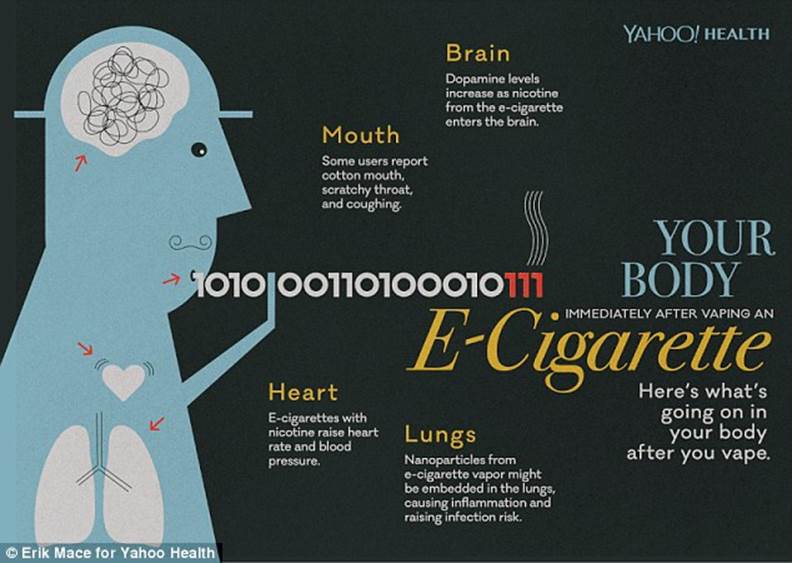
Scratchy throat, increased blood pressure and inflamed lungs: Infographic shows how the after-effects from vaping an e-cigarette can be just as harmful as the real deal

The infographic explores the effects of vaping on users’ mouth, lungs, heart and brain

  • Few studies have been done on the risks associated with the rising trend
  • E- cigarettes are not currently regulated by the FDA
  • A UK health agency recently concluded that vaporizers are 95 per cent less harmful than traditional cigarettes
  • The American Lung Association said without FDA regulation there is no way to know the short and long-term health regulations might be

Since electronic cigarettes hit the market in 2003 they have been touted by many as a ‘healthier’ options for smokers who are eager to leave the real deal behind. However, there has been little research on the rising trend – leaving some questioning the potential health risks of vaping.

And now, a new infographic created by Yahoo Health reveals what is known so far about what happens to a person’s body immediately after vaping an e-cigarette, exploring how a few puffs may affect your mouth brain, and lungs – and it’s certainly not all as ‘healthy’ as you might think.

In fact, as the infographic explains, smoking an e-cigarette can often lead to the same feeling of ‘cotton mouth’ that most smokers experience after inhaling traditional cigarettes, as well as a scratchy throat and a cough.

Healthier option? Although there are very few studies on e-cigarettes, a new infographic explores how vaping may affect your brain, heart, lungs and mouth

Healthier option? Although there are very few studies on e-cigarettes, a new infographic explores how vaping may affect your brain, heart, lungs and mouth

And then there’s the risk e-cigarettes pose to your lungs; while the dangers might not be quite so apparent as they are when it comes to actual cigarettes, vaping can still cause some serious damage to these organs.

According to the infographic, ‘nanoparticles from e-cigarette vapor’ can become embedded in the lungs, causing inflammation and increasing the risk of further infection.

Much like the traditional option, e-cigarettes also release a feeling of pleasure as dopamine levels rise and enter the brain – but those with nicotine can also raise heart rate and blood pressure.

E-cigarettes are considered to be a healthier option for smokers because they simulate the feeling of smoking without any smoke or burning, and a new study by a UK health agency deduced that vaporizers are 95 per cent less harmful than traditional cigarettes, suggesting that they can even help people quit tobacco.

‘They’re simpler than cigarettes,’ Jonathan Foulds, a professor of public health sciences and psychiatry at Penn State University’s College of Medicine and Cancer Institute told Yahoo Health.

‘You burn it, cigarettes creates 7,000 different chemicals into your body,’ he explained. ‘But with e-cigarettes, there’s no combustion. The good news is that you’re inhaling a vapor that’s got four to five things as opposed to 7,000 things.

‘The question is: What’s the effect on the body of the four to five things?’

The small amount of research shows that electronic cigarettes may affect the user’s mouth, lungs, heart and brain.

Although it is unclear why, some users complain that after vaping they experience dry mouth, coughing and throat irritation.

As for what users are inhaling, vaping may cause inflammation on the user’s lungs. According to a study published in the journal PLOS this year, the inhalation of e-cigarette vapors damage the epithelial cells in the lungs, which leave them at risk for infection.

The study’s author, Qun Wu, told Yahoo Health earlier this year that e-cigarette liquids, whether they have nicotine or not, ‘inhibit lungs’ innate immunity’, which helps it defend itself against infections.

And while glycerin, one of the ingredients in e-cigarettes, is considered safe in foods, Mr Foulds argues that eating something is not the same as ‘putting it into a vapor and inhaling it.’

‘A Mars bar is safe to eat, but I wouldn’t want to inhale it,’ he explained. ‘If something is safe as a food, it’s not highly harmful, but we don’t know what happens when you inhale it.’

The US Food and Drug Administration warns that e-cigarettes have not been properly studied, so it is unclear to how much nicotine or other potentially harmful chemicals are being inhaled through vaping.

Although the agency has issued a proposed rule that would extend its tobacco authority to include e-cigarettes, they are not currently regulated by the FDA.

The contents of the liquid solution found in vaporizers vary by brand and flavors, and nicotine isn’t necessarily a component of all e-cigarettes. Some versions of the produce even allow users to adjust the liquid solution to their liking.

There are hardly any studies on the effects of e-cigarettes on the body, and American Lung Association argues that early studies show that e-cigarettes contain nicotine and other harmful chemicals, including carcinogens.

Like traditional cigarettes, vaporizers that contain nicotine raise the user’s heart rate and blood pressure as an adrenaline rush overcomes the body, however, a European study found ‘none of the heart problems associated with tobacco cigarettes among e-cigarette’ users.

Vaping may also be addictive. E-cigarettes give users a feeling of pleasure as dopamine levels rise in the brain.

While nicotine is not a carcinogen, it is still addictive, and many agencies fear that e-cigarettes may actually increase the odds that vapers become addicted to other substances.

The American Lung Association voices concern that the claims that e-cigarettes help people quit smoking are unproven, and that they may actually serve as a gateway for the use of traditional tobacco products – particularly for teens. According to new data released by the Centers for Disease Control and Prevention electronic cigarette use among teens has surpassed traditional cigarette use for the first time.

However, one thing is for sure, pregnant women should stay away from e-cigarettes, The nicotine found in vaporizers puts unborn babies at risk for preterm birth, low birth weight, higher still birth rates.

The American Lung Association stated that without FDA regulation, ‘there is no way for the public health and medical community or consumers to know what chemicals are contained in e-cigarettes or what the short and long-term health implications might be’.

Most online e-cig vendors make false claims says watchdog

The majority of U.S. e-cig vendors make unsupported claims on their Websites, a watchdog group has charged after surveying the online presence of 159 companies.

Truth in Advertising (TINA), a nonprofit based in Connecticut, examined the firms’ online content including “social media, testimonials, [and] links to studies or media reports” – not just advertising in the conventional sense – to enumerate claims of four kinds that it contends are misleading:

That e-cigarettes have health benefits.
That they can help with smoking cessation.
That they can be legally used nearly everywhere.
That they are cheaper than tobacco smoking.
Two thirds of the suppliers made at least one of these assertions, it found.

Most frequently seen were health-benefit claims, made by around half the companies. More than 40% suggested that e-cigs are cheaper than tobacco cigarettes; nearly a third referred to e-cigs’ usefulness in giving up smoking, while a similar number said their products could be used virtually anywhere.

TINA also noted examples of companies selling e-liquid in what it calls “kid friendly flavors”, and found that around 40% offered such products.

“Online e-cigarette companies are taking advantage of the regulatory gap to market their wares with a variety of suspect claims. Some are blatant while others are subtle, craftily-drafted veiled claims,” TINA said.

Only three companies of the 159 fell foul of TINA’s criteria in all four categories and also sold flavoured e-liquid with supposedly child-friendly flavours: they were LeCig, Mt. Baker Vapor, and VapingZone.

Last year a notification from TINA was among the prompts that led Utah’s division of consumer protection to crack down on e-cig companies that had “advertised false health claims, posted false customer testimonials, marketed ‘free’ trial offers that were not in fact free of charge, and…charged customer accounts without consent”.

What This Means: It is a little unfortunate that TINA – a respectable, generally non-hysterical organisation – saw fit to jump on the “kiddie flavours” bandwagon, since selling these products has nothing to do wit

h the issue of truth in advertising, regardless of whom they may or may not appeal to.

However, we shouldn’t write off the research because of that. It’s undoubtedly the case that, while the industry as a whole is responsible, there are a lot of dubious claims being made for e-cigs online.

This likely out of ignorance or enthusiasm in most cases, rather than with any intention to deceive; but that won’t be a much of an excuse in the eyes of regulators. Bringing this issue to the forefront with some startling numbers is therefore welcome.

– Barnaby Page ECigIntelligence staff

After-effects from vaping an e-cigarette can be just as harmful as the real deal

Scratchy throat, increased blood pressure and inflamed lungs: Infographic shows how the after-effects from vaping an e-cigarette can be just as harmful as the real deal

  • The infographic explores the effects of vaping on users’ mouth, lungs, heart and brain
  • Few studies have been done on the risks associated with the rising trend
  • E- cigarettes are not currently regulated by the FDA
  • A UK health agency recently concluded that vaporizers are 95 per cent less harmful than traditional cigarettes
  • The American Lung Association said without FDA regulation there is no way to know the short and long-term health regulations might be.

By Erica Tempesta For Dailymail.com http://www.dailymail.co.uk/femail/article-3222398/Infographic-shows-effects-vaping-e-cigarette-just-harmful-real-deal.html

Since electronic cigarettes hit the market in 2003 they have been touted by many as a ‘healthier’ options for smokers who are eager to leave the real deal behind. However, there has been little research on the rising trend – leaving some questioning the potential health risks of vaping.

And now, a new infographic created by Yahoo Health reveals what is known so far about what happens to a person’s body immediately after vaping an e-cigarette, exploring how a few puffs may affect your mouth brain, and lungs – and it’s certainly not all as ‘healthy’ as you might think.

In fact, as the infographic explains, smoking an e-cigarette can often lead to the same feeling of ‘cotton mouth’ that most smokers experience after inhaling traditional cigarettes, as well as a scratchy throat and a cough.

image003 (1)Healthier option? Although there are very few studies on e-cigarettes, a new infographic explores how vaping may affect your brain, heart, lungs and mouth

And then there’s the risk e-cigarettes pose to your lungs; while the dangers might not be quite so apparent as they are when it comes to actual cigarettes, vaping can still cause some serious damage to these organs.

According to the infographic, ‘nanoparticles from e-cigarette vapor’ can become embedded in the lungs, causing inflammation and increasing the risk of further infection.

Much like the traditional option, e-cigarettes also release a feeling of pleasure as dopamine levels rise and enter the brain – but those with nicotine can also raise heart rate and blood pressure.

E-cigarettes are considered to be a healthier option for smokers because they simulate the feeling of smoking without any smoke or burning, and a new study by a UK health agency deduced that vaporizers are 95 per cent less harmful than traditional cigarettes, suggesting that they can even help people quit tobacco.

‘They’re simpler than cigarettes,’ Jonathan Foulds, a professor of public health sciences and psychiatry at Penn State University’s College of Medicine and Cancer Institute told Yahoo Health.

‘You burn it, cigarettes creates 7,000 different chemicals into your body,’ he explained. ‘But with e-cigarettes, there’s no combustion. The good news is that you’re inhaling a vapor that’s got four to five things as opposed to 7,000 things.

‘The question is: What’s the effect on the body of the four to five things?’

How safe are they? The Rise of the E-Cigarette

The small amount of research shows that electronic cigarettes may affect the user’s mouth, lungs, heart and brain.

Although it is unclear why, some users complain that after vaping they experience dry mouth, coughing and throat irritation.

As for what users are inhaling, vaping may cause inflammation on the user’s lungs. According to a study published in the journal PLOS this year, the inhalation of e-cigarette vapors damage the epithelial cells in the lungs, which leave them at risk for infection.

The study’s author, Qun Wu, told Yahoo Health earlier this year that e-cigarette liquids, whether they have nicotine or not, ‘inhibit lungs’ innate immunity’, which helps it defend itself against infections.

And while glycerin, one of the ingredients in e-cigarettes, is considered safe in foods, Mr Foulds argues that eating something is not the same as ‘putting it into a vapor and inhaling it.’

‘A Mars bar is safe to eat, but I wouldn’t want to inhale it,’ he explained. ‘If something is safe as a food, it’s not highly harmful, but we don’t know what happens when you inhale it.’

Rising trend: E-cigarettes are not currently regulated by the US Food and Drug Administration

The US Food and Drug Administration warns that e-cigarettes have not been properly studied, so it is unclear to how much nicotine or other potentially harmful chemicals are being inhaled through vaping.

Although the agency has issued a proposed rule that would extend its tobacco authority to include e-cigarettes, they are not currently regulated by the FDA.

The contents of the liquid solution found in vaporizers vary by brand and flavors, and nicotine isn’t necessarily a component of all e-cigarettes. Some versions of the produce even allow users to adjust the liquid solution to their liking.

There are hardly any studies on the effects of e-cigarettes on the body, and American Lung Association argues that early studies show that e-cigarettes contain nicotine and other harmful chemicals, including carcinogens.

Like traditional cigarettes, vaporizers that contain nicotine raise the user’s heart rate and blood pressure as an adrenaline rush overcomes the body, however, a European study found ‘none of the heart problems associated with tobacco cigarettes among e-cigarette’ users.

Vaping may also be addictive. E-cigarettes give users a feeling of pleasure as dopamine levels rise in the brain.

While nicotine is not a carcinogen, it is still addictive, and many agencies fear that e-cigarettes may actually increase the odds that vapers become addicted to other substances.

The American Lung Association voices concern that the claims that e-cigarettes help people quit smoking are unproven, and that they may actually serve as a gateway for the use of traditional tobacco products – particularly for teens. According to new data released by the Centers for Disease Control and Prevention electronic cigarette use among teens has surpassed traditional cigarette use for the first time.

However, one thing is for sure, pregnant women should stay away from e-cigarettes, The nicotine found in vaporizers puts unborn babies at risk for preterm birth, low birth weight, higher still birth rates.

The American Lung Association stated that without FDA regulation, ‘there is no way for the public health and medical community or consumers to know what chemicals are contained in e-cigarettes or what the short and long-term health implications might be’.

India’s $16 Billion Smoking-led Health Crisis

http://www.indiawest.com/blogs/india-s-billion-smoking-led-health-crisis/article_9d0956a8-52df-11e5-be1b-67e51a6e11de.html

New Delhi: In January, the government asked for public opinion on tougher new laws to curb smoking: To raise the minimum smoking age to 21 from 18, and to ban the sale of single cigarettes, which account for 70 percent of nationwide cigarette sales.

People responded enthusiastically; 45,000 emails and 100,000 letters poured in to the health ministry, as Reuters reported earlier this month. What they said, however, is not known because the government hasn’t yet read the messages, according to a health ministry representative quoted in the story.

Like those messages, the World Health Organization’s Report on the Global Tobacco Epidemic 2015 is largely ignored in India. Its single-line message: Raising tobacco taxes can help curb smoking.

Curbing smoking is very important to India for two reasons:

* About one million Indians die from smoking-related causes every year, which are among the top three ways to die.

* Smoking also saps Indians of money; more money, it emerges, than it earns for the government.

Indians aged 35 to 69 spent Rs.104,500 crore ($15.9 billion) in 2011 on diseases associated with tobacco-including cancer, respiratory diseases, tuberculosis and cardiovascular diseases. This figure is almost six times as much as central excise tax collections from all tobacco products that year, according to the Indian government, WHO and the Public Health Foundation of India.

To put the health cost of tobacco in further perspective, it exceeded the combined annual state and central government expenditure on health care by 12 percent in 2011.

Taxes on cigarettes rise – not enough – but they do. Bidis are the problem.

A 10 percent price increase on tobacco products could cut consumption between 2-8 percent in developing nations, according to the WHO. Tax hikes increase prices, which in turn lower demand and protect people from the ill-effects of tobacco.

“Raising taxes is a win-win situation,” said Arun Thapa, acting WHO representative to India. “It’s good for human health and for the country’s fiscal health.”

Over the last 19 years, taxes on cigarettes in India have risen 1,606 percent. That isn’t quite enough and the six-tier tax structure is so complex – based on stick lengths and filters – that companies manipulate it with relative ease to keep demand intact.

The biggest problem in curbing tobacco use lies with the influence wielded by those who make the humbler – but more damaging – cousin of cigarettes, the bidi.

Taxes on a pack of bidis are 7 percent of the retail price, less than a tenth of the WHO’s suggested level of 75 percent. A 20-stick pack of best-selling cigarettes is taxed around 60 percent of the retail price.

Bidi smokers make up 61 percent of the nation’s 120 million smokers, according to the Global Adult Tobacco Survey 2010. This is a conservative estimate. Some studies peg the numbers of bidi smokers higher, at 73 percent and even 85 percent.

Bidi smokers face a higher risk of developing potentially-fatal chronic obstructive pulmonary disease, among other illnesses, because tobacco is packed more loosely in bidis, requiring smokers to inhale more strongly.

But the bidi industry has consistently squeezed concessions from the government.

Millions of jobs and livelihoods at stake, so taxes must stay low, argue bidi barons.

Here are some concessions the government gives the bidi industry:

Handmade bidi units (98 percent of bidis are handmade) producing less than two million sticks in a year are exempt from excise duty.

Bigger bidi makers pay a duty of 1.6 paise per handmade stick and 2.8 paise per machine-made bidi. The duty on cigarettes varies between Rs.1.28 and Rs.3.37 per stick.

Some eight million people work as bidi rollers nationwide, said a representative of the All India Bidi Industry Federation.

“Imposing taxes on bidis and introducing pictorial warnings on bidi packs would lower demand,” said Sudhir Sable, secretary, All India Bidi Industry Federation. “Any fall in production would jeopardise the jobs of bidi rollers. It would also adversely impact tobacco farmers, as well as the thousands of corner shops selling the product.”

Increasing taxes on bidis would invariably increase the illicit trade in bidis, leading to the proliferation of fake bidis, Sable argued. It would also deprive states and the central government of tax revenue.

These arguments do not wash, say experts.

No socio-economic case for low bidi taxes, contend experts

In 2013, the bidi industry contributed less than three percent to the government’s central excise collection from tobacco products, not surprising, given the low excise duty it pays.

A Public Health Foundation of India study says there is indeed scope for taxes on bidis to be increased.

“Doubling bidi excise would help cut consumption by 40% and increase tax revenue by 22%,” said Monika Arora, director, Health Promotion and Tobacco Control Initiatives, Public Health Foundation of India.

Essentially, the argument goes, higher tax rates would offset any loss of excise from fall in consumption. In the bargain, spending on “useful” goods and services will grow.

“Money not spent on bidis or cigarettes will not disappear from the economy,” said Prabhat Jha, founding director of the Center for Global Health Research, University of Toronto. “It will be spent on other products which generate employment.”

Additional revenue could help the government meet the cost of transitioning bidi workers to other means of employment. The government has previously considered a cess on cigarettes to encourage farmers to switch from tobacco to other crops.

So, why not tax all segments of the tobacco-products industry, experts suggest, to fund a gradual transition? Bidi workers, among some of IndiaÂ’s most disadvantaged people, can only benefit.

(In arrangement with IndiaSpend.org, a data-driven, non-profit, public interest journalism platform. Charu Bahri is a freelance writer and editor based in Mount Abu, Rajasthan.)


Vaping of new synthetic drugs poses new threat

http://wwlp.com/2015/09/04/vaping-of-new-synthetic-drugs-poses-new-threat/

There’s no federal age limit on who can buy them

Sara Ganim, CNN Published: September 4, 2015, 9:15 pm Updated: September 4, 2015, 9:20 pm

Fla. (CNN) – Smoke-free devices like e-cigarettes have become a popular way to break the nicotine addiction. Vapor pens, for example, allow smokers to control the amount of nicotine they receive.

But the devices are also being used to smoke synthetic drugs, which can be dangerous, as well as hard for police to detect.

On any given afternoon, Broward County deputies come across drugs this. This is flakka – just one of the inexpensive synthetic drugs ravaging south Florida — and there’s a new twist that’s making fighting these drugs even harder: e-cigarettes or vape pens.

Lieutenant Ozzy Tianga from the Broward Sheriff’s Office said, “It’s just a huge challenge. It’s affecting our entire communities from prevention to rehabilitation.”

Lt. Tianga says vaping drugs is so discreet, teens can do it right in school. “There is no scent. They can sit in the back of the room, and they think it’s funny. They are vaping and what they are vaping, again, I cannot determine.”

It used to be that if you would try to get high, it would smell. But Tianga says, all that has changed. That same secrecy makes it tough for police to know what’s inside that vape pen. They have to get it tested by a lab.

(Sara Ganim) “You can’t determine what’s in it right away?”
(Lt. Ozzy Tianga/Broward Sheriff’s Office) “Not at all. In fact, these individuals can smoke it right in front of you.”

A recent CDC study found e-cigarette use more than tripled among middle and high schoolers in 2014. It’s not known how much of that is drug-related, but young vape users are posting videos of themselves getting high on YouTube.

The Drug Enforcement Administration is so concerned because synthetics can be so dangerous, no matter how they’re ingested.

DEA Supervisory Special Agent John Scherbenske said, “We’ve seen time and time again where someone has overdosed and died. There are a significant number of overdoses that are occurring related to these types of drugs.”

All of this is so new, no one’s keeping track.

No one knows just how many people have been injured or have died from vaping synthetic drugs. But already emergency rooms are seeing an increase, and the stories are disturbing.

Dr. John Cunha from Holy Cross Hospital said, “I have had patients in my practice in the emergency room, that I have walked in on, that are actually vaping at the bedside,”
Doctor Cunha says recently, a patient was discharged after an overdose, and went into a hospital bathroom on his way out of the hospital. There, he vaped more drugs, and had to be taken back to the ER.

Dr. Cunha says, “I think that these devices do have a role in helping people get off of actual cigarettes, and that they may be proven safer in that case. But in the hands of teenagers and drug abusers, they are definitely very dangerous thing to have.”

The thing to remember is that these are not classified as drug paraphernalia, so there’s no federal age limit on who can buy them, although many states have restrictions. And these shops are popping up everywhere, not to mention they can easily be bought on the internet.

Now, the industry says that vaping is a good thing for a lot of people; that it’s helping people to quit smoking, not start smoking. They say everything is subject to abuse by drug addicts. Of course, there is a study that show that many of the teens that vape never smoked before.

SALE OF E-CIGARETTES BANNED FOR MINORS IN NEW SOUTH WALES

http://nycity.today/content/284898-sale-e-cigarettes-banned-minors-new-south-wales

Minors in New South Wales will not be able to buy electronic cigarettes following new anti-e-cigarette laws that came into effect recently. The sale of electronic cigarettes has been banned in the southeastern Australian state. As per NSW Health Minister Jillian Skinner, the legislation was one of the priorities for the government.

According to her, “Following our re-election in March, we moved immediately to ban the sale of e-cigarettes and e-cigarette accessories to minors”.

E-cigarettes are increasingly becoming big business, even following decades of smoking laws and anti-tobacco messages. It has been revealed by data from the Centre of Disease Control that in the US, two million students have used e-cigarettes.

According to Simon Chapman, a professor of public health at the University of Sydney, “In the US now, there are more kids who are vaping than who are smoking”.

In the meantime, the American Heart Association’s Policy said that unrestricted e-cigarette use could lead to erosion of gains in smoke free laws and smoking cessation. On the other hand, some scientists support the use of e-cigarettes, saying they could be helpful in weaning people off tobacco.

A battery is used in e-cigarettes so as to heat up a liquid, generally propylene glycol or glycerol. Usually, the liquid consists of nicotine. The concoction changes into an aerosol after it is heated and the aerosol is inhaled. And the user gets the nicotine buzz of a cigarette without the need of burning tobacco.

A number of e-cigarettes are also available with a choice of different flavors like strawberry, apple and bubblegum.