The tobacco giant is pushing Marlboros in colorful ads at kiosks and handing out free smokes at parties frequented by young adults – tactics that break India’s anti-smoking laws, government officials say. Internal documents uncovered by Reuters illuminate the strategy.
http://www.reuters.com/investigates/special-report/pmi-india/
S. K. Arora spent more than three years trudging through the Indian summer heat and monsoon rains to inspect tobacco kiosks across this sprawling megacity, tearing down cigarette advertisements and handing out fines to store owners for putting them up.
But as fast as he removed the colorful ads, more appeared.
The chief tobacco control officer at the Delhi state government, Arora asked the major cigarette companies to put a stop to the cat-and-mouse routine. In official letters and face-to-face meetings, he told them India’s tobacco control laws barred such public advertising and promotion of cigarettes.
That included the Indian arm of Philip Morris International Inc, the world’s largest publicly traded tobacco company. Early last year, Arora said, he met with a Philip Morris director for corporate affairs in India, a man named R. Venkatesh, and told him the signs were an unequivocal violation of Indian law.
Like other tobacco companies, Philip Morris kept up its ad blitz.
Venkatesh says Philip Morris is doing nothing wrong. In response to questions from Reuters, he said the company’s advertising is “compliant with Indian law” and that Philip Morris has “fully cooperated with the enforcement authorities” on the matter.
But Indian government officials say Philip Morris is using methods that flout the nation’s tobacco-control regulations. These include tobacco shop displays as well as the free distribution of Marlboro – the world’s best-selling cigarette brand – at nightclubs and bars frequented by young people.
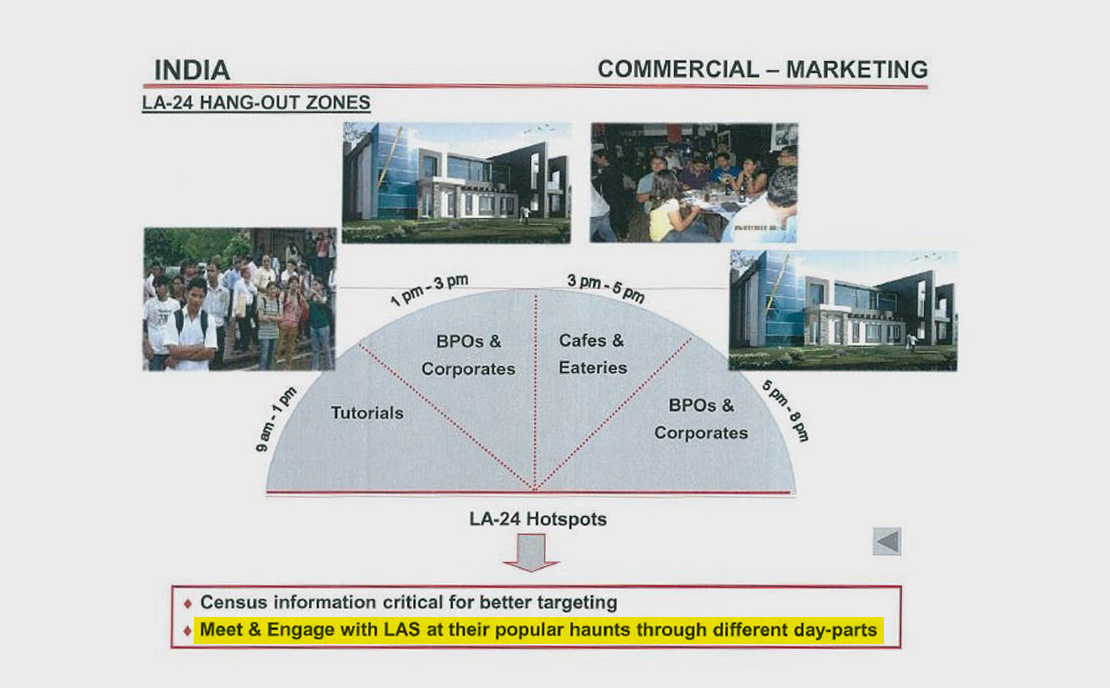
In internal documents, Philip Morris International is explicit about targeting the country’s youth. A key goal is “winning the hearts and minds of LA-24,” those between legal age, 18, and 24, according to one slide in a 2015 commercial review presentation.
As with the point-of-sale ads at kiosks, public health officials say that giving away cigarettes is a violation of India’s Cigarettes and Other Tobacco Products Act and its accompanying rules.
Philip Morris’ marketing strategy for India, which relies heavily on kiosk advertising and social events, is laid out in hundreds of pages of internal documents reviewed by Reuters that cover the period from 2009 to 2016. In them, Philip Morris presents these promotions as key marketing activities. In recent years, they have helped to more than quadruple Marlboro’s market share in India, where the company is battling to expand its reach in the face of an entrenched local giant. Reuters is publishing a selection of those documents in a searchable repository, The Philip Morris Files.
The company’s goal is to make sure that “every adult Indian smoker should be able to buy Marlboro within walking distance,” according to another 2015 strategy document.
In targeting young adults, Philip Morris is deploying a promotional strategy that it and other tobacco companies used in the United States decades ago. A study published in the American Journal of Public Health in 2002 found that during the 1990s, “tobacco industry sponsorship of bars and nightclubs increased dramatically, accompanied by cigarette brand paraphernalia, advertisements, and entertainment events in bars and clubs.”
With cigarette sales declining in many countries, Philip Morris has identified India, population 1.3 billion, as a market with opportunity for significant growth. “India remains a high potential market with huge upside with cigarette market still in infancy,” says a 2014 internal document.
According to government data, India has about 100 million smokers. Of those, about two-thirds smoke traditional hand-rolled cigarettes. Tobacco use kills more than 900,000 people a year in India, and the World Health Organization estimates that tobacco-related diseases cost the country about $16 billion annually.
Philip Morris is not alone in using marketing methods that Indian officials say are illegal. The country’s largest cigarette maker, ITC Ltd, uses similar tactics, such as advertising at kiosks. British American Tobacco Plc and Indian state-run companies have large, passive stakes in ITC, which controls about 80 percent of the market.
Tobacco-control officer Arora, a short, mustachioed man with a gruff demeanor, sent a letter to Philip Morris and other tobacco companies in mid-April, giving them until the end of the month to remove all advertisements. “Legal action will be initiated against the company” if it did not comply, he wrote in the letters, copies of which were reviewed by Reuters.
A day after Arora’s deadline passed, he and his team conducted a raid in an affluent area of cafes and coffee shops in New Delhi that showed his letters did not have the desired effect.
On that hot afternoon in May, the team cut down about a dozen advertisements for Marlboro and various ITC brands. As word of the raid spread, worried vendors covered their ads with newspapers or took them down.
One kiosk owner, Rakesh Kumar Jain, removed his Marlboro ads before Arora’s team arrived. Jain said the signs had been put up by Philip Morris representatives. In return, he said, he received free cigarettes each month worth about 2,000 rupees (about $30). Jain knew that putting up the posters was illegal, but they helped improve sales, he said.
About a dozen kiosk owners interviewed by Reuters said that tobacco companies paid them a monthly fee for advertisements and product displays, with the amount determined by factors such as location, volume of business and type of promotional material.
In payment receipts seen by Reuters, Philip Morris’ India unit promised to pay 500 Indian rupees ($7.50) a month to a cigarette seller with a small roadside kiosk in New Delhi for putting up Marlboro ads. The receipts were signed by a company representative.
During the raid, fines were issued to some vendors, many of them repeat offenders, and they were threatened with court action if the ads went up again.
Like Philip Morris, ITC says that it is in full compliance with India’s 2003 tobacco control law. If it wasn’t, the company said in a statement to Reuters, then “the relevant government authorities would have initiated action.”
Since Arora’s threat of legal action in April, there are fewer Philip Morris advertisements outside cigarette shops in the capital. But both Philip Morris and ITC say that advertising inside a shop is allowed.
“Advertisements of tobacco products at the entrance and inside the shops selling tobacco products are clearly and categorically permitted,” ITC said in response to questions from Reuters.
Arora, however, said all advertising is prohibited – “There are no two ways about it,” he insisted – but he can’t start legal proceedings until getting further guidance from the federal government. He has yet to receive an answer.
Federal health officials say in interviews that the ads are out of bounds. Amal Pusp, a director for tobacco control at the health ministry, told Reuters that “there is no confusion”: All advertisements – inside and outside shops – are illegal.
The 2003 law allows tobacco companies to advertise at shops, but subsequent rules issued by the government prohibit it.
“India remains a high potential market with huge upside with cigarette market still in infancy.”
From a 2014 internal Philip Morris document
In 2004, India became one of the first countries to ratify the World Health Organization’s Framework Convention on Tobacco Control (FCTC) treaty. The pact has 181 members and contains a raft of anti-smoking provisions, including tobacco taxes, warning labels on cigarette packs and advertising bans. The country enacted its national tobacco control law the year before ratifying the FCTC, and since then the government has added rules to strengthen the law in line with the treaty’s provisions.
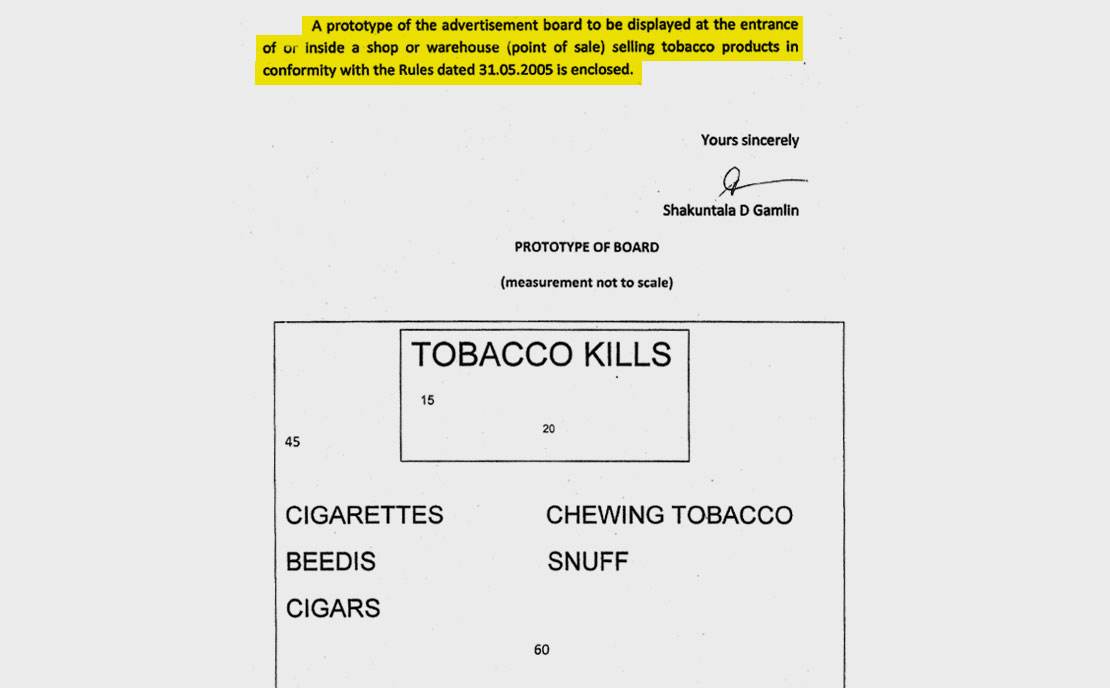
The health ministry published rules in 2005 that banned any display of brand names, pack images or promotional messages. The rule specified that tobacco retailers could only display a 60-by-45 centimeter board, roughly 24 by 18 inches. The sign can have a description of the type of tobacco products sold – such as cigarettes or chewing tobacco – but cannot include any brand advertising and must carry a large health warning.
The health ministry’s rules were challenged in court by a group of cigarette distributors and put on hold by a state-level High Court for seven years. They finally came into force in 2013 on orders of India’s Supreme Court.
The High Court had overlooked the fact that advertisement of tobacco products “will attract younger generation and innocent minds, who are not aware of grave and adverse consequences of consuming such products,” the Supreme Court said in its ruling.
Philip Morris has lobbied against the passing of stricter tobacco control rules by the Indian government. In documents detailing the company’s plans for the biennial FCTC treaty convention in India last November, Prime Minister Narendra Modi emerges as a prime target. A key goal: to pre-empt Modi from taking “extreme anti-tobacco measures” before delegates were to gather from around the world for the treaty meeting, according to a 2014 corporate affairs PowerPoint presentation.
Excerpts from the Philip Morris Files
Reuters reviewed hundreds of pages of internal Philip Morris International documents relating to India. These excerpts show the company’s marketing and lobbying tactics, which are aimed at bolstering the Marlboro brand among young adults and blocking the “enactment of extreme anti-tobacco measures.” Letters from Indian officials detail the government’s efforts to enforce the country’s tobacco control regulations. (Some documents include highlighting by Reuters.)

A slide from a Philip Morris training manual shows the kinds of people the company aims to target for Marlboro sales in India. LAS = legal age smokers.

A slide from a 2014 strategy presentation shows Philip Morris’ goals for marketing Marlboro Red in India. LA-24 = legal age to 24-year-old smokers.

This slide from a 2012 marketing presentation shows where Philip Morris planned to target 18-to-24-year-old smokers in India.

A Philip Morris training manual lays out rules for how those marketing its cigarettes should look. FWP = field work personnel.

Another slide from the Philip Morris training manual includes instructions for company representatives handing out free cigarettes at kiosks as part of brand promotion. (IPM = India Philip Morris; GPI = Godfrey Phillips India; POS = point of sale.)

Kiosk owners in Delhi say that Philip Morris pays them a monthly fee to put up its advertisements. Names have been redacted on this Philip Morris receipt.

Keshav Desiraju, then a senior health ministry official, wrote to state governments in January 2013, instructing them to stop all tobacco advertisements.

In April, S.K. Arora, the chief tobacco control officer in Delhi, warned Philip Morris International in a letter that it could face legal action over its advertising.

An excerpt from a 2013 letter from a health ministry official to state governments shows specifications for the board that can be displayed at shops selling tobacco products. According to Indian law, the board cannot include any brand names. Beedis are traditional hand-rolled cigarettes.

Ahead of the World Health Organization’s global tobacco control treaty meeting in India last November, Philip Morris planned to engage Prime Minister Narendra Modi in an effort to head off new anti-tobacco measures. The slide is from a 2014 corporate affairs document. CoP7 = Conference of the Parties, the biennial treaty meeting.
The company planned to gain Modi’s ear through those close to him. It identified several people in this group, including Commerce Minister Nirmala Sitharaman, Health Minister Jagat Prakash Nadda, and Amit Shah, president of the ruling Bharatiya Janata Party.
Modi and the other politicians didn’t respond to requests for comment. Philip Morris International also didn’t comment on the plan.
The tobacco giant’s efforts to fend off anti-smoking steps have had limited impact so far. Last year, for instance, India ordered manufacturers to cover 85 percent of the surface of cigarette packs with health warnings, up from 20 percent. The rule, which is still being challenged in a state court by the tobacco industry, including Philip Morris’ India partner, was implemented by order of the Supreme Court.
Marlboro has just a 1.4 percent share of the almost $10 billion cigarette market in India. The industry is dominated by ITC, which has a strong grip on distributors and retailers.
One major method Philip Morris is deploying to gain ground, the marketing documents show, is the free distribution of cigarettes at bars and nightclubs – known as Legal Age Meeting Points, or LAMPs, in company jargon. The hiring of young women and men to work at these gatherings is outsourced to event management companies, according to people with knowledge of the gatherings.
Some of the recruiting takes place online. “Hey girls…We are searching A++ Hot & Gorgeous girls for the Marlboro pub activity…Pay: 2000/day…Work: Promotion in clubs in Delhi,” read one post on a Facebook public group in June last year. There was no company name attached to the ad.
At several parties attended by Reuters in Delhi and Mumbai, young women dressed in the colors of the latest Marlboro variant handed out packs of cigarettes. During one party at a nightclub in a Delhi hotel, a young woman walked around with a tablet showing an ad that highlighted Marlboro features. A television screen played a video promoting the brand: “For trendsetters, for forward thinkers, a smooth and balanced smoking experience.”
In many ways, it was right out of the Philip Morris 1990s playbook. The American Journal of Public Health study, drawing on previously secret industry documents, found that Philip Morris ran bar promotions in 1990 using racing jackets, and added “neon message boards and cocktail trays” in 1991. The study described methods for collecting names for a company database “to generate smoker profiles, direct mailing campaigns, and conduct telephone research studies after the bar events.”
At the parties in India, people who took the Marlboro packs were asked their names, ages and preferred brands. Philip Morris calls this distribution of free cigarettes “sampling,” which it says in an internal document is allowed under the law.
The company has spent millions of dollars on these activities. In 2014, for example, Philip Morris estimated it spent $1.6 million on LAMP events and sampling at kiosks in India, according to the 2015 commercial review presentation.
The company planned to use LAMPs in 2015 to generate 30,000 “trials,” or samplings of cigarettes. And it planned to generate another 500,000 trials that year through sampling at cigarette shops and kiosks, according to the 2015 strategy document.
The company instructs employees to watch their words. An undated training manual for market researchers says: “Do not say this is a ‘PROMOTION’ or ‘ADVERTISING’.”
Indian health ministry officials say that anyone who hands out free cigarettes, whatever the circumstances, is breaking the law.
The Health Ministry’s Amal Pusp says the law against distribution of free cigarettes is unambiguous. He cites Section 5 of the country’s tobacco control act, which says: “No person, shall, under a contract or otherwise promote or agree to promote the use or consumption of” cigarettes or any other tobacco product. The law carries a fine of up to 1,000 rupees (about $15) and a sentence of up to two years in prison for a first conviction.
“We believe we market our products in a responsible manner, and in compliance with Indian regulations,” Philip Morris’ Venkatesh said, without elaborating.
In October last year, the month before India was due to host delegations from around the world at the biennial FCTC tobacco control conference in Delhi, tobacco-control officer Arora said he suddenly started getting traction.
The cigarette ads vanished and Delhi was “cleaned,” he said.
That success couldn’t have come at a better time for Arora and his colleagues at the federal health ministry: They wanted to make sure foreign delegates visiting India saw the country was serious about its tobacco regulations.
Weeks after the FCTC delegates left town in November, however, kiosks in the capital were again displaying ads for Marlboro.

STOREFRONT ADS: Marlboro advertisements can be seen on this kiosk in a marketplace in New Delhi in April. Despite warnings from health officials, Philip Morris has continued to advertise its Marlboro cigarettes. REUTERS/Adnan Abidi
Additional reporting by Aditi Shah in New Delhi, and Abhirup Roy and Swati Bhat in Mumbai.
The Philip Morris Files
By Aditya Kalra, Paritosh Bansal, Tom Lasseter and Duff Wilson
Design: Troy Dunkley
Photo Editing: Tom White and Altaf Bhat
Edited by Peter Hirschberg