Clear The Air News Tobacco Blog Rotating Header Image

Raise tax on tobacco and make smokers pay for health costs

I support Gauri Venkitaraman’s plea for bans in public areas where the permeation of cigarette smoke is harmful for passers-by or those trying to enjoy the outdoors (“Smoking in public leaves even non-smokers in Hong Kong facing serious health risks [1]”, July 11).

Non-smokers in proximity risk having their asthma flare up. Curious toddlers could become poisoned by ingesting carelessly discarded butts.

The fire contagion risk posed by still-burning cigarette ends is well known during the height of Australia’s bush-fire-prone sizzling summer and hot summers elsewhere.

Less smoking means fewer discarded butts posing a fire hazard. Another reason to impose smoking bans is to prevent adverse lifestyle role modelling for impressionable children.

From a public health perspective, raising tobacco sales tax is likely to reduce daily cigarette consumption and, more importantly, dissuade adolescents from taking up smoking. The cost disincentive of a higher tax holds the potential to improve the community burden of heart and lung disease that consumes avoidable health-care outlays.

It’s about time smokers who adopt unhealthy life habits subsidised the huge expense incurred in treating the acute exacerbation of chronic lung disease, pulmonary community rehabilitation as well as stents and bypass surgery required to alleviate coronary artery disease. Smokers have an addiction requiring an external agency to help them give up.

Imposing higher taxes on fast food and alcohol offers opportunities to improve public health related to “diabesity” (diabetes plus obesity), alcohol-related trauma and interpersonal violence. If we can extend sales tax disincentives to fast food and alcohol, then claims that a tobacco tax discriminates against smokers cannot be justified.

Joseph Ting, associate professor, School of Public Health and

Social Work, University of Queensland, Brisbane, Australia
________________________________________
Source URL: http://www.scmp.com/comment/letters/article/2103457/raise-tax-tobacco-and-make-smokers-pay-health-costs

Taxation: Most effective but still the least-used tobacco control measure

source: Infographic: Stop Smoking: It's Deadly and Bad for the Economy

source: Infographic: Stop Smoking: It’s Deadly and Bad for the Economy

A new report by the World Health Organization (WHO) shares some good news: Six in 10 people worldwide are now protected by at least one of the WHO Framework Convention on Tobacco Control (FCTC)-recommended demand reduction measures, including taxation. The report, launched on the sidelines of the UN high-level political forum on sustainable development, also makes clear that raising taxes to increase tobacco product prices is the most cost-effective means to reduce tobacco use and prevent initiation among the youth. But it is still one of the least used tobacco control measures.

https://blogs.worldbank.org/health/taxation-most-effective-still-least-used-tobacco-control-measure

The facts about this global public health scourge are undisputable:

  • Tobacco use is the leading single preventable cause of death worldwide, killing over 7 million people each year.
  • Cigarettes are addictive by design, and smoking cigarettes can damage every part of the body, causing different cancers from the head or neck to the lungs and cervix and other chronic conditions such as stroke and heart disease, which lead to early death.
  • The direct and indirect economic costs are also enormous, totaling more than US$1.4 trillion.
  • Controlling tobacco use is critical for the achievement of the health and social and economic targets in the 2030 Agenda for Sustainable Development.

But we know what needs to be done and governments are acting. Governments are implementing “MPOWER”, six tobacco control measures in line with the WHO Framework Convention on Tobacco Control (FCTC). MPOWER includes:

  • Monitoring tobacco use and prevention policies;
  • Protecting people from tobacco smoke;
  • Offering help to quit tobacco use;
  • Warning about the dangers of tobacco;
  • Enforcing bans on tobacco advertising, promotion and sponsorship; and
  • Raising tobacco taxes.

The WHO report indicates that 43% of the world’s population (3.2 billion people) are now covered by two or more MPOWER measures at the highest level, nearly seven times the number covered in 2007. Eight countries, including five low- and middle-income ones, have implemented four or more MPOWER measures at the highest level: Brazil, Islamic Republic of Iran, Ireland, Madagascar, Malta, Panama, Turkey, and the United Kingdom of Great Britain and Northern Ireland.

Some additional findings are noteworthy:

  • Monitoring: Several countries, such as Nepal, India, and the Philippines, that conducted WHO-backed initiatives to monitor tobacco use have used the information to adopt measures to protect people from tobacco use. For example, Philippines’ landmark Sin Tax Reform Law was passed in 2012 after its 2009 global adult tobacco survey showed high smoking rates among men (47.4%) and boys (12.9%). The implementation of this policy measure has contributed to declining tobacco use as evidenced by the country’s 2015 adult tobacco survey results.
  • Protect: Comprehensive smoke-free legislation is currently in place for almost 1.5 billion people in 55 countries. Dramatic progress has been witnessed in low- and middle-income countries, 35 of which have adopted these laws since 2007.
  • Offer: Appropriate cessation treatment is in place for 2.4 billion people in 26 countries.
  • Warn: More people are protected by strong graphic pack warnings than by any other MPOWER measure, covering almost 3.5 billion people in 78 countries – almost half (47%) the global population. And, 3.2 billion people live in a country that aired at least one comprehensive national anti-tobacco mass media campaign in the last two years.
  • Enforce: Bans on tobacco advertising, promotion, and sponsorship interfere with the tobacco industry’s ability to promote and sell its deadly products and reduce tobacco use. But only 15% of the world’s population is currently covered by a comprehensive ban.
  • Raise: Raising taxes to increase tobacco product prices is the most cost-effective measure to reduce tobacco use and encourage users to quit, but it is one of the least used tobacco control measures globally.

What the World Bank Group is doing

As an institution, the Bank has long been committed to tobacco control as reflected in its unambiguous Operational Directive 4.76 of 1999 that mandates that the World Bank Group does not lend directly or provide credits, grants, or guarantees for tobacco production, processing, or marketing. The Bank’s policy advice and technical assistance support tobacco tax increases to protect the population from health risks and to mobilize additional domestic resources.

Over the past two decades, Bank teams have carried out substantial analytical work to build the global knowledge base on issues related to tobacco control.

In recent years, the Bank, in partnership with the Gates and Bloomberg Foundations, and in coordination with WHO, has supported countries in the design of tobacco tax policy reforms to raise prices, reduce consumption, and mobilize domestic resources in accordance with the 2015 Financing for Development Addis Ababa Action Agenda.

In addition to support provided to the reforms in Philippines in 2012, in Botswana in 2013, in Ghana in 2014, and in Peru in 2015, the Bank’s assistance to Armenia, Colombia, Moldova, and Ukraine contributed to the adoption of significant tobacco tax increases in 2016. The total population covered by these policy actions is about 250 million people.

Ongoing support is being provided in 2017 to an additional set of countries across regions, including Montenegro, where the government recently announced that tobacco taxes will be increased over the next 3 years in line with the European Union Tobacco Tax Directive’s target rates, and in Lesotho, as part of the 2017 budget presented by the new government to Parliament.

In moving the global tobacco control agenda forward, as the findings of the 2017 WHO report suggest, a dedicated focus by governments with support of the international community is required to raise tobacco taxes since it continues to be the least used tobacco control measure. This is of critical importance to make these deadly products unaffordable, reduce consumption among current smokers, and prevent smoking initiation among children and youth.

While health is the main objective, we also need to argue, on the basis of country evidence from across the world, that raising tobacco taxes can generate a significant fiscal benefit by helping to expand a country’s tax base and increase the budgetary capacity of governments to fund priority investments and programs that benefit the entire population.

Philip Morris takes aim at young people in India, and health officials are fuming

The tobacco giant is pushing Marlboros in colorful ads at kiosks and handing out free smokes at parties frequented by young adults – tactics that break India’s anti-smoking laws, government officials say. Internal documents uncovered by Reuters illuminate the strategy.

http://www.reuters.com/investigates/special-report/pmi-india/

S. K. Arora spent more than three years trudging through the Indian summer heat and monsoon rains to inspect tobacco kiosks across this sprawling megacity, tearing down cigarette advertisements and handing out fines to store owners for putting them up.

But as fast as he removed the colorful ads, more appeared.

The chief tobacco control officer at the Delhi state government, Arora asked the major cigarette companies to put a stop to the cat-and-mouse routine. In official letters and face-to-face meetings, he told them India’s tobacco control laws barred such public advertising and promotion of cigarettes.

That included the Indian arm of Philip Morris International Inc, the world’s largest publicly traded tobacco company. Early last year, Arora said, he met with a Philip Morris director for corporate affairs in India, a man named R. Venkatesh, and told him the signs were an unequivocal violation of Indian law.

Like other tobacco companies, Philip Morris kept up its ad blitz.

Venkatesh says Philip Morris is doing nothing wrong. In response to questions from Reuters, he said the company’s advertising is “compliant with Indian law” and that Philip Morris has “fully cooperated with the enforcement authorities” on the matter.

But Indian government officials say Philip Morris is using methods that flout the nation’s tobacco-control regulations. These include tobacco shop displays as well as the free distribution of Marlboro – the world’s best-selling cigarette brand – at nightclubs and bars frequented by young people.

In internal documents, Philip Morris International is explicit about targeting the country’s youth. A key goal is “winning the hearts and minds of LA-24,” those between legal age, 18, and 24, according to one slide in a 2015 commercial review presentation.

As with the point-of-sale ads at kiosks, public health officials say that giving away cigarettes is a violation of India’s Cigarettes and Other Tobacco Products Act and its accompanying rules.

Philip Morris’ marketing strategy for India, which relies heavily on kiosk advertising and social events, is laid out in hundreds of pages of internal documents reviewed by Reuters that cover the period from 2009 to 2016. In them, Philip Morris presents these promotions as key marketing activities. In recent years, they have helped to more than quadruple Marlboro’s market share in India, where the company is battling to expand its reach in the face of an entrenched local giant. Reuters is publishing a selection of those documents in a searchable repository, The Philip Morris Files.

The company’s goal is to make sure that “every adult Indian smoker should be able to buy Marlboro within walking distance,” according to another 2015 strategy document.

In targeting young adults, Philip Morris is deploying a promotional strategy that it and other tobacco companies used in the United States decades ago. A study published in the American Journal of Public Health in 2002 found that during the 1990s, “tobacco industry sponsorship of bars and nightclubs increased dramatically, accompanied by cigarette brand paraphernalia, advertisements, and entertainment events in bars and clubs.”

With cigarette sales declining in many countries, Philip Morris has identified India, population 1.3 billion, as a market with opportunity for significant growth. “India remains a high potential market with huge upside with cigarette market still in infancy,” says a 2014 internal document.

According to government data, India has about 100 million smokers. Of those, about two-thirds smoke traditional hand-rolled cigarettes. Tobacco use kills more than 900,000 people a year in India, and the World Health Organization estimates that tobacco-related diseases cost the country about $16 billion annually.

Philip Morris is not alone in using marketing methods that Indian officials say are illegal. The country’s largest cigarette maker, ITC Ltd, uses similar tactics, such as advertising at kiosks. British American Tobacco Plc and Indian state-run companies have large, passive stakes in ITC, which controls about 80 percent of the market.

Tobacco-control officer Arora, a short, mustachioed man with a gruff demeanor, sent a letter to Philip Morris and other tobacco companies in mid-April, giving them until the end of the month to remove all advertisements. “Legal action will be initiated against the company” if it did not comply, he wrote in the letters, copies of which were reviewed by Reuters.

A day after Arora’s deadline passed, he and his team conducted a raid in an affluent area of cafes and coffee shops in New Delhi that showed his letters did not have the desired effect.

On that hot afternoon in May, the team cut down about a dozen advertisements for Marlboro and various ITC brands. As word of the raid spread, worried vendors covered their ads with newspapers or took them down.

One kiosk owner, Rakesh Kumar Jain, removed his Marlboro ads before Arora’s team arrived. Jain said the signs had been put up by Philip Morris representatives. In return, he said, he received free cigarettes each month worth about 2,000 rupees (about $30). Jain knew that putting up the posters was illegal, but they helped improve sales, he said.

About a dozen kiosk owners interviewed by Reuters said that tobacco companies paid them a monthly fee for advertisements and product displays, with the amount determined by factors such as location, volume of business and type of promotional material.

In payment receipts seen by Reuters, Philip Morris’ India unit promised to pay 500 Indian rupees ($7.50) a month to a cigarette seller with a small roadside kiosk in New Delhi for putting up Marlboro ads. The receipts were signed by a company representative.

During the raid, fines were issued to some vendors, many of them repeat offenders, and they were threatened with court action if the ads went up again.

Like Philip Morris, ITC says that it is in full compliance with India’s 2003 tobacco control law. If it wasn’t, the company said in a statement to Reuters, then “the relevant government authorities would have initiated action.”

Since Arora’s threat of legal action in April, there are fewer Philip Morris advertisements outside cigarette shops in the capital. But both Philip Morris and ITC say that advertising inside a shop is allowed.

“Advertisements of tobacco products at the entrance and inside the shops selling tobacco products are clearly and categorically permitted,” ITC said in response to questions from Reuters.

Arora, however, said all advertising is prohibited – “There are no two ways about it,” he insisted – but he can’t start legal proceedings until getting further guidance from the federal government. He has yet to receive an answer.

Federal health officials say in interviews that the ads are out of bounds. Amal Pusp, a director for tobacco control at the health ministry, told Reuters that “there is no confusion”: All advertisements – inside and outside shops – are illegal.

The 2003 law allows tobacco companies to advertise at shops, but subsequent rules issued by the government prohibit it.

“India remains a high potential market with huge upside with cigarette market still in infancy.”

From a 2014 internal Philip Morris document

In 2004, India became one of the first countries to ratify the World Health Organization’s Framework Convention on Tobacco Control (FCTC) treaty. The pact has 181 members and contains a raft of anti-smoking provisions, including tobacco taxes, warning labels on cigarette packs and advertising bans. The country enacted its national tobacco control law the year before ratifying the FCTC, and since then the government has added rules to strengthen the law in line with the treaty’s provisions.

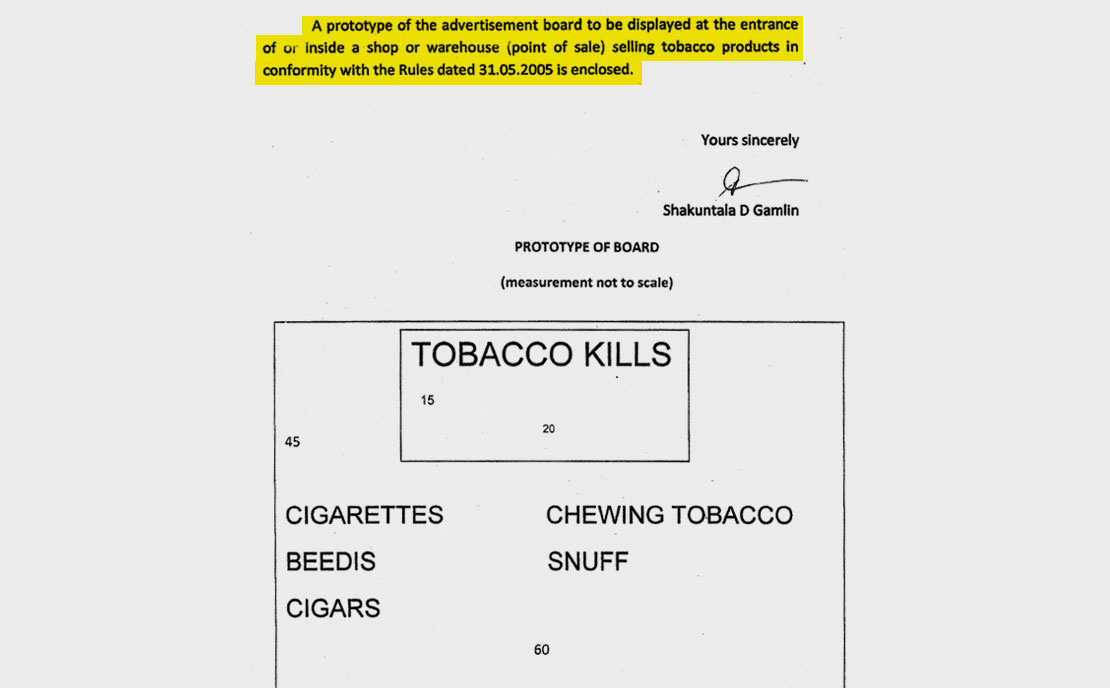
The health ministry published rules in 2005 that banned any display of brand names, pack images or promotional messages. The rule specified that tobacco retailers could only display a 60-by-45 centimeter board, roughly 24 by 18 inches. The sign can have a description of the type of tobacco products sold – such as cigarettes or chewing tobacco – but cannot include any brand advertising and must carry a large health warning.

The health ministry’s rules were challenged in court by a group of cigarette distributors and put on hold by a state-level High Court for seven years. They finally came into force in 2013 on orders of India’s Supreme Court.

The High Court had overlooked the fact that advertisement of tobacco products “will attract younger generation and innocent minds, who are not aware of grave and adverse consequences of consuming such products,” the Supreme Court said in its ruling.

Philip Morris has lobbied against the passing of stricter tobacco control rules by the Indian government. In documents detailing the company’s plans for the biennial FCTC treaty convention in India last November, Prime Minister Narendra Modi emerges as a prime target. A key goal: to pre-empt Modi from taking “extreme anti-tobacco measures” before delegates were to gather from around the world for the treaty meeting, according to a 2014 corporate affairs PowerPoint presentation.

Excerpts from the Philip Morris Files

Reuters reviewed hundreds of pages of internal Philip Morris International documents relating to India. These excerpts show the company’s marketing and lobbying tactics, which are aimed at bolstering the Marlboro brand among young adults and blocking the “enactment of extreme anti-tobacco measures.” Letters from Indian officials detail the government’s efforts to enforce the country’s tobacco control regulations. (Some documents include highlighting by Reuters.)

A slide from a Philip Morris training manual shows the kinds of people the company aims to target for Marlboro sales in India. LAS = legal age smokers.

A slide from a Philip Morris training manual shows the kinds of people the company aims to target for Marlboro sales in India. LAS = legal age smokers.

A slide from a 2014 strategy presentation shows Philip Morris’ goals for marketing Marlboro Red in India. LA-24 = legal age to 24-year-old smokers.

A slide from a 2014 strategy presentation shows Philip Morris’ goals for marketing Marlboro Red in India. LA-24 = legal age to 24-year-old smokers.

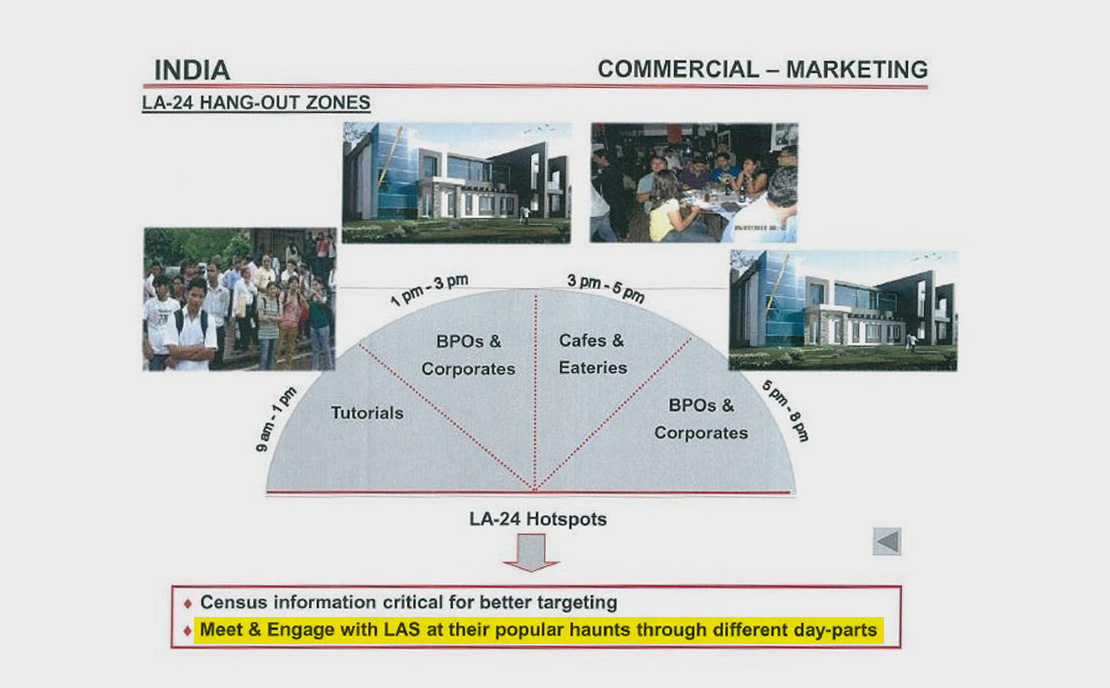
This slide from a 2012 marketing presentation shows where Philip Morris planned to target 18-to-24-year-old smokers in India.

This slide from a 2012 marketing presentation shows where Philip Morris planned to target 18-to-24-year-old smokers in India.

A Philip Morris training manual lays out rules for how those marketing its cigarettes should look. FWP = field work personnel.

A Philip Morris training manual lays out rules for how those marketing its cigarettes should look. FWP = field work personnel.

Another slide from the Philip Morris training manual includes instructions for company representatives handing out free cigarettes at kiosks as part of brand promotion. (IPM = India Philip Morris; GPI = Godfrey Phillips India; POS = point of sale.)

Another slide from the Philip Morris training manual includes instructions for company representatives handing out free cigarettes at kiosks as part of brand promotion. (IPM = India Philip Morris; GPI = Godfrey Phillips India; POS = point of sale.)

Kiosk owners in Delhi say that Philip Morris pays them a monthly fee to put up its advertisements. Names have been redacted on this Philip Morris receipt.

Kiosk owners in Delhi say that Philip Morris pays them a monthly fee to put up its advertisements. Names have been redacted on this Philip Morris receipt.

Keshav Desiraju, then a senior health ministry official, wrote to state governments in January 2013, instructing them to stop all tobacco advertisements.

Keshav Desiraju, then a senior health ministry official, wrote to state governments in January 2013, instructing them to stop all tobacco advertisements.

 In April, S.K. Arora, the chief tobacco control officer in Delhi, warned Philip Morris International in a letter that it could face legal action over its advertising.

In April, S.K. Arora, the chief tobacco control officer in Delhi, warned Philip Morris International in a letter that it could face legal action over its advertising.

An excerpt from a 2013 letter from a health ministry official to state governments shows specifications for the board that can be displayed at shops selling tobacco products. According to Indian law, the board cannot include any brand names. Beedis are traditional hand-rolled cigarettes.

An excerpt from a 2013 letter from a health ministry official to state governments shows specifications for the board that can be displayed at shops selling tobacco products. According to Indian law, the board cannot include any brand names. Beedis are traditional hand-rolled cigarettes.

Ahead of the World Health Organization’s global tobacco control treaty meeting in India last November, Philip Morris planned to engage Prime Minister Narendra Modi in an effort to head off new anti-tobacco measures. The slide is from a 2014 corporate affairs document. CoP7 = Conference of the Parties, the biennial treaty meeting.

Ahead of the World Health Organization’s global tobacco control treaty meeting in India last November, Philip Morris planned to engage Prime Minister Narendra Modi in an effort to head off new anti-tobacco measures. The slide is from a 2014 corporate affairs document. CoP7 = Conference of the Parties, the biennial treaty meeting.

The company planned to gain Modi’s ear through those close to him. It identified several people in this group, including Commerce Minister Nirmala Sitharaman, Health Minister Jagat Prakash Nadda, and Amit Shah, president of the ruling Bharatiya Janata Party.

Modi and the other politicians didn’t respond to requests for comment. Philip Morris International also didn’t comment on the plan.

The tobacco giant’s efforts to fend off anti-smoking steps have had limited impact so far. Last year, for instance, India ordered manufacturers to cover 85 percent of the surface of cigarette packs with health warnings, up from 20 percent. The rule, which is still being challenged in a state court by the tobacco industry, including Philip Morris’ India partner, was implemented by order of the Supreme Court.

Marlboro has just a 1.4 percent share of the almost $10 billion cigarette market in India. The industry is dominated by ITC, which has a strong grip on distributors and retailers.

One major method Philip Morris is deploying to gain ground, the marketing documents show, is the free distribution of cigarettes at bars and nightclubs – known as Legal Age Meeting Points, or LAMPs, in company jargon. The hiring of young women and men to work at these gatherings is outsourced to event management companies, according to people with knowledge of the gatherings.

Some of the recruiting takes place online. “Hey girls…We are searching A++ Hot & Gorgeous girls for the Marlboro pub activity…Pay: 2000/day…Work: Promotion in clubs in Delhi,” read one post on a Facebook public group in June last year. There was no company name attached to the ad.

At several parties attended by Reuters in Delhi and Mumbai, young women dressed in the colors of the latest Marlboro variant handed out packs of cigarettes. During one party at a nightclub in a Delhi hotel, a young woman walked around with a tablet showing an ad that highlighted Marlboro features. A television screen played a video promoting the brand: “For trendsetters, for forward thinkers, a smooth and balanced smoking experience.”

In many ways, it was right out of the Philip Morris 1990s playbook. The American Journal of Public Health study, drawing on previously secret industry documents, found that Philip Morris ran bar promotions in 1990 using racing jackets, and added “neon message boards and cocktail trays” in 1991. The study described methods for collecting names for a company database “to generate smoker profiles, direct mailing campaigns, and conduct telephone research studies after the bar events.”

At the parties in India, people who took the Marlboro packs were asked their names, ages and preferred brands. Philip Morris calls this distribution of free cigarettes “sampling,” which it says in an internal document is allowed under the law.

The company has spent millions of dollars on these activities. In 2014, for example, Philip Morris estimated it spent $1.6 million on LAMP events and sampling at kiosks in India, according to the 2015 commercial review presentation.

The company planned to use LAMPs in 2015 to generate 30,000 “trials,” or samplings of cigarettes. And it planned to generate another 500,000 trials that year through sampling at cigarette shops and kiosks, according to the 2015 strategy document.

The company instructs employees to watch their words. An undated training manual for market researchers says: “Do not say this is a ‘PROMOTION’ or ‘ADVERTISING’.”

Indian health ministry officials say that anyone who hands out free cigarettes, whatever the circumstances, is breaking the law.

The Health Ministry’s Amal Pusp says the law against distribution of free cigarettes is unambiguous. He cites Section 5 of the country’s tobacco control act, which says: “No person, shall, under a contract or otherwise promote or agree to promote the use or consumption of” cigarettes or any other tobacco product. The law carries a fine of up to 1,000 rupees (about $15) and a sentence of up to two years in prison for a first conviction.

“We believe we market our products in a responsible manner, and in compliance with Indian regulations,” Philip Morris’ Venkatesh said, without elaborating.

In October last year, the month before India was due to host delegations from around the world at the biennial FCTC tobacco control conference in Delhi, tobacco-control officer Arora said he suddenly started getting traction.

The cigarette ads vanished and Delhi was “cleaned,” he said.

That success couldn’t have come at a better time for Arora and his colleagues at the federal health ministry: They wanted to make sure foreign delegates visiting India saw the country was serious about its tobacco regulations.

Weeks after the FCTC delegates left town in November, however, kiosks in the capital were again displaying ads for Marlboro.

STOREFRONT ADS: Marlboro advertisements can be seen on this kiosk in a marketplace in New Delhi in April. Despite warnings from health officials, Philip Morris has continued to advertise its Marlboro cigarettes. REUTERS/Adnan Abidi

STOREFRONT ADS: Marlboro advertisements can be seen on this kiosk in a marketplace in New Delhi in April. Despite warnings from health officials, Philip Morris has continued to advertise its Marlboro cigarettes. REUTERS/Adnan Abidi

Additional reporting by Aditi Shah in New Delhi, and Abhirup Roy and Swati Bhat in Mumbai.

The Philip Morris Files
By Aditya Kalra, Paritosh Bansal, Tom Lasseter and Duff Wilson
Design: Troy Dunkley
Photo Editing: Tom White and Altaf Bhat
Edited by Peter Hirschberg

Big tobacco bullies the global south. Trade deals are their biggest weapon

The industry has a long history of using trade to force their products into new markets. This has led to at least a 5% increase in cigarette deaths

https://www.theguardian.com/commentisfree/2017/jul/17/big-tobacco-trade-deals-new-markets-bat

Cigarette packets often carry the warning to “protect children: don’t make them breathe your smoke”. In 2014, the Kenyan government attempted to do just that – banning the sale of single cigarettes, banning smoking in vehicles with a child and keeping the tobacco industry out of initiatives aimed at children and young people.

But as the Guardian reported last week, British American Tobacco, in an effort to keep Kenyans breathing their smoke, fought the regulations on the grounds that they “constitute an unjustifiable barrier to international trade”.

In fact, big tobacco has a long history of using trade and investment rules to force their products on markets in the global south and attack laws and threaten lawmakers that attempt to control tobacco use.

Back in the 1980s, as cigarette consumption fell off in North America and western Europe, US trade officials worked aggressively to grant American companies access to markets in Asia, demanding not only the right to sell their products, but also the right to advertise, sponsor sports events and run free promotions. Smoking rates surged.

In the 1990s, World Trade Organisation agreements led to a liberalisation of the international tobacco trade, with countries reducing import tariffs on tobacco products. The impact, according to a joint study of the World Health Organisation and the World Bank, was a 5% increase in global cigarette consumption and accompanying mortality rates.

Big tobacco’s lawyers were quick to discover the value of “next generation” trade agreements. In the 1990s, Canada dropped a plain packaging initiative after US manufacturers threatened a suit using the first next-gen trade deal, the North American Free Trade Agreement (Nafta). A few years later, Philip Morris threatened Canada again after it prohibited terms such as “light” and “mild” cigarettes. Philip Morris argued it would be owed millions in compensation for damage to its brand identity.

Philip Morris was able to credibly wield this threat because of the extraordinary powers that Nafta grants international corporations: the right to sue governments in private tribunals over regulations that affect their profits.

A toxic combination of far-reaching and poorly defined “rights” for investors, eye-watering legal costs, and tribunals composed of corporate lawyers with the power to set limitless awards against governments makes investment arbitration and the modern “trade” agreement a formidable weapon to intimidate regulators.

And what big tobacco learned in the global north it has been replicating in the global south, where threats carry greater force against poorer countries that may lack the resources to see down a legal challenge.

In 2010, Philip Morris launched a $25m claim against Uruguay after it introduced graphic warnings on cigarette packs. Though Uruguay successfully defended the measure, it still faced millions in legal costs. And Philip Morris effectively won, as Costa Rica and Paraguay held off introducing similar measures.

Such are the fears around big tobacco’s aggressive use of trade and investment rules that the US-negotiated Trans-Pacific Partnership trade deal featured a carve-out excluding big tobacco from investment protections – an explicit admission of the problem.

But this does not go far enough. The important thing to realise is that the problem goes beyond big tobacco. Big oil, big pharma and big mining follow the same playbook, launching investment arbitration cases to defend their business models from governments that would regulate to protect public health, the local environment or the climate.

Rather than target individual companies or sectors, we must push our governments to reform trade and investment rules that grant such extraordinary powers to corporations. That means removing special investor rights and investment courts from trade agreements. It means removing limits on the freedom of governments to protect public health, labour and human rights and the environment.

Of course, this is easier said than done. Robert Lighthizer, US trade representative, served as deputy in a Reagan administration that pressured countries to open their tobacco markets to US exporters in the 1980s.

Vice-President Mike Pence’s record includes opposing smoking regulation, taking huge campaign donations from big tobacco, and denying the causal link between smoking and lung cancer. The EU commission, meanwhile, has been criticized for its meetings with big tobacco while it was negotiating EU-US trade talks.

The good news is that from Brazil to India to Ecuador, countries are stepping away from outdated trade and investment rules. In the UK, the Labour party manifesto opposes parallel courts for multinationals and proposes to review the UK’s investment treaties.

But until we scrap the powers that we grant big tobacco and others to frustrate and bypass our laws, efforts around the world to protect public health will continue to go up in smoke.

Ban on display of tobacco products to take effect on Aug 1 as grace period ends

After a one-year grace period, the ban on displaying cigarettes and other tobacco products in stores will take effect on Aug 1, the Ministry of Health (MOH) reminded in a news release on Tuesday (Jul 18).

http://www.channelnewsasia.com/news/singapore/ban-on-display-of-tobacco-products-to-take-effect-on-aug-1-as-9041262

Retailers must keep the tobacco products in plain, undecorated storage devices, and out of customers’ direct line of sight.

“Existing display cabinets can be modified to one that is permanently fixed, self-closing and opaque,” said the ministry. “Alternatively, new storage units that meet the same requirements can also be constructed.”

Laws to ban the display of tobacco products were passed in Parliament last March, under amendments to the Tobacco (Control of Advertisements and Sale) Bill. It is part of MOH’s efforts to discourage smoking, particularly among younger people in Singapore.

Under the regulations, the point of sale will remain fixed at the cashier, to reduce the accessibility of cigarettes to youths and non-smokers.

In addition, a text-only price list based on a template prescribed by MOH may be shown to customers only at their request.

Retailers convicted of flouting the ban face a maximum jail term of six months, a fine of up to S$10,000, or both. The penalties are double for repeat offenders.

ANTI-TOBACCO : THE PR DAUTZENBERG DENOUNCES THE ACTIONS OF BAT

After the revelations from Reuters about the methods of lobbying from Philip Morris International, it is the turn of British American Tobacco (BAT) to suffer the blowback of its business strategy. And it was Professor Bertrand Dautzenberg, pulmonologist at the Pitié-Salpêtrière hospital in paris and secretary general of the Alliance against tobacco, which denounces the strategy of BAT.

https://sivertimes.com/anti-tobacco-the-pr-dautzenberg-denounces-the-actions-of-bat/54893

In a message posted on Twitter and an article in the Figaro, he denounces the attempt to approach the world leader in tobacco, which has sent a registered letter inviting him to discuss ” new product to reduced harm “, to ” change the software regarding the fight against smoking “.

Disagreement on the substance…

Ploom Japan Tobacco, iQos, Philip Morris, Glo BAT : these new devices are the link between the cigarette and the electronic cigarette. They do not use combustion but still contain tobacco. An electrical resistance heater at a low temperature, which would, inter alia, to delete the inhalation of tar and carbon monoxide, according to the manufacturers.

A statement that the Pr Dautzenberg contests. “The industry we swear that this heated tobacco is less toxic than cigarette smoking, but this is not proven at all, and there must be a little bit of burning still, since they found traces of carbon monoxide in the fumes, he said in Le Figaro. Today, tobacco kills one of its faithful consumers. Even if the tobacco said to be less of a risk” not to kill that one in three or one in ten, or even one in a hundred, it’s still unacceptable. “

The doctor also points out that this type of reflection had been carried out on cigarettes light. A reflection at the time supported by a part of the medical community, before it can be recognized that the risk was ultimately the same. Cigarettes light favored only other cancers of the respiratory tract.

PRISON RIGHTS: SCOTLAND IS ABOUT TO BAN INMATES FROM SMOKING

Scotland is set to ban smoking in its prisons as part of a government drive to slash tobacco use—but an expert has warned it could mean a boom in smuggling, and a greater risk of violence.

http://www.newsweek.com/smoking-scotland-prison-ban-637586

Staff, visitors and contractors are already not allowed to smoke anywhere on Scottish Prison Service (SPS) property. But a 2015 survey found that 72 percent of prisoners smoked, more than three times the proportion of the general population who did so, the BBC reported.

The Scottish government aims at creating a “tobacco-free generation” by 2034. Smoking in enclosed public spaces has been barred since 2006, but prisons have remained an exception.

It aims to end smoking in its prisons by the end of 2018, citing the need to tackle the dangers of secondhand smoke.

Phil Fairlie, chairman of the Prison Officers’ Association Scotland, welcomes the news. “Our members have claimed and argued all along, since the smoking ban was introduced, that they are constantly exposed to very high levels of smoking inside prisons,” he told the BBC.

But stopping smoking in prisons is not without risks and problems.

Alex Cavendish, a former prisoner turned prison expert, tells Newsweek that the demand for contraband tobacco in smoke-free prisoners could lead to a vast black market.

In one prison in Dartmoor, England, which has tested a smoke-free environment, a pack of rolling tobacco could cost as much as £100, Cavendish said. The “huge price differential” between such rates inside the jail compared to shops outside where tobacco was relatively cheap and legal leads to “a temptation to corruption.” A prison officer from the Dartmoor jail was convicted of smuggling tobacco in May this year.

Such markets create new administrative pressures on staff as they become embroiled in a “cat-and-mouse game of trying to stop people doing what is lawful to do on the outside,” Cavendish said.

Black markets also can breed violence when prisoners are punished for not keeping up with debts. Cavendish added: “Prison is a very unforgiving place when it comes to nonpayment of debt.”

Colin McConnell, chief executive of the SPS, said: “This will be a significant challenge. The percentage of people who smoke in prisons is much higher than the community at large,” STV reported.

“I fully understand how difficult it will be for many in our care to give up smoking—that is why we are committed to working alongside our partners in the NHS to provide every support possible to assist them.”

Scottish Health Secretary Shona Robison said, “Smoking remains the biggest single cause of preventable ill-health and premature death in Scotland.

“We have taken wide-ranging action to address this, from our campaigns to take smoking right outside, to measures on tobacco advertising and packaging.

“I endorse this important step by SPS, which will contribute towards our ambition of creating a tobacco-free generation by 2034.”

Why Smoking in Films Harms Children

We want to believe we’re raising our kids to think for themselves, and not to do dumb or unhealthy things just because the cool kids are doing them.

https://www.nytimes.com/2017/07/17/well/family/why-smoking-in-films-harms-children.html

But research shows that when it comes to smoking, children are heavily influenced by some of the folks they consider the coolest of the cool: actors in movies.

“There’s a dose-response relationship: The more smoking kids see onscreen, the more likely they are to smoke,” said Dr. Stanton Glantz, a professor and director of the University of California, San Francisco, Center for Tobacco Control Research and Education. He is one of the authors of a new study that found that popular movies are showing more tobacco use onscreen.

“The evidence shows it’s the largest single stimulus,” for smoking, he said; “it overpowers good parental role modeling, it’s more powerful than peer influence or even cigarette advertising.”

He said that epidemiological studies have shown that if you control for all the other risk factors of smoking (whether parents smoke, attitudes toward risk taking, socioeconomic status, and so on), younger adolescents who are more heavily exposed to smoking on film are two to three times as likely to start smoking, compared with the kids who are more lightly exposed.

Those whose parents smoke are more likely to smoke, he said, but exposure to smoking in movies can overcome the benefit of having nonsmoking parents. In one study, the children of nonsmoking parents with heavy exposure to movie smoking were as likely to smoke as the children of smoking parents with heavy movie exposure.

To Dr. Glantz, and the other people who study this topic, that makes smoking in movies an “environmental toxin,” a factor endangering children.

“There’s no excuse for continuing to have smoking in movies that are rated to be sold to kids, and so the policy objective we have is there should be no smoking in movies that are rated for kids,” said Dr. Glantz, who maintains a website called Smoke Free Movies. “The studios have it in their power to fix this with a phone call.” The rating system needs to start treating smoking like a proscribed obscenity, he said; if it’s in the movie, the movie gets an R rating.

The Centers for Disease Control and Prevention’s fact sheet on smoking in the movies estimates that taking smoking out of films rated for children would save 18 percent of the 5.6 million young people alive today who will otherwise die of tobacco-related diseases – a million lives. “There’s nothing you could do that would be so cheap and save so many lives,” Dr. Glantz said.

This has been studied in 17 different countries, he said, and though policies vary widely and cultures are very different, the results are remarkably similar. “You consistently see this two to three times risk in kids who are exposed to a lot of onscreen smoking, all over the world.”

Five years ago, the people who worry about the impact on the young of seeing smoking in the movies thought things were looking good. In movies rated for a young audience (that is, G or PG or PG-13), there had been a steady drop in the number of “onscreen tobacco incidents.” Not only that, but in 2012, convinced by a heavy array of scientific evidence, the Surgeon General issued a report saying explicitly that seeing people smoke in movies caused kids to start smoking: “longitudinal studies have found that adolescents whose favorite movie stars smoke on screen or who are exposed to a large number of movies portraying smokers are at a high risk of smoking initiation.”

But after 2010, despite the accumulating evidence, the rate of cinematic smoking started to rise in those youth-rated movies, according to the new study, published this month in the C.D.C.’s Morbidity and Mortality Weekly Report, which looked at incidents of tobacco use in top-grossing movies from 2010 to 2016.

As far as movies rated G, PG, and PG-13, “When we compared 2010 to 2016, there was a slight decrease in the number of movies, but an increase in the number of incidents,” said Michael Tynan, a public health analyst in the office on smoking and health at the C.D.C., and the lead author of the new study. Dr. Glantz is also an author, and he and two of the four other authors have received grants from the Truth Initiative, an antismoking group.

The number of times that an actor used a tobacco product in a top-grossing movie “increased 72 percent among all movies and 43 percent among PG-13 movies,” Mr. Tynan said. In other words, he said, by 2016 there were “more tobacco incidents concentrated in fewer movies.”

One out of every four movies rated for youth today continues to feature tobacco use, Mr. Tynan said, “and we know this is harmful to youth and causes youth to start using tobacco.”

And the policies that the studios have in place, which seemed to be working as of 2012, are clearly not sufficient, Mr. Tynan said. “The frequency of tobacco use in PG-13 movies is a public health concern.” So what should be done? “One change is to rate movies with tobacco use with an R rating,” he suggested. Other steps that might help would be to have studios certify that there was no paid product placement, and to end the use of any actual tobacco brands on the screen. All of these strategies are supported by the American Academy of Pediatrics, which has issued a statement calling the new study “alarming.”

In a study done back in the ’90s, researchers pointed to some of the differences between who smokes on screen and who smokes in the real world. In the real world, smokers are likely to be “poor people, people with mental illness,” Dr. Glantz said. “If you look at the power players, the rich people, people who are in control, they’re not smoking.” But in movies, it tends to be more desirable or powerful characters, even if they’re the bad guys, and in that way, movie images may reinforce images in cigarette advertising.

And movie images are powerful. In one experiment, young people who were smokers were shown montages of clips from recent movies; the participants were randomized so that some saw clips with smoking in them and some did not. Then they were given a 10-minute break, and the people who saw the smoking images were significantly more likely to smoke during the break than the smokers who had not seen the images.

“Keeping smoking onscreen is like putting arsenic in the popcorn,” Dr. Glantz said. The new study “shows they’ve taken half of the arsenic out,” he said. “Now they need to take the rest out.”

Furore over tobacco harm-reduction efforts

Most countries all over the world have banned smoking in public places and the popular advice is, “smoking is dangerous to your health… smokers are liable to die young.”

https://guardian.ng/features/furore-over-tobacco-harm-reduction-efforts/

Researches indicate that most deaths due to smoking result from respiratory diseases such as lung cancer, chronic obstructive pulmonary disease and pneumonia.

In Nigeria, most cities including Lagos have outlawed smoking backed with legislation but poor enforcement has been the pitfall. People still smoke in public places in all the nook and crannies in the country exposing the non-smoker and tender ones to secondhand smoke, which has also been associated with cancer of the lung and other ill-health effects.

According to the World Health Organisation (WHO), the tobacco epidemic is one of the biggest public health threats, killing more than seven million people a year. There are currently one billion smokers worldwide, with nearly 80 per cent of them living in low and middle-income countries, where the burden of tobacco-related illness is greatest.

Indeed, several studies have shown that smoking tobacco is the most harmful way of using nicotine, with the tars and gasses in cigarette smoke being harmful to health, however, many people find it difficult to stop smoking because they find it hard to go without nicotine.

A school of thought suggests that making lower risk products available may help people switch from smoking, ultimately helping avoid the risk of smoking known as “tobacco harm reduction”.

Tobacco harm reduction is a pragmatic approach to reducing the harm of smoking related diseases. People smoke because they are addicted to nicotine and seek a “hit”, but it is the other toxins in tobacco smoke that cause most of the harm. Nicotine can be obtained from a range of products, which vary in their level of harm and addictiveness, from smoked tobacco (that is cigarettes) at the top end of the harm/addiction spectrum, to medicinal nicotine (that is nicotine replacement therapy products) at the bottom end.

A harm reduction approach to tobacco control encourages those smokers that cannot, or are unwilling to, stop smoking, to switch to using nicotine in a less harmful form, and ideally would result in them ultimately quitting nicotine use altogether.

Potential harm reduction products include: Smokeless Tobacco (Snus); E-cigarettes; and Nicotine Replacement Therapy (under construction). The use of safer nicotine products is a rapidly evolving area, with many new non-combustible products emerging. The rapid development and use of these products raises a number of challenging scientific questions about their safety, who uses them and why, and the impact on smoking. These products also raise challenges for governments who seek to understand what kind of policy and regulation is appropriate.

To address these issues, the Global Forum on Nicotine (GFN) 2017 was held last month in Warsaw, Poland.

Reflecting commitment to the development and promotion of evidence-based policies and interventions, the theme of this year’s meeting was “Reducing Harm, Saving Lives”, drawing attention to the potential of safer nicotine products, such as e-cigarettes, oral tobaccos and “heat-not-burn” tobacco products, to reduce the global health burden of smoking.

Participants comprised of policy analysts, regulators and standards experts, academics and researchers, parliamentarians, public health professionals, consumer advocates, and makers and distributors of alternative nicotine products – all with an interest in nicotine and its uses.

This year’s programme examined the rapidly developing science in relation to nicotine use and the changing landscape, including policy responses and the influence of different stakeholders in this. The programme comprised plenary sessions, symposia, panel discussions and poster presentations – including video posters.

Several studies have shown that tobacco harm reduction has been controversial and divisive in public health, in particular where the debate has focused on a possible role for other tobacco products such as Snus, within a tobacco harm reduction strategy. One of the reasons harm reduction is a sensitive topic is that it could involve engaging with the tobacco industry, which has a history of manipulating public debate and public health policy.

Critics posit that to fully understand the harmfulness of potentially reduced risk products and their effectiveness for smoking cessation, tobacco industry investments and research into harm reduction and potentially reduced risk products should be carefully scrutinised. Who has paid for the research, which scientists, organisations and institutions are involved?

In fact, a number of scientists leading the debate on harm reduction and/or potentially reduced risk products are allegedly funded by the tobacco industry. Examples include: Jed E. Rose is director of the Center for Nicotine and Smoking Cessation Research (CNSCR) at Duke University in the United States (US), an institution with a long history of tobacco money. He is the inventor of the nicotine patch, and a nicotine aerosol technology. The Center, his research and his career are closely interlinked with the tobacco industry, more specifically Philip Morris.

The story on Duke University, US, and the Tobacco Industry shows Philip Morris actively promoting the nicotine patch as a quitting strategy, with the research funded by the company and with the endorsement of scientists involved.

A 2012 editorial in the public health journal Addiction suggested we should not be fooled by industry investments in potentially reduced risk products like snus, highlighting that Philip Morris US is currently advertising its Marlboro snus “for when you can’t smoke”, thus encouraging dual use instead of smoking cessation.

Further evidence from the US, where smokeless tobacco is freely available, confirms that smokeless tobacco is being marketed as a tobacco alternative in smoke-free environments. This would suggest that contrary to the industry’s discourse on harm reduction, and the favoured approach by public health experts advocating tobacco harm reduction, the industry appears to have little intention of promoting Snus use as a permanent switch from smoking.

However, the GFN is changing that perception. Chair of GFN, Prof. Dave Sweanor from Canada, told participants at 2017 GFN: “GFN is the only international conference to focus on the role of safer nicotine products that help people switch from smoking. Safer nicotine products include e-cigarettes, oral tobaccos such as Swedish snus, and ‘heat-not-burn’ tobacco products. This is a rapidly evolving area with many new non-combustible products emerging.

“The first conference was held in 2014 and this year we see the fourth annual renewal. All the conferences to date have been in Warsaw. The conference is funded by registration fees and does not receive any sponsorship from manufacturers, distributors or retailers of nicotine products, including pharmaceutical, electronic cigarette and tobacco companies.”

Sweanor said the programme is developed by an international programme committee and is supported by a Polish Host Committee. Knowledge-Action-Change (KAC) provides the administration for the conference. New data released at the GFN showed low risk nicotine product snus is 95 per cent safer than smoking and has the potential to stop 320,000 premature deaths across Europe each year.

The latest evidence, presented by Peter Lee, epidemiologist and medical statistician, indicates that snus is at least 95 per cent safer than smoking.

Analysis by Lars Ramström, snus researcher in Sweden, shows that if snus were made available in Europe –where it is currently banned with the exception of Sweden –and similar use levels to Sweden were adopted, up to
320,000 premature deaths could be avoided among men every year.

While 46 per cent of deaths due to smoking result from respiratory diseases such as lung cancer, chronic obstructive pulmonary disease and pneumonia, there is no evidence that using snus increases risk of these diseases. Nor does snus appear to increase the risk of other smoking related diseases including heart disease, stroke and a range of cancers.

In addition, the public health benefits of snus versus cigarettes are not only much lower, but the role of snus in both reducing initiation of smoking and increasing cessation of smoking is a key element in defeating the actual cause of tobacco-related ill-health caused by the cigarette.

Current European legislation does not allow snus to be marketed in any European country except Sweden. However, due to strong evidence behind its potentially life saving benefits, The New Nicotine Alliance (NNA), a United Kingdom (UK) consumer group supporting access to safer nicotine products, is calling for its legalization and has joined legal action case against the banning of snus, which has now been referred to the European Courts of Justice.

Gerry Stimson, Chair of the NNA stated, “Snus is a tobacco product that has consistently been proven to be less harmful to health than cigarettes. The ban on snus limits smokers choices of safer alternatives and has a significant negative impact on public health”.

Phillips Morris International (PMI) in its presentation at the Forum noted: “Harm reduction policies are based on the view acknowledged by virtually all public health organizations that tobacco use will continue well into the future. As the United Nation (UN) stated in 2004, even assuming current rates of decline in consumption, ‘the number of tobacco users would still be expected to increase to 1.46 billion by 2025.’

“The recognition that people will continue to smoke has led many public health authorities to the conclusion that developing tobacco products that have a reduced risk of causing disease is a crucial element of tobacco policy. This is contrasted with those groups who take an abstinence-based approach that focuses solely on preventing people from beginning to use tobacco products and encouraging people to quit using tobacco products.

“Following a harm reduction policy does not preclude governments from pursuing the objectives of prevention of initiation and encouraging cessation. On the contrary, most proponents of harm reduction are vigorous supporters of those important goals. As we see it, tobacco harm reduction should complement prevention and cessation efforts — not compete with them.

“Our support of harm reduction follows two paths: one is through our research and development of products with the potential to reduce the risk of tobacco related diseases. The other path is through our support of regulation based on the principle of harm reduction.”

Big tobacco’s push to legalise e-cigarettes needs to be quashed immediately

If Philip Morris truly believed it’s push to legalise e-cigarettes containing nicotine in this country had merit it would be making its case publicly and under its own name.

http://www.canberratimes.com.au/comment/ct-editorial/big-tobaccos-push-to-legalise-ecigarettes-needs-to-be-quashed-immediately-20170713-gxaow8.html

The fact the tobacco giant is using its catspaw smokers’ rights lobby group “I Deserve To Be Heard” to lend the argument the dubious legitimacy of contrived popular support is, in itself, a good reason for the Federal Government to refuse to give this matter any oxygen.

Another is that in the almost 500 years since Spanish merchants introduced tobacco to Europe from the New World big tobacco’s track record of advocating anything in the public interest has been appalling.

It’s a pretty good bet, just on the historical record, that if Philip Morris thinks it would benefit from the legalisation of e-cigarettes there’s likely some sort of downside for the broader society.

Despite the handsome revenues governments rake in from the taxes, levies and charges imposed on what is arguably the most deadly mass consumption product available for public sale, the industry, and its users, always come out ahead.

The costs to other taxpayers from picking up the burden of additional healthcare and lost productivity arising from the chronic illnesses and early deaths caused by consumption on tobacco products far outweigh the revenues that come in.

An estimated 15,000 Australians die of smoking related causes each year at a cost to the community, in terms of health expenditure and economic costs, of $31.5 billion a year. This is almost three times the roughly $12 billion spent on tobacco products in Australia in 2015.

This is not a message big tobacco is keen to spread. Instead, by enlisting proxies from the nicotine-using and “vaping” communities, it is trying to play this as a “free speech” and “freedom of choice” issue.

That is not the case. Public health was, is and must always be, the core issue in the smoking debate. Everything else, as was demonstrated by the industry’s failed bid to overturn plain packaging, is a side show.

Health concerns were behind the many initiatives, including increased prices, that have seen Australian smoking rates fall to less than 13 per cent compared to 1945 when 72 per cent of males and 26 per cent of females smoked.

Today’s battle is not so much to wean the last hard core smokers off the habit as it is to stop young people from taking it up.

This is why e-cigarettes, which could be touted as a “reduced risk” and potentially “cool” way to imbibe must stay banned.

If legalised they would simply serve as yet another gateway towards the use of the traditional product.