Clear The Air News Tobacco Blog Rotating Header Image

Clearing the Smoke around the Chamber’s ‘Tobacco Related’ Advocacy

https://www.uschamber.com/blog/clearing-smoke-around-chamber-s-tobacco-related-advocacy

U.S. Chamber Staff

Recent articles in the New York Times have falsely alleged that the U.S. Chamber is working around the world to promote the use of tobacco. Let’s be very clear: This organization is not in the business of promoting cigarette smoking at home or abroad, period.

Smoking is a clear hazard to one’s health. As an employer we strongly encourage our own staff to avoid tobacco products, and we offer various cessation products and services to them through our health provider.

It’s disappointing that the New York Times gathered a number of letters the Chamber sent to governments around the world for its recent articles but then doesn’t seem to have bothered to read them. Our communications to governments concerning tobacco have explicitly made clear that we support their efforts to address public health concerns.

Yet while we do not support tobacco use, we still believe that governments should uphold intellectual property rights, adhere to international commitments, and promulgate rules that are sensible and effective. It is these concerns that have been the focus of our advocacy efforts on behalf of this and many other industries.

To be more specific:

Intellectual Property – Companies invest in their brand which is why they seek trademark protection from governments. Trademark protection isn’t selectively granted on an industry by industry basis. It’s available to all legal industries and should be respected.

Discriminatory Treatment – Legal industries, even those that are unpopular, should not be targets of discriminatory treatment, nor should proposed government measures target those who conduct business with an out of favor industry. Such attempts are unfair and like most ill-conceived government policies come with unintended consequences.

Tax – Upon occasion we have weighed in regarding excise taxes in cases where we believe the proposals are excessive and where the proposed use of the resulting government windfall is fiscally questionable. It is well known that tobacco taxes can reach a level where they become a key driver of illicit trade.

To underscore, these very same policy principles apply not just to the tobacco industry but to all industries. We routinely advocate them in our communications to governments around the world and at home, on behalf of the broad American business community.

The Chamber believes that public health policy aimed at curbing smoking can yield positive results, while still upholding intellectual property protections, honoring international agreements, and not singling out any specific industry for discriminatory treatment or destruction of company brands.

Electronic Nicotine Delivery Systems: Key Facts CDC Office on Smoking and Health

Download (PDF, 895KB)

U.S. Chamber Fights Smoking Laws While Hospitals and Insurers Sit on Its Board

http://www.nytimes.com/2015/07/02/business/international/many-board-members-fight-smoking-even-as-chamber-opposes-tobacco-laws.html?ref=topics&_r=0

Anthem, one of the nation’s largest health insurers, wants its members to stop smoking.

It reimburses those who enroll in smoking-cessation programs or who buy products, like nicotine patches, intended to help people quit. It has even offered to arrange sessions with a coach who talks smokers through the process of quitting.

“Smoking is an unhealthy habit,” the insurer proclaimed in one of its publications. “It’s a smart business decision to urge your employees to quit smoking.”

But Anthem’s executive vice president, Wayne S. DeVeydt, serves on the board of the U.S. Chamber of Commerce, which is engaged in a worldwide campaign to block antismoking laws. These include taxes on cigarettes in the Philippines, graphic health warnings on cigarette packs in Jamaica and Nepal, a plan to prohibit the display of cigarettes by retailers in Uruguay and restrictions on smoking in public spaces in Moldova.

The chamber’s global opposition to antismoking measures, reported by The New York Times this week, poses a challenge for many of the members of the organization, particularly hospitals and health insurers. Four executives of leading health care organizations, including Mr. DeVeydt, are members of the chamber’s board. The other three executives come from the Health Care Service Corporation, an insurer based in Chicago, the Steward Health Care System of Boston and the Indiana University Health system.

“Smoking is one of the leading causes of death,” Brooke Thurston, a spokeswoman for Steward, said in a statement, adding, “If the chamber is in fact advocating for increased smoking we do not agree with them on this public health issue.”

The other three companies declined to comment.

Their silence stands in contrast to opposition to the chamber’s tobacco lobbying from a surprising source: the public relations firm Burson-Marsteller.

“It’s pretty obvious that you don’t want to be seen doing the bidding of an interest which is no longer legitimate,” said David Earnshaw, president of the Brussels office of Burson-Marsteller, a company that long worked for the tobacco industry. He tried unsuccessfully to prevent a major affiliate of the chamber, based in Brussels, from issuing a position paper targeting a European proposal on plain packaging.

In a statement Tuesday, the chamber said, “we know that smoking carries obvious health risks,” but added that “we are concerned that a number of governments have acted in ways that are inconsistent with their international obligations.”

The statement said the chamber had raised “substantive concerns” about “the destruction of intellectual property and the dangerous precedent of discrimination against a legal product possibly spreading to other sectors.” It added, “We make no apology for asking governments to keep their word.”

The chamber has not addressed why it has opposed health measures like restricting smoking in public places.

The Times reported this week that the chamber lobbies against antismoking laws in many countries, pits countries against one another on tobacco issues in trade forums, and, in Washington, defends the ability of the tobacco industry to sue under future trade deals.

The chamber, which claims more than three million members, previously encountered friction over its policies. Apple abandoned the chamber in 2009 over its rejection of climate change regulation. The construction giant Skanska left in 2013 after protesting the chamber’s resistance to green building codes.

Last year, when the branch of the American Chamber of Commerce in Brussels, known as AmCham EU, drafted its paper outlining opposition to plain packaging, the only inkling of dissent came from a footnote.

“This position paper does not represent the views of all members of AmCham EU,” it said, in an italicized note at the end.

Burson-Marsteller, which has had its share of controversial clients, was an unlikely rebel against the chamber’s position. The firm developed public relations and marketing campaigns for RJR Reynolds like “Project SPA,” the introduction of its failed Premier brand of cigarettes in the 1980s. Burson, a member of AmCham EU, also worked extensively for Philip Morris U.S.A., now part of Altria, developing campaigns that included a strategy to beat back criticism of the cigarette maker’s sponsorship of women’s tennis.

But in 2010 the firm renounced tobacco. Last year, Mr. Earnshaw raised objections with AmCham EU about aligning with tobacco interests, especially with many members in the cross hairs of European regulators and lawmakers facing concerns about privacy, the dominance of technology companies based in the United States and negotiations over a trans-Atlantic trade treaty.

“I tried to stop AmCham from shooting itself in the foot,” Mr. Earnshaw said. “It’s particularly crazy at a time when there are such big issues that American companies need to be involved in.”

“AmCham is extremely influential in public affairs,” he added. “If it starts producing position papers defending big tobacco on plain packaging, it’s going to make itself look ridiculous.”

The chamber’s E.U. branch proceeded with the position paper, arguing that plain packages unfairly harmed tobacco maker’s intellectual property and posed a broader threat to trademarks, representing “a potential precedent for other sectors and consumer goods or services.”

The chamber’s argument sounded as if it could have been written by the tobacco industry. An unpublished early version of the position paper, which was obtained by The Times, reveals that the rapporteur, or primary author, was Anne-Laure Covin, an executive of Philip Morris International, which is now separate from Philip Morris U.S.A. The company had no comment.

Philip Morris was not the only company involved. The paper came from a committee at the chamber’s European Union branch run by a Time Warner executive, Vincent Jamois, whose name and corporate affiliation are on the draft version of the paper, right above Ms. Covin’s name.

In other forums, Time Warner has expressed concern about cigarettes; in 2005 the company introduced a Tobacco Depiction Policy that sought to limit the number of times people were shown smoking in movies. The goal was “to reduce or eliminate the depiction of smoking and tobacco products/brands in their feature films, unless there is a compelling creative reason for such depictions,” the policy said.

Time Warner even undertook a detailed study of the effectiveness of the policy, finding that total depictions of smoking in its movies fell to 534 in 2013 from 1,346 in 2006.

The committee Mr. Jamois leads deals with intellectual property. The tobacco industry has attracted broader corporate support by framing opposition to plain packaging as a defense of intellectual property rights.

A spokesman for Time Warner declined to comment.

Other companies and institutions whose executives are listed on the U.S. Chamber’s board include Pfizer, which markets the smoking-cessation drug Chantix.

“Tobacco use is the leading cause of preventable death in the world,” Sharon Castillo, a spokeswoman for Pfizer, said in response to questions. But she continued, “Our membership of any group comes with the clear understanding that we may not always agree with all the positions of the organization.”

Part of the chamber’s campaign seeks to discredit antismoking efforts by claiming they lack scientific evidence of effectiveness, particularly requirements that cigarettes be sold in plain packages shorn of corporate logos, or that they be covered with graphic health warnings, or sometimes a combination of the two. A letter from the chamber to the prime minister of Jamaica in 2013 was typical, contending that graphic health warnings “are not effective in reducing smoking prevalence.”

But many studies have found that plain packaging and packages covered with diseased lungs and other disturbing images make smoking less palatable.

“Graphic warnings do work, they motivate people to quit smoking,” said Seth Noar, an author of an analysis by researchers at the University of North Carolina of 37 tobacco studies.

For health care companies, a prominent role in a group that antismoking advocates see as the tobacco industry’s biggest ally can be particularly awkward. Like Anthem, the Health Care Service Corporation encourages members to stop smoking.

One video on its website called “Da Couch Potato” features an overweight man who smokes, drinks beer and watches the Chicago Bears but wants to get back in shape. A news release highlights that “smoking one pack of cigarettes per day can add up to $1,825.00 each year and tobacco use accounts for more than $96 billion a year in medical costs.”

John Cannon, HCSC’s executive vice president and chief administrative officer, is a member of the chamber’s board.

Dr. Ralph de la Torre, a cardiac surgeon and the chairman and chief executive of the Steward health system, also is a board member. One of Steward’s hospitals advertises a smoking-cessation program by saying, “There are a million reasons to quit smoking but it only takes one.”

Daniel F. Evans Jr., chief of the Indiana University Health system, is another member of the chamber’s board. His health system offers a program called “Beat Tobacco” taught by “qualified tobacco educators” who “understand the struggles and side effects of tobacco cessation.”

Lisa Gilbert, who tracks the chamber for Public Citizen, a consumer advocacy group founded by Ralph Nader, said the health companies were conflicted.

“It’s interesting to think of a company giving money to another organization to lobby while publicly proclaiming the opposite policy position,” she said. Such companies either “have no idea what’s being lobbied on and would be appalled to learn that something is diametrically opposed to what they support,” or “there is some actual reason to invest in tobacco control publicly but work to keep laws just as they are in private.”

Call for tobacco levy to fund non-smoking advertising as those quitting through NHS drop by a third in a year

http://www.heraldscotland.com/news/home-news/call-for-tobacco-levy-to-fund-non-smoking-advertising-as-those-quitting-through-nhs-d.130615462

CAMPAIGNERS have called for a levy on tobacco industry profits to fund mass media advertising of official smoking services as the numbers trying to quit using NHS assistance in Scotland fell by almost a third in a year.

Martin Williams

Scots made 73,338 attempts to give up cigarettes using health service help last year according to provisional official figures, a fall of 31per cent from 2013.

It also reveals that there were 2,876 quit attempts made by pregnant women, a drop of 73 on 2013, although an NHS statistics report says this may be partly accounted for by incomplete submissions.

The NHS report says a “plausible explanation” for the fall in quit attempts through NHS services would be the rise in the use of e-cigarettes.

A poll carried out by the ASH Scotland anti-smoking charity in April 2014 found that 45 per cent of current smokers in Scotland had tried an e-cigarette in 2014, compared to only seven per cent in 2010.

Data from a survey done in England showed a “marked increase in use of e-cigarettes for quitting” from around eight per cent of smokers trying to give up in 2012 to 35 per cent now, overtaking Nicotine Replacement Therapy (NRT) for the first time as the most popular aid for giving up smoking. The report added that “trends in Scotland may well be similar”.

ASH Scotland, however, believed another major factor of the drop in the use of NHS smoking cessation services is a lack of promotion.

Sheila Duffy, chief executive of the anti-smoking charity, described the figures as “alarming” because they showed a “real, significant drop” in the number of people setting quit dates through stop smoking services.

“Some years ago the government decided there wasn’t the funding to do mass media TV advertising of the kind that has driven people to use these services and take advantage of their expertise and the free support that is available,” she said. “I believe the lack of mass media advertising on smoking cessation over the last few years has left these vital services largely invisible to the people who need them most.

“We need to look at that again and I am calling for a levy on tobacco company profits to support smokers to quit smoking and to fund mass media advertising of stop smoking services in Scotland.”

Health organisations say smoking costs the NHS at least £2bn a year and a further £10.8bn in wider costs to society, including social-care costs of more than £1bn.

Ms Duffy added: “Scotland’s NHS stop smoking services are expert and effective in helping smokers to quit. These services matter because tobacco is responsible for about a quarter of the recorded adult deaths in Scotland every year.”

The data shows that around seven per cent of the adult smoking population in Scotland made a quit attempt with an NHS smoking cessation service in 2014. In 2013 it was 10per cent.

The proportion of smokers using NHS smoking cessation services in individual NHS boards was highest in East Dunbartonshire (12 per cent) and East Renfrewshire (10.3 per cent) and lowest in the Western Isles (3.5 per cent) and Orkney (3.7 per cent).

Simon Clark, director of the smokers’ group Forest added a tobacco levy would not work as it would “almost certainly be passed on to consumers forcing some smokers further into poverty”.

He also pointed out that smokers wanting to give up were increasingly using e-cigarettes “which mimic the act of smoking, unlike nicotine patches and other quit smoking aids”.

He added: “You can’t force people to use NHS smoking cessation services so unless the public sector learns from the private sector and embraces products that encourage more smokers to switch from traditional cigarettes, the idea is doomed to fail.”

Giles Roca, director general of the Tobacco Manufacturers’ Association said: “Tobacco control measures such as a levy would cost the Treasury billions over the next parliament and would simply provide government funding for this group to continue lobbying the government. All this comes on top of a number of tobacco control measures that have not even been implemented, let alone evaluated.

“Aside from the unwarranted intrusion on individual freedoms, this continued drive to over-regulate the UK tobacco market will simply create greater opportunities for organised crime groups involved in smuggling on a massive scale. These proposals are an unprecedented, un-evidenced, dogmatic attack on a legal industry that would have hugely damaging consequences.”

Maureen Watt, minister for public health, said the NHS stop smoking services continue to support “significant numbers of smokers” to give up despite the rise of the e-cigarette.

“Importantly, the largest number of quit attempts have come from our most deprived areas, where smoking rates are highest. This proves that stop smoking services are effective in reaching deprived groups,” she said.

U.S. Chamber Fights Smoking Laws While Hospitals and Insurers Sit on Its Board

http://www.nytimes.com/2015/07/02/business/international/many-board-members-fight-smoking-even-as-chamber-opposes-tobacco-laws.html?_r=0

By DANNY HAKIM

Anthem, one of the nation’s largest health insurers, wants its members to stop smoking.

It reimburses those who enroll in smoking-cessation programs or who buy products, like nicotine patches, intended to help people quit. It has even offered to arrange sessions with a coach who talks smokers through the process of quitting.

“Smoking is an unhealthy habit,” the insurer proclaimed in one of its publications. “It’s a smart business decision to urge your employees to quit smoking.”

But Anthem’s executive vice president, Wayne S. DeVeydt, serves on the board of the U.S. Chamber of Commerce, which is engaged in a worldwide campaign to block antismoking laws. These include taxes on cigarettes in the Philippines, graphic health warnings on cigarette packs in Jamaica and Nepal, a plan to prohibit the display of cigarettes by retailers in Uruguay and restrictions on smoking in public spaces in Moldova.

The chamber’s global opposition to antismoking measures, reported by The New York Times this week, poses a challenge for many of the members of the organization, particularly hospitals and health insurers. Four executives of leading health care organizations, including Mr. DeVeydt, are members of the chamber’s board. The other three executives come from the Health Care Service Corporation, an insurer based in Chicago, the Steward Health Care System of Boston and the Indiana University Health system.

Capture

Letters from the U.S. Chamber of Commerce in Washington to governments all over the world:

Australia
In a May 2011 letter, the chamber says it is “deeply concerned” about a plain packaging proposal, saying it would not improve public health.

Jamaica
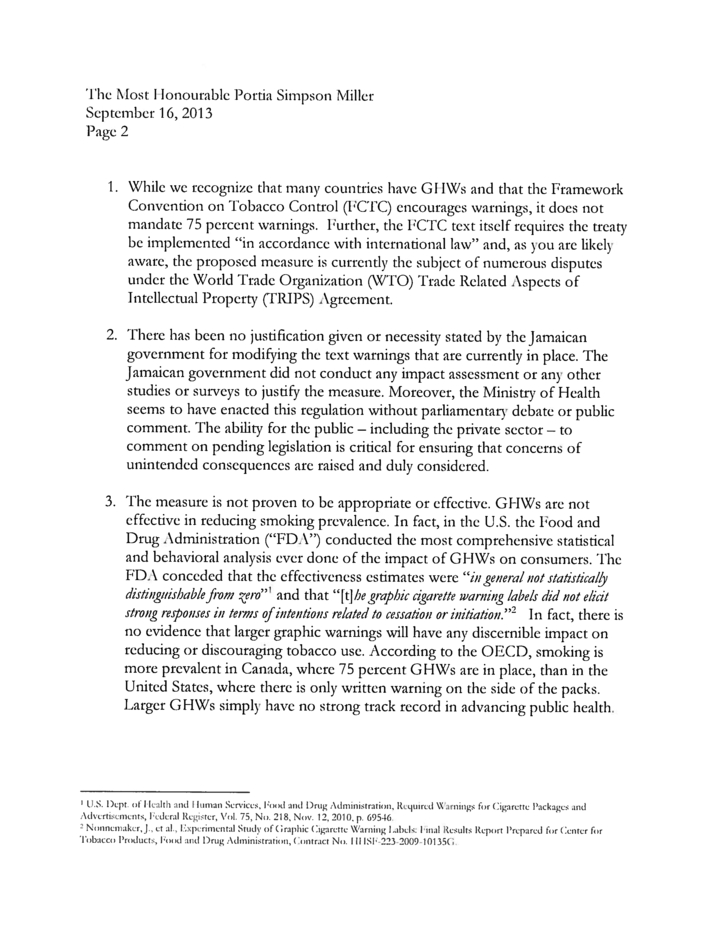
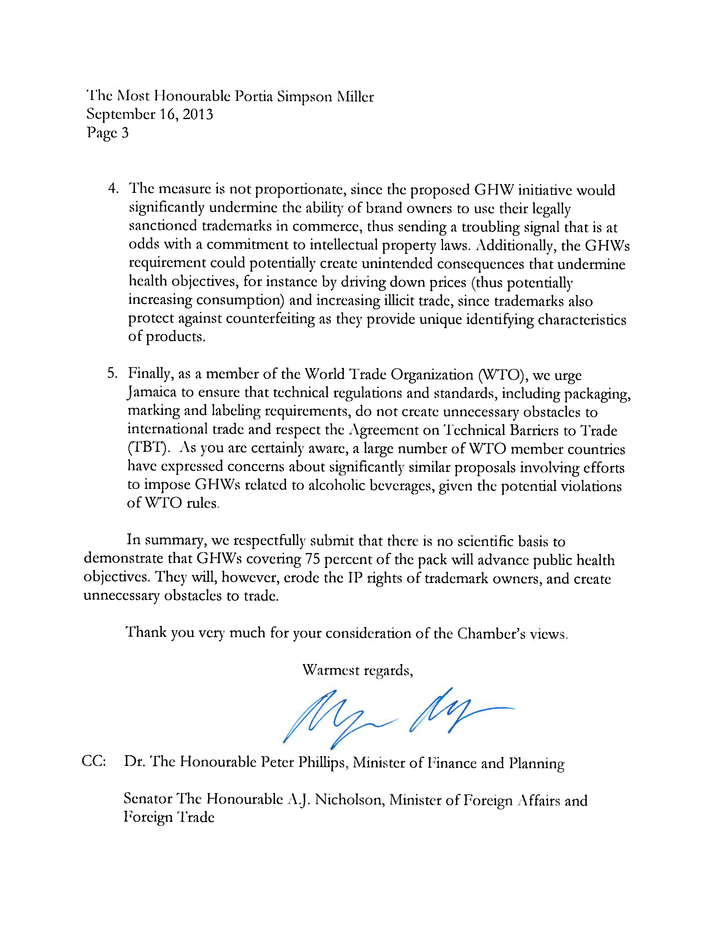
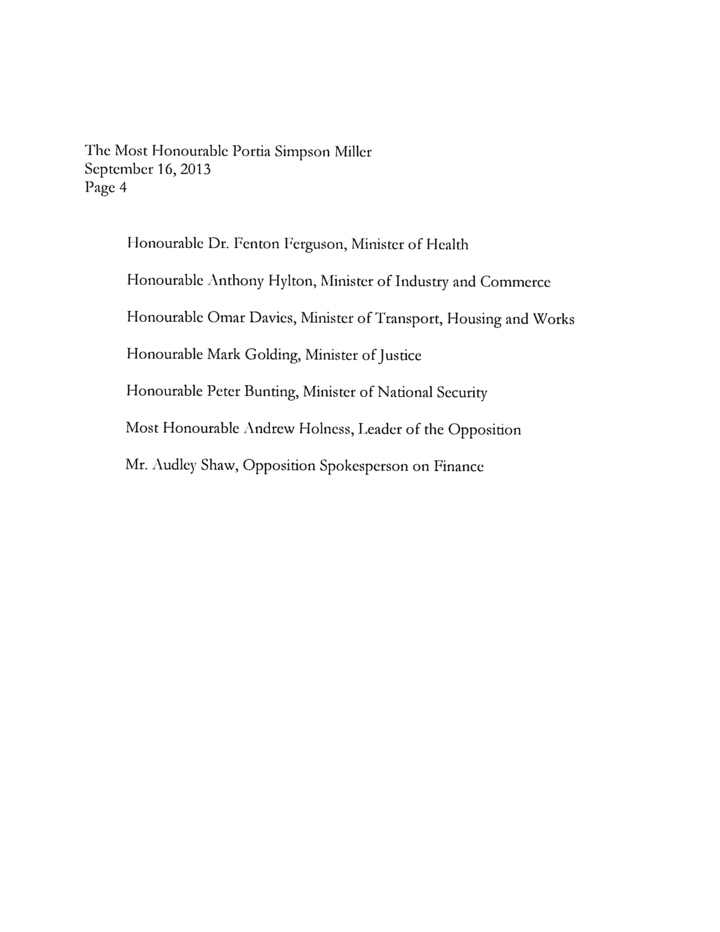
A September 2013 letter to the prime minister protests a new regulation, claiming graphic warning labels “are not effective” and create “unnecessary obstacles to international trade.”

Moldova
In a February 2014 letter, the chamber called a number of proposals “extreme measures” including bans on menthol and slim cigarettes, a ban on advertising at the point of sale and restrictions on smoking in public places.

Nepal
In a January 2015 letter, the chamber says a proposal to increase graphic health warnings on cigarette packs is “of concern to American companies,” and there is not “science-based evidence” it will have an impact.

Uruguay
In an April 2014 letter to the president of the Senate, the chamber expresses concern over new legislation that would bar retailers from displaying tobacco products, calling it “a serious threat to intellectual property.”

New Zealand
In a March 2014 letter, the chamber says new plain packaging legislation “sets a dangerous precedent” by violating trade laws.


jamaica_1-720 jamaica_2-720 jamaica_3-720 jamaica_4-720

Letters and documents from the U.S.
Chamber of Commerce’s foreign affiliates

These generally refer to legislation within their own country, but not always.

New Zealand (and Indonesia)
In a March 2014 letter sent to the parliamentary health committee in Ireland, the American Chamber of Commerce in Indonesia objects to the plain package proposal, calling the evidence “questionable.”

Croatia
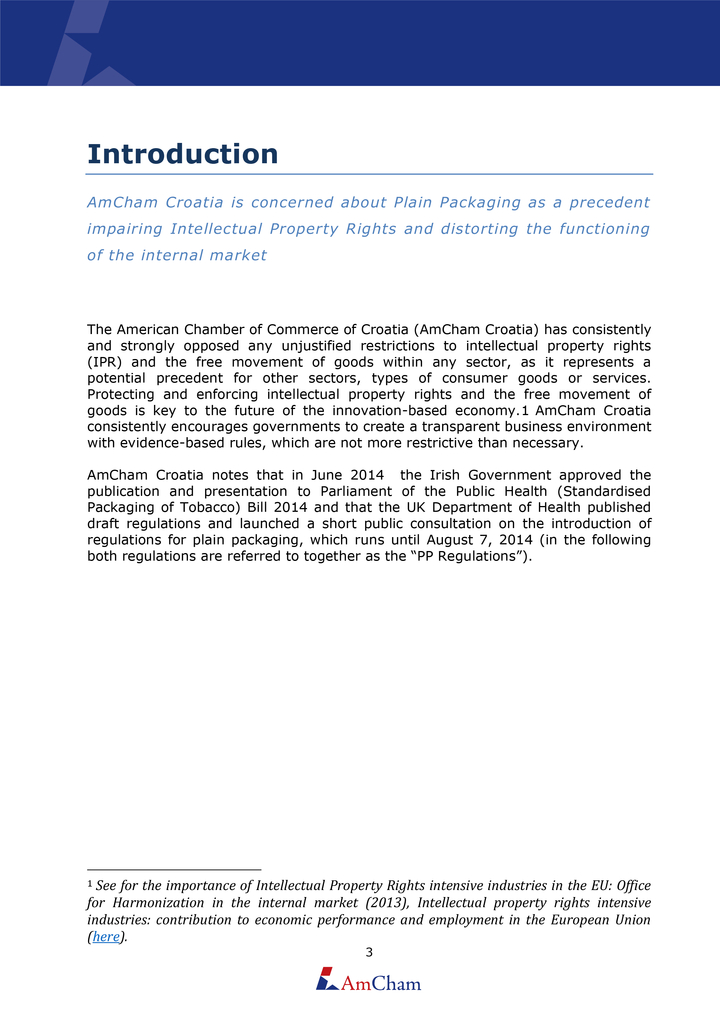
In a September 2014 position paper, the American Chamber of Commerce in Croatia outlined its opposition to legislation requiring cigarettes be sold in plain packages in other European Union member states.

Estonia
A paper outlining the policy priorities of the chamber affiliate quotes a Philip Morris executive who says protecting intellectual property in Estonia is crucial “to maintain its competitive position in the global economy.”

Ireland (and Poland)
In a July 2014 letter to the prime minister, the Polish affiliate says both countries “would all be losing out” if Ireland imposes plain packaging requirements.

Ukraine
In May, the prime minister, Arseniy Yatsenyuk, said that his country began a trade case against Australia’s plain packaging law in 2012 because of a complaint by the U.S. Chamber.

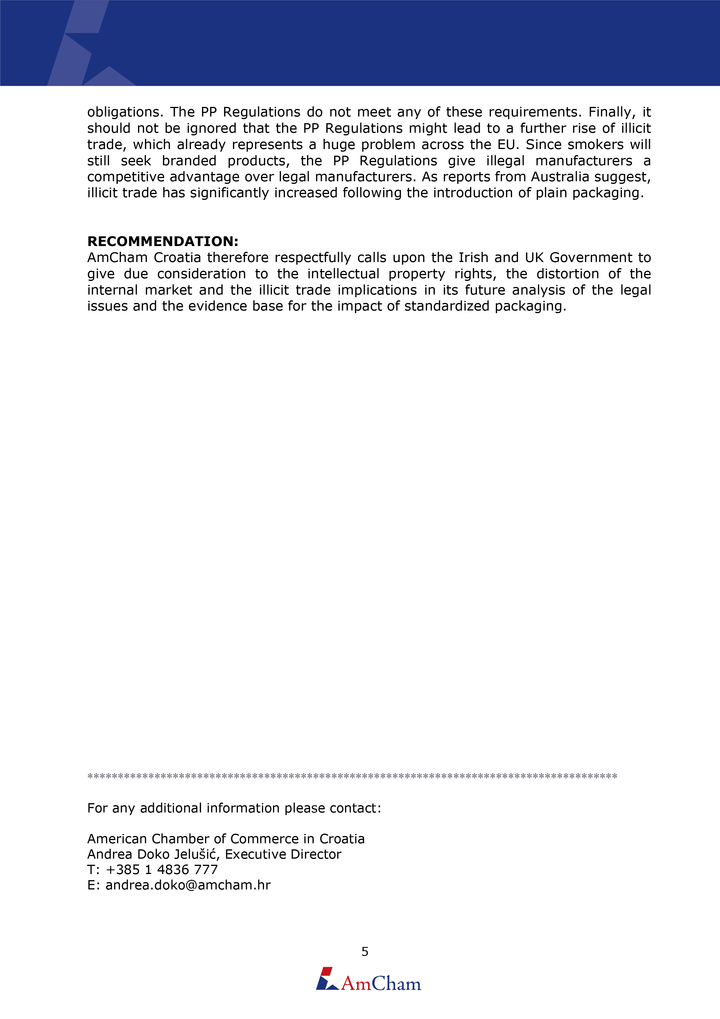
croatia_to_ireland_1-720

croatia_to_ireland_2-720

croatia_to_ireland_3-720

croatia_to_ireland_4-720

croatia_to_ireland_5-720


Letters from the U.S. Chamber with other business groups

European Union
In an April 2013 letter to the European Union’s ambassador to the United States, the U.S. Chamber joined other American business groups in opposing “arbitrary product prohibitions” in new tobacco legislation.

White House
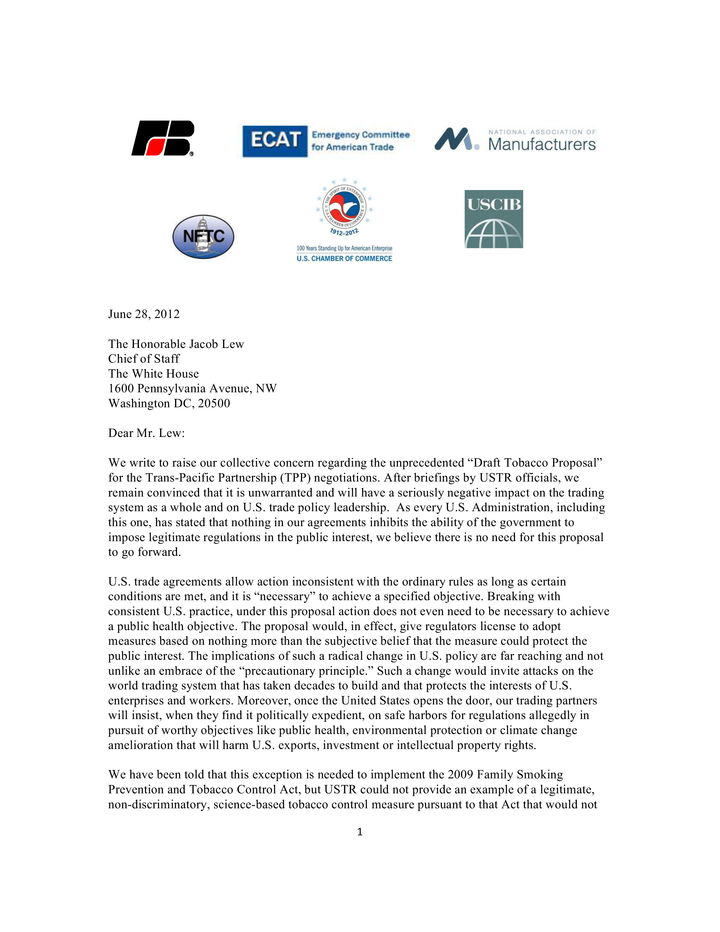
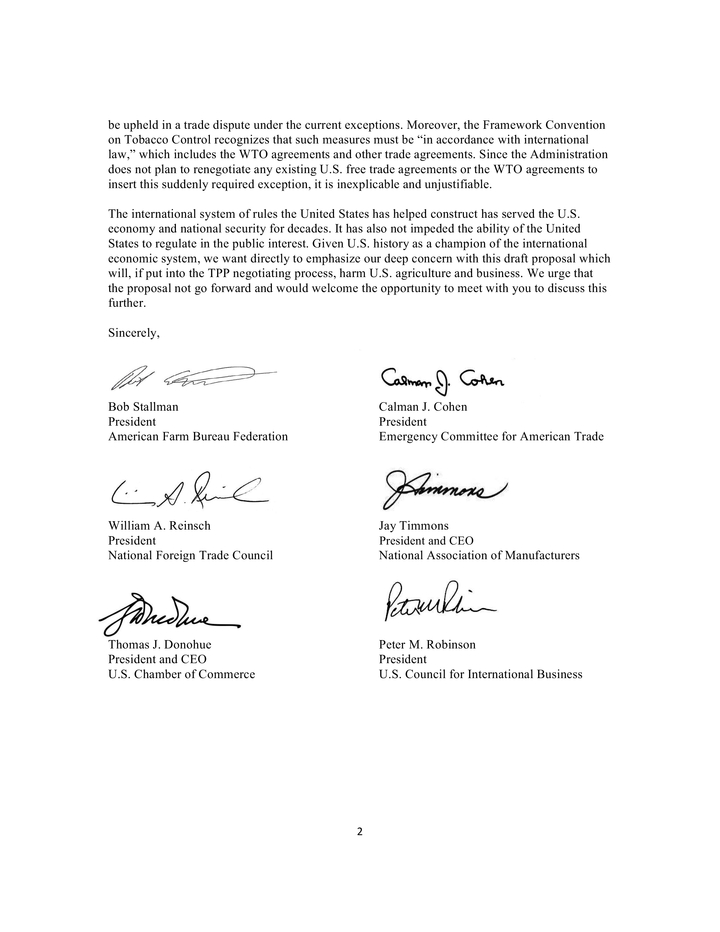
In a June 2012 letter to the then chief of staff, Jacob Lew, the chamber, with five other business groups, objects to the Draft Tobacco Proposal for the Trans-Pacific Partnership negotiations.

U.S. Trade Representative
The chamber, in August 2013 letter with more than 15 other business groups, objects to a “product-specific reference to tobacco or any other product” in relation to the Trans-Pacific Partnership negotiations.

white_house_1-720 white_house_2-720

“Smoking is one of the leading causes of death,” Brooke Thurston, a spokeswoman for Steward, said in a statement, adding, “If the chamber is in fact advocating for increased smoking we do not agree with them on this public health issue.”

The other three companies declined to comment.

Their silence stands in contrast to opposition to the chamber’s tobacco lobbying from a surprising source: the public relations firm Burson-Marsteller.

“It’s pretty obvious that you don’t want to be seen doing the bidding of an interest which is no longer legitimate,” said David Earnshaw, president of the Brussels office of Burson-Marsteller, a company that long worked for the tobacco industry. He tried unsuccessfully to prevent a major affiliate of the chamber, based in Brussels, from issuing a position paper targeting a European proposal on plain packaging.

In a statement Tuesday, the chamber said, “we know that smoking carries obvious health risks,” but added that “we are concerned that a number of governments have acted in ways that are inconsistent with their international obligations.”

The statement said the chamber had raised “substantive concerns” about “the destruction of intellectual property and the dangerous precedent of discrimination against a legal product possibly spreading to other sectors.” It added, “We make no apology for asking governments to keep their word.”

The chamber has not addressed why it has opposed health measures like restricting smoking in public places.

The Times reported this week that the chamber lobbies against antismoking laws in many countries, pits countries against one another on tobacco issues in trade forums, and, in Washington, defends the ability of the tobacco industry to sue under future trade deals.

The chamber, which claims more than three million members, previously encountered friction over its policies. Apple abandoned the chamber in 2009 over its rejection of climate change regulation. The construction giant Skanska left in 2013 after protesting the chamber’s resistance to green building codes.

Last year, when the branch of the American Chamber of Commerce in Brussels, known as AmCham EU, drafted its paper outlining opposition to plain packaging, the only inkling of dissent came from a footnote.

“This position paper does not represent the views of all members of AmCham EU,” it said, in an italicized note at the end.

Burson-Marsteller, which has had its share of controversial clients, was an unlikely rebel against the chamber’s position. The firm developed public relations and marketing campaigns for RJR Reynolds like “Project SPA,” the introduction of its failed Premier brand of cigarettes in the 1980s. Burson, a member of AmCham EU, also worked extensively for Philip Morris U.S.A., now part of Altria, developing campaigns that included a strategy to beat back criticism of the cigarette maker’s sponsorship of women’s tennis.

But in 2010 the firm renounced tobacco. Last year, Mr. Earnshaw raised objections with AmCham EU about aligning with tobacco interests, especially with many members in the cross hairs of European regulators and lawmakers facing concerns about privacy, the dominance of technology companies based in the United States and negotiations over a trans-Atlantic trade treaty.

“I tried to stop AmCham from shooting itself in the foot,” Mr. Earnshaw said. “It’s particularly crazy at a time when there are such big issues that American companies need to be involved in.”

“AmCham is extremely influential in public affairs,” he added. “If it starts producing position papers defending big tobacco on plain packaging, it’s going to make itself look ridiculous.”

The chamber’s E.U. branch proceeded with the position paper, arguing that plain packages unfairly harmed tobacco maker’s intellectual property and posed a broader threat to trademarks, representing “a potential precedent for other sectors and consumer goods or services.”

The chamber’s argument sounded as if it could have been written by the tobacco industry. An unpublished early version of the position paper, which was obtained by The Times, reveals that the rapporteur, or primary author, was Anne-Laure Covin, an executive of Philip Morris International, which is now separate from Philip Morris U.S.A. The company had no comment.

Philip Morris was not the only company involved. The paper came from a committee at the chamber’s European Union branch run by a Time Warner executive, Vincent Jamois, whose name and corporate affiliation are on the draft version of the paper, right above Ms. Covin’s name.

In other forums, Time Warner has expressed concern about cigarettes; in 2005 the company introduced a Tobacco Depiction Policy that sought to limit the number of times people were shown smoking in movies. The goal was “to reduce or eliminate the depiction of smoking and tobacco products/brands in their feature films, unless there is a compelling creative reason for such depictions,” the policy said.

Time Warner even undertook a detailed study of the effectiveness of the policy, finding that total depictions of smoking in its movies fell to 534 in 2013 from 1,346 in 2006.

The committee Mr. Jamois leads deals with intellectual property. The tobacco industry has attracted broader corporate support by framing opposition to plain packaging as a defense of intellectual property rights.


Other companies and institutions whose executives are listed on the U.S. Chamber’s board include Pfizer, which markets the smoking-cessation drug Chantix.

“Tobacco use is the leading cause of preventable death in the world,” Sharon Castillo, a spokeswoman for Pfizer, said in response to questions. But she continued, “Our membership of any group comes with the clear understanding that we may not always agree with all the positions of the organization.”

Part of the chamber’s campaign seeks to discredit antismoking efforts by claiming they lack scientific evidence of effectiveness, particularly requirements that cigarettes be sold in plain packages shorn of corporate logos, or that they be covered with graphic health warnings, or sometimes a combination of the two. A letter from the chamber to the prime minister of Jamaica in 2013 was typical, contending that graphic health warnings “are not effective in reducing smoking prevalence.”

But many studies have found that plain packaging and packages covered with diseased lungs and other disturbing images make smoking less palatable.

“Graphic warnings do work, they motivate people to quit smoking,” said Seth Noar, an author of an analysis by researchers at the University of North Carolina of 37 tobacco studies.

For health care companies, a prominent role in a group that antismoking advocates see as the tobacco industry’s biggest ally can be particularly awkward. Like Anthem, the Health Care Service Corporation encourages members to stop smoking.

One video on its website called “Da Couch Potato” features an overweight man who smokes, drinks beer and watches the Chicago Bears but wants to get back in shape. A news release highlights that “smoking one pack of cigarettes per day can add up to $1,825.00 each year and tobacco use accounts for more than $96 billion a year in medical costs.”

John Cannon, HCSC’s executive vice president and chief administrative officer, is a member of the chamber’s board.

Dr. Ralph de la Torre, a cardiac surgeon and the chairman and chief executive of the Steward health system, also is a board member. One of Steward’s hospitals advertises a smoking-cessation program by saying, “There are a million reasons to quit smoking but it only takes one.”

Daniel F. Evans Jr., chief of the Indiana University Health system, is another member of the chamber’s board. His health system offers a program called “Beat Tobacco” taught by “qualified tobacco educators” who “understand the struggles and side effects of tobacco cessation.”

Lisa Gilbert, who tracks the chamber for Public Citizen, a consumer advocacy group founded by Ralph Nader, said the health companies were conflicted.

“It’s interesting to think of a company giving money to another organization to lobby while publicly proclaiming the opposite policy position,” she said. Such companies either “have no idea what’s being lobbied on and would be appalled to learn that something is diametrically opposed to what they support,” or “there is some actual reason to invest in tobacco control publicly but work to keep laws just as they are in private.”

FDA seeks data on e-cigarettes after surge in poisoning cases

http://www.channelnewsasia.com/news/health/fda-seeks-data-on-e-cigar/1952276.html

REUTERS: The U.S. Food and Drug Administration said it is seeking additional data and comments on liquid nicotine as it considers warning the public about the dangers of its exposure amid a rise in electronic cigarette use.

The agency has evaluated data and science on the risks, especially to infants and children, from accidental exposure to nicotine and liquid nicotine that is used in e-cigarettes. (http://1.usa.gov/1GXeSo4)

More Americans are using e-cigarettes and other vaporizing devices than a year ago, a Reuters/Ipsos poll showed in June.

The surge in e-cigarette use comes as conventional cigarette smoking has declined in the United States to about 19 percent of adults, prompting tobacco companies such as Altria Group Inc, Philip Morris International Inc and Reynolds American Inc to rush into the e-cigarette market.

(Graphic on global market: http://link.reuters.com/kuk83w)

Recent increases in calls and visits to poison control centers and emergency rooms involving liquid nicotine poisoning have raised public health concerns, FDA said.

The health regulator is now considering if it should warn the public about the dangers of nicotine exposure and require that some tobacco products be sold in child-resistant packaging.

Among high school students, e-cigarette use jumped to 13.4 percent in 2014 from 4.5 percent in 2013, according to the Centers for Disease Control and Prevention. Cigarette use over the same period fell to 9.2 percent from 12.7 percent, the largest year-over-year decline in more than a decade.

Commission participation to the Eurasia Tax Forum 2015 Letter

Download (PDF, 227KB)

Making Tobacco’s Case

The U.S. Chamber’s work in support of the tobacco industry in recent years has emerged as a priority at the same time the industry has faced one of the most serious threats in its history. A global treaty, negotiated through the World Health Organization, mandates anti-smoking measures and also seeks to curb the influence of the tobacco industry in policy making. The treaty, which took effect in 2005, has been ratified by 179 countries; holdouts include Cuba, Haiti and the United States.

Facing a wave of new legislation around the world, the tobacco lobby has turned for help to the U.S. Chamber of Commerce, with the weight of American business behind it. While the chamber’s global tobacco lobbying has been largely hidden from public view, its influence has been widely felt.

Letters, emails and other documents from foreign governments, the chamber’s affiliates and antismoking groups, which were reviewed by The New York Times, show how the chamber has embraced the challenge, undertaking a three-pronged strategy in its global campaign to advance the interests of the tobacco industry.

In the capitals of far-flung nations, the chamber lobbies alongside its foreign affiliates to beat back antismoking laws.

In trade forums, the chamber pits countries against one another. The Ukrainian prime minister, Arseniy Yatsenyuk, recently revealed that his country’s case against Australia was prompted by a complaint from the U.S. Chamber.

And in Washington, Thomas J. Donohue, the chief executive of the chamber, has personally taken part in lobbying to defend the ability of the tobacco industry to sue under future international treaties, notably the Trans-Pacific Partnership, a trade agreement being negotiated between the United States and several Pacific Rim nations.

“They represent the interests of the tobacco industry,” said Dr. Vera Luiza da Costa e Silva, the head of the Secretariat that oversees the W.H.O treaty, called the Framework Convention on Tobacco Control. “They are putting their feet everywhere where there are stronger regulations coming up.”

Thomas J. Donohue, the head of the U.S. Chamber of Commerce, has defended the tobacco industry's right to sue under future international treaties.

Thomas J. Donohue, the head of the U.S. Chamber of Commerce, has defended the tobacco industry’s right to sue under future international treaties.

The increasing global advocacy highlights the chamber’s enduring ties to the tobacco industry, which in years past centered on American regulation of cigarettes. A top executive at the tobacco giant Altria Group serves on the chamber’s board. Philip Morris International plays a leading role in the global campaign; one executive drafted a position paper used by a chamber affiliate in Brussels, while another accompanied a chamber executive to a meeting with the Philippine ambassador in Washington to lobby against a cigarette-tax increase. The cigarette makers’ payments to the chamber are not disclosed.

It is not clear how the chamber’s campaign reflects the interests of its broader membership, which includes technology companies like Google, pharmaceutical giants like Pfizer and health insurers like Anthem. And the chamber’s record in its tobacco fight is mixed, often leaving American business as the face of a losing cause, pushing a well-known toxin on poor populations whose leaders are determined to curb smoking.

The U.S. Chamber issued brief statements in response to inquiries. “The Chamber regularly reaches out to governments around the world to urge them to avoid measures that discriminate against particular companies or industries, undermine their trademarks or brands, or destroy their intellectual property,” the statement said, adding, “we’ve worked with a broad array of business organizations at home and abroad to defend these principles.”

The chamber declined to say if it supported any measures to curb smoking.

The chamber, a private nonprofit that has more than three million members and annual revenue of US$165 million, spends more on lobbying than any other interest group in America. For decades, it has taken positions aimed at bolstering its members’ fortunes.

While the chamber has local outposts across the United States, it also has more than 100 affiliates around the world. Foreign branches pay dues and typically hew to the U.S. Chamber’s strategy, often advancing it on the ground. Members include both American and foreign businesses, a symbiotic relationship that magnifies the chamber’s clout.

For foreign companies, membership comes with “access to the U.S. Embassy” according to the Cambodian branch, and entree to “the U.S. government,” according to the Azerbaijan branch.

Members in Hanoi get an invitation to an annual trip to “lobby Congress and the administration” in Washington.

Since Mr. Donohue took over in 1997, he has steered the chamber into positions that have alienated some members. In 2009, the chamber threatened to sue if the Environmental Protection Agency regulated greenhouse gas emissions, disputing its authority to act on climate change. That led Nike to step down from the chamber’s board, and to Apple’s departure from the group. In 2013, the American arm of the Swedish construction giant Skanska resigned, protesting the chamber’s support for what Skanska called a “chemical industry-led initiative” to lobby against green building codes.

The chamber’s tobacco lobbying has led to confusion for many countries, Dr. da Costa e Silva said, adding “there is a misconception that the American chamber of commerce represents the government of the U.S.” In some places like Estonia, the lines are blurred. The United States ambassador there, Jeffrey Levine, serves as honorary president of the chamber’s local affiliate; the affiliate quoted Philip Morris in a publication outlining its priorities.

The tobacco industry has increasingly turned to international courts to challenge antismoking laws that countries have enacted after the passage of the W.H.O. treaty. Early this year, Michael R. Bloomberg and Bill Gates set up an international fund to fight such suits. Matthew L. Myers, president of the Campaign for Tobacco-Free Kids, an advocacy group that administers the fund, called the chamber “the tobacco industry’s most formidable front group,” adding, “it pops up everywhere.”

In Ukraine, the chamber’s involvement was no surprise to Hanna Hopko, the lawmaker who led the hearing in Parliament. She said the chamber there had fought against antismoking laws for years.

“They were against the tobacco tax increase, they were against placing warning labels on cigarettes,” she said. “This is just business as usual for them.”

Plain packaged tobacco products with health warnings in Sydney, Australia.

Plain packaged tobacco products with health warnings in Sydney, Australia.

Country-by-Country Strategy

More than 3,000 miles away, in Nepal, the health ministry proposed a law last year to increase the size of graphic warning labels from covering three-fourths of a cigarette pack to 90 percent. Countries like Nepal that have ratified the W.H.O. treaty are supposed to take steps to make cigarette packs less appealing.

Not long afterward, one of Nepal’s top officials, Lilamani Poudel, said he received an email from a representative of the chamber’s local affiliate in the country, warning that the proposal “would negate foreign investment” and “invite instability.”

In January, the U.S. Chamber itself weighed in. In a letter to Nepal’s deputy prime minister, a senior vice president at the chamber, Tami Overby, wrote that she was “not aware of any science-based evidence” that larger warning labels “will have any discernible impact on reducing or discouraging tobacco use.”

A 2013 Harvard study found that graphic warning labels “play a lifesaving role in highlighting the dangers of smoking and encouraging smokers to quit.”

While Nepal eventually mandated the change in warning labels, cigarette companies filed for an extension and compliance has stalled.

“Since we have to focus on responding to the devastating earthquake, we have not been able to monitor the state of law enforcement effectively,” said Shanta Bahadur Shrestha, a senior health ministry official.

The episode reflects the chamber’s country-by-country lobbying strategy. A pattern emerged in letters to seven nations: Written by either the chamber’s top international executive, Myron Brilliant, or his deputies, they introduced the chamber as “the world’s largest business federation.”

Then the letters mention a matter “of concern.” In Jamaica and Nepal, it was graphic health warnings on packages. In Uruguay, it was a plan to bar cigarettes from being displayed by retailers. The Moldovan president was warned against “extreme measures” in his country, though they included common steps like restricting smoking in public places and banning advertising where cigarettes are sold.

A proposal to raise cigarette taxes in the Philippines would open the floodgates to smugglers, the government there was told. Tax revenue has increased since the proposal became law.

“We are not cowed by them,” said Jeremias Paul, the country’s under secretary of finance. “We meet with these guys when we’re trying to encourage investment in the Philippines, so clearly they are very influential, but that doesn’t mean they will dictate their ways.”

Protecting tobacco companies is portrayed by the chamber as vital for a nation’s economic health. Uruguay’s president is warned that antismoking laws will “have a disruptive effect on the formal economy.” El Salvador’s vice president is told that “arbitrary actions” like requiring graphic health warnings in advertisements undermine “investment and economic growth.”

On the ground, the chamber’s local affiliates use hands-on tactics.

After Moldova’s health ministry proposed measures in 2013, Serghei Toncu, the head of the American Chamber of Commerce in Moldova, laid out his objections in a series of meetings held by a regulatory review panel.

“The consumption of alcohol and cigarettes is at the discretion of each person,” Mr. Toncu said at one meeting, adding that the discussion should not be about “whether smoking is harmful.”

“You do not respect us,” he told the health ministry at another. At a third, he called the ministry’s research “flawed from the start.”

His objections were not merely plaintive cries. The American chamber has a seat on Moldova’s regulatory review panel giving it direct influence over policy making in the small country.

“The American Chamber of Commerce is a very powerful and active organization,” said Oleg Chelaru, a team leader on the staff that assists the review panel. “They played a very crucial role in analyzing and giving an opinion on this initiative.”

Mr. Toncu, who has since left the chamber, declined to comment. Mila Malairau, the chamber’s executive director, said its main objective was to make sure the industry “was consulted” in “a transparent and predictable manner.”

Protesters displayed fake body bags at a tobacco trade show at Pasay, the Philippines, in 2013.

Protesters displayed fake body bags at a tobacco trade show at Pasay, the Philippines, in 2013.

After recently passing in Parliament, the long-stalled measures were subject to fresh objections from the chamber and others, and have not yet been enacted.

Fighting a Trade Exception

In Washington, the U.S. Chamber’s tobacco lobbying has been visible in the negotiations over the Trans-Pacific Partnership, a priority of the Obama administration that recently received critical backing in Congress.

One of the more controversial proposals would expand the power of companies to sue countries if they violate trade rules. The U.S. Chamber has openly opposed plans to withhold such powers from tobacco companies, curbing their ability to challenge national antismoking laws. The chamber says on its website that “singling out tobacco” will “open a Pandora’s box as other governments go after their particular bêtes noires.”

The issue is still unresolved. A spokesman for the United States trade representative said negotiators would ensure that governments “can implement regulations to protect public health” while also “ensuring that our farmers are not discriminated against.”

Email traffic shows that Mr. Donohue, the chamber’s head, sought to raise the issue in 2012 directly with Ron Kirk, who was then the United States trade representative. In email exchanges between staff members of the two, Mr. Donohue specifically sought to discuss the role of tobacco in the trade agreement.

“Tom had a couple of things to raise, including urging that the tobacco text not be submitted at this round,” one of Mr. Donohue’s staff members wrote to Mr. Kirk’s staff. The emails were produced in response to a Freedom of Information request filed by the Campaign for Tobacco-Free Kids, which provided them to The Times.

Mr. Kirk is now a senior lawyer at Gibson, Dunn, a firm that counts the tobacco industry as a client. He said in an interview that during his tenure as trade representative, he met periodically with Mr. Donohue but could not recall a specific conversation on tobacco.

He said trade groups were generally concerned about “treating one industry different than you would treat anyone else, more so than doing tobacco’s bidding.”

The chamber declined to make Mr. Donohue available for an interview.

A Face-Saving Measure

In Ukraine, it was Valeriy Pyatnytskiy who signed off on the complaint against Australia in 2012, which was filed with the World Trade Organization. At the time, he was Ukraine’s chief negotiator to the W.T.O. His political career has survived the revolution and he is now an adviser to the Ukrainian prime minister, Mr. Yatsenyuk.

In a recent interview, he said that for Ukraine, the case was a matter of principle. It was about respecting the rules.

He offered a hypothetical: If Ukraine allowed Australia to use plain packaging on cigarettes, what would stop Ukraine from introducing plain packaging for wine? Then Ukrainian winemakers could better compete with French wines, because they would all be in plain bags marked red or white.

“We had this in the Soviet times,” he said. “It was absolutely plain packaging everywhere.”

Some Ukrainian officials have long been troubled by the case.

“It has nothing to do with trade laws,” said Pavlo Sheremeta, who briefly served as Ukraine’s economic minister after the revolution. “We have zero exports of tobacco to Australia, so what do we have to do with this?”

Last year, he urged the American Chamber in Kiev to reconsider.

“I wrote a formal letter, asking them, ‘Do you still keep the same position?’ ” Mr. Sheremeta said. “Basically I was suggesting a face-saving way out of this.” But when he met with chamber officials, the plain packaging case was outlined as a top priority.

They refused to back down. After Mr. Pyatnytskiy, a tobacco ally, was installed as his deputy, Mr. Sheremeta resigned.

“The world was laughing at us,” he said of the case.

Shortly after The Times discussed the case with Ukrainian government officials, there were new protests from activists. Mr. Yatsenyuk called for a review of the matter. Ukraine has since suspended its involvement, but other countries including Cuba and Honduras are continuing to pursue the case against Australia.

Andy Hunder, who took over as president of the American Chamber of Commerce in Kiev in April, said the organization was moving on, adding, “We are looking forward now.”
Sofiia Kochmar contributed reporting from Kiev, Bhadra Sharma from Kathmandu and Palko Karasz from London.

U.S. Chamber of Commerce Works Globally to Fight Antismoking Measures

By DANNY HAKIMJUNE 30, 2015

http://www.nytimes.com/2015/07/01/business/international/us-chamber-works-globally-to-fight-antismoking-measures.html?_r=0

A demonstration against World No Tobacco Day in Jakarta, Indonesia, in 2013. The U.S. Chamber of Commerce and its foreign affiliates have joined efforts to fight antismoking laws around the world.

A demonstration against World No Tobacco Day in Jakarta, Indonesia, in 2013. The U.S. Chamber of Commerce and its foreign affiliates have joined efforts to fight antismoking laws around the world.

KIEV, Ukraine — A parliamentary hearing was convened here in March to consider an odd remnant of Ukraine’s corrupt, pre-revolutionary government.

Three years ago, Ukraine filed an international legal challenge against Australia, over Australia’s right to enact antismoking laws on its own soil. To a number of lawmakers, the case seemed absurd, and they wanted to investigate why it was even being pursued.

When it came time to defend the tobacco industry, a man named Taras Kachka spoke up. He argued that several “fantastic tobacco companies” had bought up Soviet-era factories and modernized them, and now they were exporting tobacco to many other countries. It was in Ukraine’s national interest, he said, to support investors in the country, even though they do not sell tobacco to Australia.

Mr. Kachka was not a tobacco lobbyist or farmer or factory owner. He was the head of a Ukrainian affiliate of the U.S. Chamber of Commerce, America’s largest trade group.

U.S. Chamber Of Commerce: Lobbying Hard For Big Tobacco Worldwide

http://consumerist.com/2015/06/30/u-s-chamber-of-commerce-lobbying-hard-for-big-tobacco-worldwide/

By Kate Cox June 30, 2015

The term “Chamber of Commerce” plants visions of a quaint, local organization helping hang banners in the town square at Christmas time, or sponsoring youth groups in a Fourth of July parade during warmer seasons. Realistically, however, the U.S. Chamber of Commerce is the nation’s largest business and commerce trade group. And among all their other lobbying work, the Chamber of Commerce has become one of the world’s biggest advocates for Big Tobacco, pushing that industry’s interests globally.

The New York Times reports today on the U.S. Chamber of Commerce’s extensive efforts overseas, where it’s doing everything in its power to torpedo other nations’ anti-tobacco efforts.

Big tobacco is, after all, big business — and the Chamber of Commerce exists to promote business interests. From one point of view, it’s a natural fit. And so the organization has taken on a global effort in order to bolster the interests of tobacco companies against other nations’ attempts to curtail the industry.

It’s a tricky time for the tobacco industry, as the NYT points out. A global treaty, negotiated through the World Health Organization, has pushed anti-smoking and anti-tobacco measures worldwide. The treaty went into effect ten years ago and so far there are 179 signatory nations — but the United States, built in so many ways on the existence of tobacco farming, is not among them.

In that intervening decade, many of the signatory nations have gotten moving on their promised anti-smoking legislation — and that’s where lobbying from the U.S. Chamber of Commerce, and its international partners, comes in.

One of the biggest examples of the Chamber’s intervention that the NYT cites is one that comedian John Oliver delved into earlier this year: Ukraine’s unexpected support of Philip Morris in a claim the company made against Australia a few years ago.

In their filings, Ukraine claimed that Australia’s plain packaging law would hurt Ukrainian exports. If Ukraine had ever exported tobacco to Australia, that might make sense — but they don’t. “Ukraine is inserting themselves into something they have nothing to do with,” as Oliver described it in February. “They’re taking the Kanye West approach to international trade disputes.”

But of course Ukraine did not act without encouragement, and that encouragement came from the U.S. Chamber of Commerce. This March, the NYT reports, Ukraine’s parliament convened a hearing to try and sort out why they were involved in a lawsuit against Australia.

“When it came time to defend the tobacco industry, a man named Taras Kachka spoke up,” the Times writes. “He argued that several ‘fantastic tobacco companies’ had bought up Soviet-era factories and modernized them, and now they were exporting tobacco to many other countries. It was in Ukraine’s national interest, he said, to support investors in the country, even though they do not sell tobacco to Australia.”

The speaker, as the NYT explains, was neither a tobacco industry member nor lobbyist. He was the head of a Ukranian affiliate of the U.S. Chamber of Commerce. And indeed, the Ukranian prime minister recently revealed that Ukraine’s case against Australia was in fact prompted by a complaint from the Chamber.

The U.S. Chamber of Commerce not only meddles in existing legislative processes around the world in favor of tobacco companies, but also works to maintain their interests in future agreements as well. The current head of the U.S. Chamber of Commerce has lobbied extensively to make sure that as part of the Trans-Pacific Partnership, the pending trade agreement the U.S. is poised to sign with a dozen Pacific Rim nations, that tobacco companies retain their rights to sue governments when they feel they are being too strongly impinged upon.

That’s not a hypothetical scenario: Since 2010, Philip Morris has sued Uruguay, Australia, and the U.K. as well as making legal threats against other, smaller nations like Togo, Moldova, and Nepal.

The Chamber has sent letters and reports to several nations, taking different approaches. To smaller or less wealthy nations, the letters might be an implicit threat for U.S. businesses to take their ball and go home.

“The U.S. Chamber of commerce is committed to promoting a robust and growing trade and investment relationship with Jamaica,” reads a 2013 letter to that nation’s Prime Minister. “For this to occur, the decisions made by public policymakers must have a sound basis in science and reflect global best practice.”

In other countries, the Chamber has taken alternate approaches. A 2014 letter to New Zealand’s parliament takes a different tactic, claiming that nation’s plans to implement plain packaging — which strips branding and logos from the exterior of tobacco products and replaces it with health warnings — are in violation of trademark and intellectual property laws. That’s the same approach that Philip Morris took in its 2011 lawsuit against Australia.

Of course, not everyone involved with the Chamber of Commerce is necessarily on board with this plan. The organization has over three million member companies, including health insurers and pharmaceutical companies, as well as 21st century tech giants that tend to promote healthful living.

When the Times asked the Chamber of Commerce for a statement, the organization replied: “The Chamber regularly reaches out to governments around the world to urge them to avoid measures that discriminate against particular companies or industries, undermine their trademarks or brands, or destroy their intellectual property. We’ve worked with a broad array of business organizations at home and abroad to defend these principles.”

American tobacco companies might be feeling the strain as other countries try their hardest to enact anti-smoking measures, but American lobbying exports seem to be doing just fine.

U.S. Chamber of Commerce Works Globally to Fight Antismoking Measures [New York Times]