

Scotland Votes Regulation for E-cigarettes
http://www.utahpeoplespost.com/2016/03/scotland-regulation-e-cigarettes/
Recent years have brought a rapid rise in popularity to e-cigarettes, so much so that researchers and regulators haven’t had the time to decide on their benefits and health side effects.
Consequently, e-cigs are now the subject of heated debate: do they indeed provide helpful a cessation treatment for smokers? Or do they actually make smoking more attractive to young people?
At the same time, some group advocates claim that e-cigarettes are Big Tobacco’s way of protecting its profits in markets, seeing that smoking is declining in some markets.
While their benefits continue to be debated, and the potential risks to non-smokers remain under-explored, politicians across the world and regulators must still decide what to do.
Scotland is among the latest countries confronted with this question, where parliament has just banned people under 18 years old from using e-cigarettes. This decision – which imposes the same age limit as for traditional cigarettes – brings Scotland into line with England and Wales.
Countries across the globe take different approaches to vaping – the broadly used term for using e-cigarettes. In Canada, sales have technically been made illegal, although regulation is still largely unenforced.
In the US, regulation is mixed, but San Francisco has just raised the minimum buying age to 21 years. Across Europe, countries like Ireland, Poland, and Bulgaria have yet to regulate sales and advertising, while Wales takes a more restrictive approach, looking to introduce a ban on e-cigarettes in public places.
But which approach is the most sensible? While voting on the new Scottish Health Bill, opponents of e-cigarette regulations argued that vaping is significantly less harmful than traditional cigarettes and help smokers to quit.
According to this group, restrictions will only prevent smokers from trying safer alternatives, and reduce the chances of lowering tobacco consumption.
On the other side of the debate, supporters of regulation say claim that children and young people need to be protected from developing a nicotine addiction.
They advocate a precautionary approach until researchers offer evidence that e-cigarettes do not undermine the country’s recent successes at curbing smoking.
More than just banning sales of e-cigs to under-18s, the new Scottish laws requires retailers to ask customers who look under 25 to offer proof of age. They also ban selling e-cigarettes from vending machines, make it illegal to buy on behalf of someone under 18.
Even though there might be some years before we have any clear evidence about the risks of e-cigarettes, the Scottish Parliament can, at least, say it has done what the country wants. Back in 2014, a large majority of respondents supported the regulation.
Stringent rules on sale of e-cigarettes needed to protect youngsters
A survey published last month by the Census and Statistics Department shows daily cigarette smokers account for 10.5 per cent of all persons aged 15 and over in Hong Kong – the lowest figure since 1982.
The results offer little room for complacency as it was revealed in the same report that 9 per cent of secondary school students reported having used electronic cigarettes. If the statistics are any guide, there are reasons to be concerned about easy access to e-cigarettes.
Teenagers are at risk as the health implications of e-cigarettes are often played down. More stringent rules governing the sale and use of e-cigarettes should be in place.
A laboratory test commissioned by the Hong Kong Council on Smoking and Health (COSH) shows that of the 13 e-cigarettes sampled, most contain harmful chemicals. Among them are formaldehyde, glycerin and polycyclic aromatic hydrocarbons. Also, e-cigarette cartridges contain various concentrations of nicotine. Vaping may induce nicotine dependence and blood vessel constriction.
A study published in the journal Oral Oncology showed that vapour from the electronic devices could have deleterious effects on DNA or even kill human cells.
Indeed, the World Health Organisation in 2014 questioned the effectiveness of e-cigarettes as a seemingly more favourable way to quit smoking. They have not been widely credited with promising smoking cessation.
While the WHO has warned of the health implications of e-cigarettes, there is differing evidence for or against their health impact. However, there is no escaping the fact that carcinogens are present in e-cigarette vapour, albeit lower compared with tobacco smoke.
Even if there is no evidence pointing to the fact that vaping is as harmful as smoking, teenagers should not think that vaping is any less harmful. The lesser-of-two-evils idea is a self-deception.
That COSH has no qualms about calling for a blanket ban on the sale of e-cigarettes in Hong Kong (“E-cigarette cancer alarm raised”, March 1) is a timely reminder that measures targeting e-cigarettes have to be in line with other efforts in place.
Before the e-cigarette business spins out of control and the population of people using them expands, it is crucial that we nip that expansion in the bud and keep them away from teenagers.
Borromeo Li Ka-kit, Happy Valley
________________________________________
Source URL: http://www.scmp.com/comment/letters/article/1920592/stringent-rules-sale-e-cigarettes-needed-protect-youngsters?comment-sort=all
Responsibility for Environmental Waste
The tobacco industry has not only designed and marketed a product that is deadly when used as directed, but it also causes substantial and dangerous environmental pollution, says the Smokefree Coalition. New research findings released in the Tobacco …Tobacco companies should take responsibility for environmental waste, say smokefree advocates
http://business.scoop.co.nz/2016/03/05/responsibility-for-environmental-waste/
The tobacco industry has not only designed and marketed a product that is deadly when used as directed, but it also causes substantial and dangerous environmental pollution, says the Smokefree Coalition. New research findings released in the Tobacco Control Journal today show 98 percent of all cigarettes contain plastic non-biodegradable filters.
“When smokers discard their butts into the surrounding environment, they may not realise they collectively leave behind them a huge carbon footprint – perhaps 2-4 trillion non-biodegradable butts each year around the world,” says Smokefree Coalition Executive Director Dr Prudence Stone.
“It’s time for new regulations to force the tobacco industry to be legally responsible for their environmentally unsafe design. Ironically, this design was introduced in the 1960s to purposefully mislead consumers into thinking cigarettes would be less harmful. In fact, the product doubled its potential to harm; both to the consumer’s health and also to our shared environment.”
The researchers reveal the serious environmental concerns regarding the production and use of tobacco products throughout their lifecycle, especially involving tobacco product waste (TPW).
There are 7000 chemicals contained in cigarettes, with at least 50 known carcinogens. These chemicals have been found to be acutely toxic to marine and freshwater organisms, and poisonous to humans and domestic animals.
The writers say the current level of corporate accountability by the tobacco industry is cynical, and simply isn’t working. The Smokefree Coalition agrees new laws and regulations are necessary to hold the industry to account for preventing, reducing and mitigating the unacceptable harms done to the environment, from their product’s farming, manufacturing, shipping and distribution, and finally the discarded waste left by their consumers.
“This is not an industry we can rely on to do the right and ethical thing voluntarily. If it was, it would have recalled all tobacco products decades ago, when it was first known they caused cancer, respiratory illness and heart disease,” says Dr Stone.
“Reversing the harm this industry causes will require action from decision makers in Government, the mistrust of civil society, and green industries, scientists and other conscientious citizens working together to hold the tobacco industry accountable.”
More than 600m illicit cigarettes seized by HMRC in six months
Between April and September 2015, hundreds of millions of cigarettes and 137 tonnes of hand-rolling tobacco worth £232m in unpaid duty found
http://www.theguardian.com/business/2016/mar/05/600m-illicit-cigarettes-seized-hmrc-six-months-tobacco
More than 600m illicit cigarettes and 137 tonnes of hand-rolling tobacco with a tax value of £232m were seized by the government in the space of six months in 2015.
HM Revenue and Customs (HMRC) said the figures showed the department was reducing the illicit trade but that it remained a “significant problem”.
An HMRC spokesman said by working with other enforcement agencies it had halved the size of the illicit market in cigarettes and that of illicit hand-rolling tobacco by a third.
Between April and September 2015 more than 619.1m cigarettes were seized – with 10.7m of these inland, 182.8m at the border and 425.6m overseas. In the same period 137.8 tonnes of hand-rolling tobacco was also seized.
The combination of both illicit hauls would have lost the government £232m in unpaid duty if they had not been seized.
The spokesman said: “Last year HMRC prosecuted 417 people, prevented £746m revenue losses as a result of investigation of organised crime groups and seized over 1.8bn cigarettes and 313 tonnes of hand-rolling tobacco.
“Tobacco fraud cost the UK £2.1bn in 2014/15. We encourage anyone with information about the illegal sale of tobacco to contact the customs hotline on 0800 59 5000.”
A report published by HMRC in March 2015 said smuggling “undermines legitimate business and is dominated by internationally organised criminal groups often involved in other crimes such as drug smuggling and people trafficking”.
Following the launch of the tackling tobacco smuggling strategy in 2000, HMRC said it had had a significant impact on reducing the trade.
Since then it has decreased the illicit market for cigarettes from 22% to 10% now – with hand-rolling tobacco down from 61% to 35%.
In that same period the revenue lost has fallen from £3.4bn to £2.1bn per year
Hybrid device delivers tobacco flavors with e-cig like vapor
http://www.eurekalert.org/pub_releases/2016-03/raba-hdd030316.php
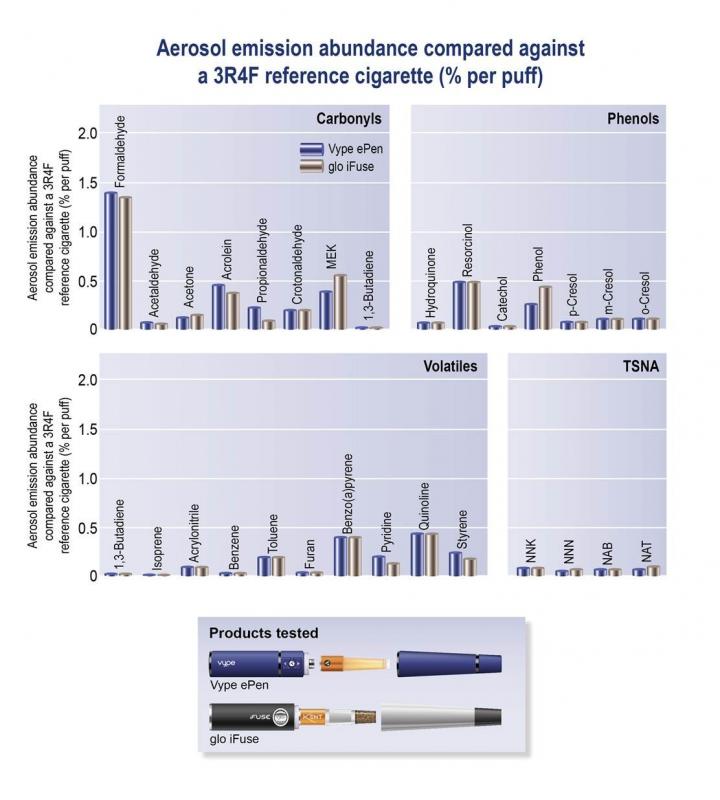
A novel hybrid product that combines e-cigarette technology with fresh tobacco, called ‘ glo iFUSE’, has been shown to successfully deliver natural tobacco flavours without impacting the potentially reduced risk nature of the aerosol produced.
E-cigarettes are believed to be substantially reduced risk compared to cigarettes, and the simple composition of the vapour compared to that of cigarette smoke is an important factor in this.
Flavourings are an important part of the vaping experience, but currently available e-cig flavours are food grade and the tobacco flavourings are unsatisfactory. This hybrid technology delivers a natural tobacco flavour without having to directly heat or burn the tobacco, thereby eliminating many of the toxicants that would be produced by excessive heating or burning of the tobacco leaf.
‘e-cigarettes have proven hugely popular, but one size does not fit all, which is why we are developing a range of innovative tobacco and nicotine products, in addition to e-cigarettes, to give consumers a greater choice of less risky products,’ said Dr Ian Fearon, Principal Scientist, at British American Tobacco.
glo iFUSE is a patented novel tobacco product that combines e-cigarette technology with carefully selected tobacco. When the device is used, a heated coil warms an e-liquid to create a vapour that is drawn over a bed of blended tobacco with every puff. The aerosol cools from around 35ºC to 32ºC as it passes over the tobacco, and the resulting energy exchange draws tobacco flavours from the tobacco into the vapour.
Sensory testing confirmed that the tobacco flavours were detectable and a comprehensive chemical comparison revealed that the vapour produced was almost indistinguishable from the parent e-cig vapour, which suggests that the tobacco blend is not adding any toxicants.
The chemical comparison was made between the vapour produced by glo iFUSE, a commercial e-cigarette Vype ePen and a 3R4F reference cigarette. Up to 113 compounds of interest were targeted by advanced chemical analyses. Among them, twenty nine compounds were measured on a per puff basis for all three aerosols. A reduction of at least 98% for all 29 compounds was recorded for both glo iFUSE and Vype ePen, compared to the reference cigarette.
There were small amounts of some aldehydes, semi-volatile compounds and phenolic compounds present in the aerosol and negligible amounts tobacco-specific nitrosamines compared to the reference cigarette. In most cases, the vapour produced by the hybrid product, glo iFUSE, was indistinguishable from that produced by the e-cigarette.
Many in the public health community believe e-cigarettes offer great potential for reducing the public health impact of smoking. Public Health England, an executive body of the UK Department of Health, recently published a report saying that e-cigarettes are 95% safer than cigarettes.
We’re unsure if e-cigarettes are harmful, but it still makes sense to restrict them
https://theconversation.com/were-unsure-if-e-cigarettes-are-harmful-but-it-still-makes-sense-to-restrict-them-55777
E-cigarettes have rapidly risen in popularity in recent years and are now the subject of heated debate as to whether they are effective in helping smokers quit tobacco or whether they are actually making smoking attractive to young people. Are they a way for Big Tobacco to protect its profits in markets where smoking is declining and lure people back into nicotine addiction or are they just a fashion that will quickly lose its appeal?
Given that vaping has been around for barely a decade and studies into the long-term effects take time, we cannot answer these questions with certainty yet. The benefits of e-cigarettes’ continue to be debated – and the potential risks to non-smokers and young people remain under-explored.
This makes it difficult to make recommendations, but politicians across the world are nonetheless having to decide what to do. The latest country to confront this question is Scotland, where the parliament has just voted to ban under-18s from using e-cigarettes. One of a raft of restrictions, this imposes the same age limit as for traditional cigarettes, bringing Scotland broadly into line with England and Wales. Was it the right thing to do?
Different countries have taken different approaches to vaping. Canada has technically made sales illegal, though regulation remains largely unenforced. While regulation across the US is mixed, San Francisco has just raised the minimum buying age from 18 to 21 years.
In some European countries, – among them Bulgaria, Ireland and Poland – sales and advertising are unregulated. In May, however, new EU regulations will impose standardised quality control on liquids and vaporisers across the union as well as requiring disclosure of ingredients in vaping liquids and child-proofing and tamper-proofing for liquid packaging. They will also restrict cross-border advertising. Wales meanwhile looks likely to extend its restrictions by introducing a ban on e-cigarettes in public places.
The ayes and the noes
In the run up to the vote on the new Scottish Health Bill, opponents and supporters of e-cigarette regulations fiercely debated which approach was the most sensible. Opponents usually argue that vaping is less harmful than traditional cigarettes and effective in helping smokers to quit. They want minimal restrictions on availability and complete freedom for advertising, promotion and the use of e-cigarettes in public. Restrictions, they argue, might prevent smokers from switching to safer alternatives and reduce the chances of curbing tobacco consumption.
Supporters of regulation say that children and young people need to be protected from using products which imitate smoking and from developing nicotine addiction. They also favour regulation to ensure product safety and quality. They advocate a precautionary approach until there is evidence that e-cigarettes do not undermine our recent successes at controlling tobacco.
As well as banning sales to under-18s, the new Scottish laws require retailers to ask for proof of age when selling to someone that looks under 25 (similar to alcohol). They ban the sale of e-cigarettes from vending machines, make it an offence to buy on behalf of someone under 18, and require retailers to put their names on a product register. Scottish ministers will also have the power to further restrict or prohibit advertising and promotions in future.
Tighter shackles, please
While the evidence about the risks of e-cigarettes is likely to remain unclear for several years, the Scottish parliament can at least say it is doing what the country wants. A large majority of respondents backed regulation in the consultation of 2014, including representatives of health bodies, local authorities, charities, academics and members of the public. As well as supporting a ban on sales to under-18s or adults buying e-cigarettes on their behalf and preventing young people from seeing advertising and promotions, respondents also widely endorsed restricting the use of e-cigarettes in public places.
‘Save me from myself’ Milles Studio
The Scottish public’s desire for these kinds of rules is also reflected in research I co-published that looked at debates about e-cigarettes in the UK media and found that supporters of regulation greatly outnumbered opponents. I have also been involved in a new study, about to be published, which investigates the views of UK adolescents on regulation. We found they have a very sophisticated understanding of the advantages and disadvantages. While aware of the potential benefits of e-cigarettes to smokers – including those teenage smokers who want to quit – young people overwhelmingly support strong e-cigarette regulation. This includes restrictions on sales to minors, marketing and the use of e-cigarettes in public places.
The reality is that, until the jury returns, it makes sense to trust the public to reach a view from the best information on e-cigarettes that is available. Even if current regulations were to end up looking disproportionate in years to come, no one will be able to accuse the Scottish government of ignoring people’s concerns and taking public health issues lightly. In a situation where no one really knows what to do for the best, regulation which restricts access and promotion to young people looks like the best policy.
North Carolina man loses eye after e-cig explosion
http://www.whdh.com/story/31393198/north-carolina-man-loses-eye-after-e-cig-explosion
A man in Wilmington, North Carolina is telling his story after an e-cigarette blew up in his face.
It all started as a way to quit smoking.
“I should have just stop using the electric cigarette because I had the nicotine down to zero. There was no nicotine in it or anything so,” Christopher Roberts said.
When he went to take an inhale of this milky white smoke, he never expected it to explode.
“I started saying out loud ‘Oh my God, Oh my God’ because I had grabbed a rag and I put it on my face, and as I was putting it on my face I noticed below me there was just a pool of blood,” Roberts said.
The e-cig exploded in his face with such force Chris said it broke a piece of the steering wheel off.
The explosion gave him second and third degree burns on his chest, over 50 stitches in his nose and cost him his left eye.
“The night before they took my eye out I was at a 15,” Roberts said. “I was literally crawling up the walls in pain.”
A month and a half after his three different surgeries, Chris says he’s still getting used to some things, but it’s changed his perspective.
“I have friends that are missing limbs and stuff like that and they’re not limited to anything,” Roberts said. “So losing my eye is not going to limit me to anything.”
But he does have a message to anyone who is about to take a quick hit from an e-cig.
“Just for people to be aware that not everything is safe about it,” Roberts said. “There is harm in it as well.”
Hong Kong Customs detects suspected illicit cigarettes smuggling case in Man Kam To Control Point
Hong Kong (HKSAR) – Hong Kong Customs detected a suspected case of illicit cigarettes smuggling in Man Kam To Control Point today (March 4). About 460 000 sticks of suspected illicit cigarettes were seized from an incoming container truck.
Customs officers intercepted an incoming container truck declared to contain assorted cargoes in Man Kam To Control Point today. After thorough inspection, Customs officers found about 460 000 sticks of suspected illicit cigarettes in 29 carton boxes.
The market value of the cigarettes was about $1.3 million with a duty potential of about $0.9 million. The suspected illicit cigarettes were mix-loaded with other goods and concealed in the foremost part of the container. The 59-year-old male driver was arrested and the container truck used for conveying the suspected illicit cigarettes was detained.
Hong Kong Customs will continue to carry out stringent enforcement actions against the smuggling of illicit cigarettes at boundary control points.
Under the Import and Export Ordinance, smuggling is a serious offence.
The maximum penalty is a fine of $2 million and imprisonment for seven years.
Members of the public are urged to report any suspected illicit cigarette activities by calling the Customs’ 24-hour hotline 2545 6182.
The Brain Science Behind Raising the Tobacco Buying Age to 21
http://www.livescience.com/53947-brain-science-smoking-age-21.html
San Francisco’s new tobacco ordinance — which raises the legal age to buy tobacco products from 18 to 21 — could help improve the health of a new generation of people by preventing addiction, health officials said.
Nationally, 18-year-olds can buy tobacco products, including cigarettes and cigars. However, in the past decade or so, some American communities, cities and one state (Hawaii) have passed ordinances and laws increasing the minimum age to 21.
These new policies could lead to better brain development among young adults who might have otherwise chosen to smoke at a younger age, said Brian King, the deputy director for research translation at the Centers for Disease Control and Prevention’s Office on Smoking and Health.
Research suggests that tobacco use, particularly nicotine exposure, can harm the developing human brain, King said. Moreover, the brain doesn’t stop developing during the teenage years, but continues until about age 25, he said.
“There’s an emerging body of evidence that has demonstrated that nicotine exposure can particularly harm the prefrontal cortex [of the brain] and lead to adverse health effects in the developing adolescent brain,” King told Live Science. “And that can also continue into young adulthood.”
The prefrontal cortex is involved with aspects of decision-making, cognition and memory, he added.
The new San Francisco ordinance, which is set to take effect June 1 and will also affect e-cigarettes, is also aimed at deterring people from smoking at an early age. About 90 percent of tobacco users begin before age 18, and the vast majority of the rest start before age 26, King said.
“If you can prevent use before the age of 18, you’re preventing about 9 in 10 tobacco users,” he said. “Then we don’t have to help them quit, if we can prevent them from starting in the first place.”
According to the 2009 Family Smoking Prevention and Tobacco Control Act, the Food and Drug Administration cannot raise the national age of purchasing tobacco products above age 18, King said. Congress could pass a bill increasing the age, but if it does not, any decision to set the age higher will have to come from individual states, cities and communities, he said.
However, it’s not immediately clear how the San Francisco ordinance will affect smoking rates. New York City; Berkeley, California; Boston; and dozens of other cities and communities have increased the minimum buying age to 21, according to the Preventing Tobacco Addiction Foundation, but not enough time has passed in order to study the outcomes of these measures sufficiently.
The preliminary data looks promising, King said. The city of Needham, Massachusetts, raised the buying age to 21 more than a decade ago, in 2005, and a recent survey of the region’s youth showed that teenagers in Needham smoked less tobacco in the past 30 days than their peers in neighboring communities did.
That 2015 study, published in the journal Tobacco Control, showed that reported smoking rates dropped from 13 percent to 7 percent among teens in Needham from 2006 to 2010. This drop was larger than the 15 percent to 12 percent decrease seen in neighboring communities that did not raise the buying age, the researchers who conducted the study said.
Furthermore, the decline was consistent for both genders and for Caucasian and non-Caucasian youth, the researchers reported.
In a March 2015 report, the Institute of Medicine estimated that if all states were to raise the minimum tobacco-buying age to 21, there would be a 12 percent drop in cigarette smoking prevalence across the nation by the year 2100, said King, who was not involved with the research.
“That would translate into nearly 250,000 fewer premature deaths from smoking,” he said.
King added that raising the buying age is only one piece of the puzzle in the movement to stem tobacco use in youth and young adults. Policies to keep buildings or other areas smoke-free, media campaigns and better patient services are also helping to prevent or stop tobacco use, he said.
“Youth and young adults are particularly vulnerable to addiction for a variety of reasons,” he said. “And so, preventing youth and young adults from starting in the first place could potentially prevent them from a lifelong addiction to tobacco products.”