Clear The Air News Tobacco Blog Rotating Header Image

September, 2015:

Uruguay Slams Big Tobacco, Defends Marijuana Policy

http://www.telesurtv.net/english/news/Uruguay-Slams-Big-Tobacco-Defends-Marijuana-Policy-20150929-0025.html

President Tabare Vazquez of Uruguay addresses attendees during the 70th session of the United Nations General Assembly at the U.N. headquarters in New York,

“We can regulate these markets without a prohibitionist stance,” Vazquez said.

​Uruguayan President Tabare Vazquez defended his country’s “sovereign” decisions over public health and slammed the multinational tobacco industry, which he said “in order to double its profits doesn’t have any problem in killing its customers.”

During his speech before the UN General Assembly, Tuesday, Vazquez singled out Phillip Morris for suing Uruguay over the country’s anti-smoking campaign. The company is suing Uruguay for US$25 million under a bilateral investment treaty between Uruguay and Switzerland.

“It is not ethical that tribunals of multinational organizations can give priorities to trade aspects over the defense of fundamental human rights,” said Vazquez.

He said that perhaps Uruguay was being singled out, because they are a small country, so that others don’t follow their lead against big tobacco and Uruguay’s attempt to “give its people a better life.”

“Public health is an essential component of the sovereignty of nations,” said Vazquez, who worked as a doctor for many years.

As part of public health policies, Vazquez spoke on his country’s moves to deal with drug abuse and alcoholism and defended his country’s 2013 legislation that legalized marijuana.

“We can regulate these markets without a prohibitionist stance,” said Vazquez.

He also called on other countries to do more.

“Nothing can be achieved in isolation,” he said. “Let us make better use of what we have.”

He highlighted the need to address poverty and use preventative measure to particularly address the “global epidemic” of cancer.

“By 2030, 1 million Latin Americans will die yearly from cancer,” he said. “Seven million will die globally.”

On Latin American issues, Vazquez again called for an end to the U.S. blockade on Cuba, and pledged his support for the Colombian peace accords and the dialogue between Venezuela and Colombia over border issues. Vazquez, who is the pro-tempore president of the Union of South American Nations, attended a meeting between Colombian President Juan Manuel Santos and Venezuelan President Hugo Chavez last week in Quito, Ecuador, to resolve border tensions.

Finally, Vazquez said the international community should to take preventative means to deal with the world’s problems.

“It is important … to implement systems to address poverty,” he said, highlighting that the global community must focus on improving education, health, dignity and respect for the planet and future generations.

He discussed the European refugee crisis and the image of Aylan Kurdi that shocked public opinion and led to a “swift” international reaction.

“Let’s hope it’s not a passing reaction,” he said, “We have to deal with the causes that led to this.”

“The world seems to be a lunatic asylum run by its own patients,” he said, but added that humanity could not “resign itself to this situation.”

Expert Opinion – Dr Mark Hellowell & Dr Katherine Smith on ‘earmarked’ funding for tobacco control

http://scienceblog.cancerresearchuk.org/2015/09/29/expert-opinion-dr-mark-hellowell-dr-katherine-smith-on-earmarked-funding-for-tobacco-control/

Tobacco is the single biggest avoidable cause of cancer in the world. Smoking causes over a quarter of cancer deaths in the UK. So we want the Government to bring in a tobacco industry levy where tobacco companies, who have made vast profits on the back of a public health epidemic, pay an annual fee to fund tobacco control services.

This is particularly important, given the recent cuts announced to the budgets of local authorities, who are now responsible for stop smoking services.

We asked Dr Mark Hellowell, an expert in health financing, and Dr Katherine Smith, who has examined tobacco industry responses to different forms of taxation, both from the University of Edinburgh, to explain the economics of how a tobacco levy would work, and the concept of ’hypothecation’; what it is, how it works, the arguments for and against, and how it can be used to improve the public health services.

Mark is a senior lecturer on public policy who has advised the World Bank on healthcare financing. Katherine is a reader in global public health who has written extensively on the impact of policy on health inequalities.

What is hypothecation?

Hypothecation, also known as ‘earmarking’, is the word used by economists to describe the process of assigning tax revenues for a specified purpose.

In its ‘pure’ form, it involves linking the spending on a particular programme directly to the money raised by a particular tax. It’s not new: the BBC licence fee is a familiar example.

But it contrasts with the overwhelmingly dominant approach to public finance in the UK, in which public services are funded from a single pot of money, with decisions over how to fund different services taken by the Chancellor of the Exchequer.

Why might earmarking be a good idea?

It offers two potential benefits:

First, it connects people to the taxes they pay, by allowing voters to see what they’re spent on. As the centre-left think tank, Demos, argued, this is “good for democracy, encouraging sovereignty to be shared between elected representatives and citizens”.

Indeed, it has been proposed that this is the real reason that senior politicians are often so hostile to hypothecation: it weakens central control by building a bridge between service providers and users.

Second, it can help bolster public support for taxation. Pragmatically, earmarking is likely to make people more accepting of higher taxes and therefore can help government decisions to increase certain forms of taxes which boost public funding for specified services. So if, for example, a proposal is made to introduce a new tax on the basis that the funding will be used to support a popular service, like education or healthcare, it is more likely to enjoy public backing.

So why isn’t it more popular with governments?

Despite its potential to increase public support for tax increases, governments in general, and finance ministries in particular, tend to be sceptical about earmarking, for several valid reasons.

Firstly, with ‘pure’ earmarking, it is unlikely that the ‘right’ amount to spend on a particular service will be the same as the amount of money raised from a particular tax.

Secondly, the amount it raises can – like the economy as a whole – be quite unpredictable. And for some taxes, such as ‘sin taxes’ on tobacco or alcohol – which also attempt to help people change behaviour – the revenues may even reduce over time, by design.

So if the services paid for are valued by society (and if they are not, then questions should be raised about why we are funding them at all), this unpredictability is inefficient and is unlikely to be politically acceptable.

This matters, because governments should be seeking to raise money in the most effective way possible, and to spend it in the most efficient way possible. As pointed out by the Institute of Fiscal Studies for the two reasons above, it can be very difficult for policymakers to justify hypothecation.

But rather than creating a new earmarked fund, a government could decide instead to raise an existing tax, such as an extra penny on the basic rate of income tax. The problem with this is less about efficiency and more about accountability: it is normally difficult to verify that a government’s promises have led to any changes in the allocation of public spending.

Suppose, for instance, the government says it is going to spend the money raised by that extra penny on income tax on the NHS. This might sound good, but without detailed plans as to what the government would have spent on the NHS in the absence of this increase (which a government would not normally produce – and might even be unable to produce), it would be impossible to verify that this is actually how the extra cash had been allocated.

Commercial opposition to earmarking

Because earmarking can make people more amenable to taxation, it’s something that businesses are often opposed to, especially where hypothecated taxes are linked to their products. Tobacco industry lobbyists have been adept at using economists’ concerns about earmarking to argue against it.

Common arguments include the idea that earmarked funds will be used in ways which the public does not support, and/or which differ from those described in government proposals. Such views may be helped by the fact that governments often do divert the funds in practice (e.g. to make up for budgetary shortfalls). More generally, evidence shows that, over time, hypothecated taxes become less strict – and the extent of earmarking less clear cut.

Without proper methods for letting the public know that earmarking has taken place, this may reduce the acceptance of earmarked taxes – and strengthen the hand of those opposed to them.

How might hypothecated taxes be made to work?

There are powerful economic arguments for earmarking, especially if (as seems likely in the current fiscal context) there is a case for increasing spending on public goods and public sector services.

In the case of a tobacco tax, these arguments are strengthened by evidence showing how such taxes can influence behaviour, making society (and individuals, including smokers) better off. A tobacco levy can provide the funding to create a more ‘direct’ positive behaviour change – by funding interventions such as Stop Smoking Services, mass media campaigns, and efforts to tackle illicit tobacco.

In the context of the forthcoming Spending Review, in which many areas of public service, including the NHS, are likely to see unprecedented funding constraints over a long period, there is a clear need for innovative forms of taxation that the public agree with.

To head off the potential for government manipulation, the Office of Budget Responsibility could be asked to monitor the earmarked funds and ensure that they are used only used for their specified purposes. That would also help to safeguard the political acceptability of the move.

Yet, even if carefully and sensitively applied in this way, commercial interests are likely to lobby strongly against the introduction of a tobacco levy.

Strong and sustained political will, alongside clear and unambiguous evidence of changes in behaviour, are likely to be necessary conditions of long-term success.

Mark and Katherine

Why India Drags its Feet on Pictorial Warnings in Tobacco Packs?

However bad you thought smoking was, it’s even worse.

Every cigarette you smoke makes it more likely for you to get a heart disease. Roughly 1 in 5 deaths from heart disease is directly linked to smoking. More than 2.5 million teenagers smoke everyday in India and tobacco kills 150 people every hour in the country. (Source: International Tobacco Control Project)

The World Health Organisation has been asking India for more graphic and gory warnings which cover 85% of the cigarette pack as against the present 40%. In April 2015, the Union Health Ministry had agreed to implement this but days before the deadline, the tobacco lobby had its way over the Modi government and the proposal was shelved indefinitely.

Pictorial Warnings Around the World

WARNING: Though real, some readers may find the images below disturbing.

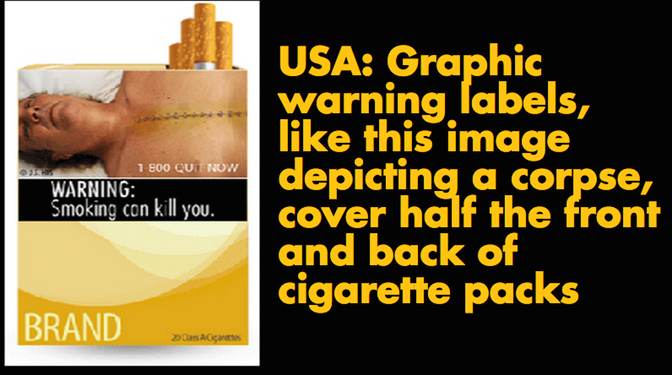
smoking hero image Screen Shot 2015-09-29 at 4.09.25 pm Screen Shot 2015-09-29 at 3.49.14 pm Screen Shot 2015-09-29 at 3.39.09 pm Screen Shot 2015-09-29 at 3.43.09 pm Screen Shot 2015-09-29 at 3.58.48 pm

Even though India continues to buckle under the pressure of the tobacco lobby, world-over 80 countries have more than 60% graphic warnings on cigarette packs.

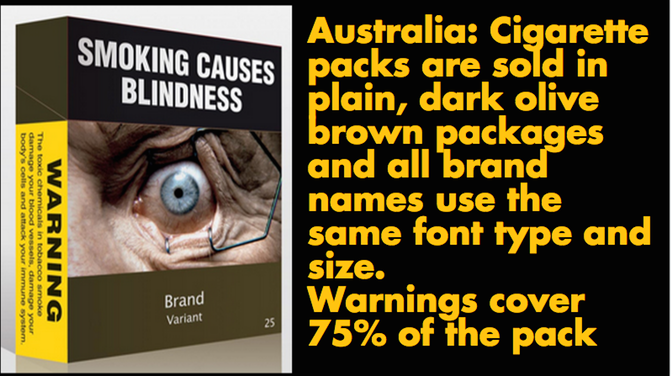
From puss-oozing, mouth tumours in Thailand to skulls in Romania, cigarette packs around the world vividly warn of the perils of smoking. Australia has the world’s toughest restrictions on cigarette packets. They sell tobacco in drab, brown boxes without distinguishing features other than brand and product name.

India, on the other hand, is ranked at 136 out of 198 countries that include pictorial health warnings on tobacco packaging. This is lower than the 123rd position that the country had in 2012.

Do Pictorial Warnings Work?

Yes. Big warnings plant the first seed of doubt. According to WHO, nearly 67% of smokers in Brazil and New Zealand and 44% in Canada and Thailand wanted to quit smoking as a result of graphic pictorial warnings.

Warnings act as intervention, perhaps why policymakers urgently need to make warnings larger and more graphic because noticing the warnings is the first step toward getting smokers to think about and attempt to quit.

Major Cardiologists Demand 85% Coverage

Heart diseases kill 26% people in India and tobacco is a huge risk factor. What’s worse, tobacco related diseases are easily preventable but they cost India two times more than the costs incurred to treat cancers.

People must realise the high stakes of using tobacco, not just for themselves but also their families. It is only through measures like the 85% pack warnings, that we can reach our national target of 30% relative reduction of current tobacco use.
– Prof. K. Srinath Reddy, President, Public Health Foundation of India.

Tobacco kills 10 lakh Indians every year.

Immediate steps should be taken to tackle tobacco use in India. Strong control measures are critical at this time and we demand 85% warnings on both sides of all types of tobacco packs.
– Dr KK Aggarwal,President, Heart Care Foundation of India.

At present, pictorial health warnings cover 40% of the principal display area of tobacco packages in India.

Recent studies show that up to 94% of users of both smoking and smokeless products have no intention to quit. This points to the fact that our tobacco control efforts are not adequately highlighting the heinous effects of tobacco use.
– Dr H.K. Chopra, President, Cardiological Society of India.

While tobacco companies exploit the entire cigarette pack, including the cigarette, as a sophisticated communications tool, policy makers are far less creative.

Why doesn’t the government exploit the same techniques to dissuade consumers which the tobacco companies use to attract smokers? Since the companies stamp their brand name on each cigarette, why not put a health warning there too?

Here, I’ve come up an example of a cigarette carrying the words “Smoking kills”. Anyone listening?

Would you fancy flaunting a cigarette if it looked like this death stick?

Indonesia’s Marlboro Boys

Download (PDF, 477KB)

Philip Morris’ iQOS ‘Smells Like an Ashtray': Imperial Tobacco

http://www.nasdaq.com/article/philip-morris-iqos-smells-like-an-ashtray-imperial-tobacco-cm524936

According to a recent report, Philip Morris International Inc. ‘s PM newly launched device, iQOS, was criticized by tobacco maker Imperial Tobacco plc, which led to an unusual war of words.

Reportedly, Imperial Tobacco’s head of scientific regulatory affairs commented that “a lot of black crud” is deposited in the iQOS after usage making it smell “like an ashtray”.

Philip Morris launched the heat-not-burn cigarette alternative, iQOS, in Nov 2014 in Nagoya, Japan and Milan, Italy. The iQOS products combine the features of analogs and electronic cigarettes and heat the tobacco instead of burning it. iQOS was also launched in Switzerland in August this year.

Philip Morris conducted eight clinical studies on the device and long-term tests are underway. The company expects to submit the test results to the U.S. Food and Drug Administration in 2016.

The allegation comes at a time when tobacco makers are firing on all cylinders to find healthier alternatives to conventional cigarettes to battle the dwindling volumes of traditional cigarettes.

Reynolds American Inc.’s  RAI subsidiary R.J. Reynolds Tobacco Company and British American Tobacco plc (“BAT”), recently joined forces to leverage their technological knowhow to boost their presence in the unconventional cigarette space. The two companies will work on a joint research, development and technology-sharing framework to develop e-cigarettes through 2022 per the multi-year deal.

Further, in Dec 2013, Philip Morris International, carrying a Zacks Rank #3 (Hold), and Altria Group Inc. MO collaborated to ramp up the distribution of their unconventional cigarettes. While Altria sells Marlboro exclusively in the U.S., Philip Morris sells them internationally. Per the deal, Philip Morris will market Altria’s MarkTen e-cigarettes internationally and the latter will distribute two of Philip Morris’ heated tobacco products in the country. The two companies further expanded their agreement to include joint research, development and technology-sharing framework for developing their unconventional cigarettes.

7-Eleven at Cineleisure gets permanent tobacco sale ban; four other sellers suspended

http://www.straitstimes.com/singapore/health/7-eleven-at-cineleisure-gets-permanent-tobacco-sale-ban-four-other-sellers

SINGAPORE – The 7-Eleven store at Cineleisure Orchard is no longer allowed to sell tobacco products.

Its licence was permanently revoked by the Health Sciences Authority (HSA) after an employee was found to have sold tobacco products to minors under 18 years of age – the second time that this has happened at the outlet.

It was first suspended for 6 months in 2011.

“Despite its previous conviction, the outlet continued to commit the offence, resulting in its licence being revoked. It will no longer be allowed to sell tobacco products,” said the HSA in a statement on Monday. The worker, it added, was caught during the authority’s ground surveillance and enforcement activities.

Four other errant retailers – Hwa Soon Heng Mini-Supermarket, Tastebud Foodcourt, J Plus Ten Mini Mart and Nice Minimart – had their licenses suspended, and will not be able to sell tobacco products for six months as this is their first offence.

In its statement, the HSA also reminded tobacco retailers that they are responsible for all transactions taking place at their outlets, as well as for the actions of their employees.

“HSA urges all tobacco retail licencees to educate their employees on the law pertaining to the sale of tobacco products and for sellers to check the age of those who wish to buy tobacco products,” it said.

Under the Tobacco (Control of Advertisements and Sale) Act, anyone caught selling tobacco products to persons below the age of 18 can be fined up to $5,000 for the first offence and up to $10,000 for subsequent offences.

The retailer’s tobacco licence will be suspended for 6 months for the first offence and revoked for the second.

In the last three years, 37 tobacco retail licences were suspended and 22 were revoked.

HSA encourages members of the public who have information on the illegal sales of tobacco products to under-18 minors to call the Tobacco Regulation Branch at 66842036 or 66842037 during office hours.

NZ smoking rates decrease – but not as fast as Australia

http://www.nzherald.co.nz/lifestyle/news/article.cfm?c_id=6&objectid=11520097

Smokers are a dwindling group in New Zealand with tobacco consumption down 23 per cent in the past five years.

But anti-smoking advocates say rates here are still not falling as fast as in Australia, where the introduction of plain packaging has been credited with a 20 per cent drop in consumption in just three years.

The figures, supplied to the Ministry of Health by New Zealand tobacco manufacturers, show average cigarette consumption has declined 6.3 per cent each year since 2010 equating to a 23 per cent decline in consumption overall.

In Australia figures show consumption has plunged 13 per cent in the last year and 19.6 per cent in the three years since plain packaging laws and tobacco tax increases were introduced.

“Standardised packs and annual tax increases have provided a powerful double-whammy that’s saving many lives across the ditch,” said Smokefree Coalition Chair Dr Jan Pearson.

“New Zealand’s falling smoking rates must have big tobacco worried, but if we stopped playing ‘wait and see’ and introduced standardised packs we’d worry them even more and prevent a lot of sickness and suffering.”

The coalition and another group, Action on Smoking and Health (ASH), are calling on Government to make plain packaging legislation an immediate priority.

“Standardised packs are inevitable. Britain and Ireland will introduce them from May next year and the entire European Union is expected to do the same. Many other countries are considering the move and in years to come we’ll wonder what the fuss was about – just as we did with smokefree bars and workplaces,” Dr Pearson said.

“The evidence is clear that plain packaging stops tobacco companies’ ability to advertise through their clever and attractive branding. That means fewer people will die of smoking-related diseases, and fewer children will grow up to become the next generation of addicted smokers. Other states aren’t scared of big tobacco and we shouldn’t be either.”

ASH director Stephanie Erick said standardised packs and annual tax increases were just two of 13 measures Smokefree Coalition members advocate for through an evidence-based National Action Plan to achieve the Smokefree 2025 Goal.

She said smoking rates had reduced sharply in a generation – from 33 per cent of adults in 1983 to less than 15 per cent right now – but more could be done to become smokefree.

The Smokefree National Action Plan was developed by the smokefree sector pending the Government’s development of a strategy towards Smokefree 2025.

The pending development of a governmental tobacco control plan was announced by Associate Minister of Health Peter Dunne recently, during his launch of the Alcohol and Drug Policy in August.

Plain packaging legislation could decrease number of smokers in NZ even further

http://www.maoritelevision.com/news/national/plain-packaging-legislation-could-decrease-number-smokers-nz-even-further

According to the Ministry of Health, there are less smoking adults in New Zealand. In 1983, 33% of adults were smokers, compared to 15% right now. But smokefree organisations say the Government need to make plain packaging of cigarettes an immediate priority.

Australia have taken the lead and have seen results since implementing plain cigarette packaging.

Figures show that in the last year, the consumption of cigarettes in Australia has decreased by 13%. In the last three years since the plain packaging and tobacco tax increases came in to effect, consumption of cigarettes has plunged 19.6%.

Smokefree Coalition Chair and National Smokefree Working Group member Dr Jan Pearson says, “Standardised packs and annual tax increases have provided a powerful double-whammy that’s saving many lives across the ditch,”

The evidence is clear that plain packaging stops tobacco companies’ ability to advertise through their clever and attractive branding. That means fewer people will die of smoking-related diseases, and fewer children will grow up to become the next generation of addicted smokers. Other states aren’t scared of big tobacco and we shouldn’t be either.”

Cigarette Exposure In Early Life Increases Risk Of Behavioral Problems

http://www.scienceworldreport.com/articles/30559/20150928/cigarette-exposure-in-early-life-increases-risk-of-behavioral-problems.htm

Children who are exposed to tobacco early in life may be at a higher risk of behavioral problems later in life than counterparts who are not exposed, according to a recent study published in the journal.

During the study, researchers analyzed data on pre- and postnatal exposure to tobacco in the homes of 5,200 primary school children, noting how association is stronger when exposure takes place both during pregnancy and after birth.

The researchers assessed both prenatal and postnatal exposure to tobacco smoke in the home with the help of a standardized questionnaire completed by the parents. Behavioural disorders were assessed via the Strengths and Difficulties Questionnaire (SDQ) used to assess the behavioural and psychosocial functioning of the children, which was also completed by the parents.

“Exposure to ETS in the postnatal period, alone or in association with exposure during pregnancy, increases the risk of behavioural disorders in primary school children,” added Isabella Annesi-Maesano, Inserm Research Director.

Findings revealed that exposure to ETS during prenatal and postnatal periods was a concern for 21 percent of the children in the study, with conduct disorders showing an association to ETS exposure in children, as well.

Researchers noted how the observations seem to confirm previous studies carried out in animals, i.e. that the nicotine contained in tobacco smoke may have a neurotoxic effect on the brain. During pregnancy, nicotine in tobacco smoke stimulates acetylcholine receptors, and causes structural changes in the brain. In the first months of life, exposure to tobacco smoke generates a protein imbalance that leads to altered neuronal growth.

“Our data indicate that passive smoking, in addition to the well-known effects on health, should also be avoided because of the behavioural disorders it may cause in children,” the researchers concluded.

Blackburn-based e-cigarette manufacturer set to fight ‘unfair’ ruling

http://www.lancashiretelegraph.co.uk/news/13788912.Blackburn_based_e_cigarette_manufacturer_set_to_fight____unfair____ruling/

AN EAST Lancashire electronic cigarette manufacturer will formally challenge an EU directive this week which it says breaches European Union law and would put its industry at an unfair trading disadvantage.

Blackburn-based Totally Wicked is the only e-cigarette firm to win the right to challenge Article 20 of the EU Tobacco Products Directive (TPD), which will bring e-cigarettes and e-liquid within its regulatory scope as a ‘tobacco-related product’ – despite not containing tobacco.

It means e-cigarettes would be subject to more stringent regulation than some tobacco products.

And the company, which believes the TPD is likely to adversely impact the availability of good quality, electronic cigarettes and e-liquids, will formally challenge its validity at the Court of Justice of the EU (CJEU) in Luxembourg on Thursday.

Totally Wicked managing director Fraser Cropper said: “It is crucial that our industry is allowed to mature within a proportionate regulatory framework, which supports appropriate controls and safety requirements, and necessary social responsibility and continues to provide consumer choice to maximise the enormous potential of these products. Article 20 of this directive patently will not deliver this environment.”

Totally Wicked’s challenge is based on its view that Article 20 of the TPD represents a disproportionate impediment to the free movement of goods and the free provision of services, places electronic cigarettes at an unjustified competitive disadvantage to tobacco products, fails to comply with the general EU principle of equality, and breaches the fundamental rights of electronic cigarette manufacturers.

Left to develop under proportionate consumer regulation, e-cigarettes have the potential to render tobacco obsolete and prevent millions of deaths from smoking, a company spokesman added.