Clear The Air News Tobacco Blog Rotating Header Image

Smoking Ban

Up to the government to make smoking ban work

SCMP

Hongkongers are known for being resourceful and innovative, so it comes as no surprise our city’s smokers lost no time adapting to the extension of the smoking ban to bars and entertainment venues. In as little time as it takes to light up, they found ways around the ban by moving to upstairs or out-of-the-way bars prepared to tolerate them, or even standing in a street-front bar with one foot on the pavement, blowing cigarette smoke outwards.

If just some of them get tired of it and give up smoking, and fewer young people take it up, then from a community health point of view, the long fight to bring in the ban in the face of opposition from licensees will have been worth it. The prospect of a fixed HK$1,500 fine on offending smokers that begins next month should help.

There is, however, a need for the ban to be better enforced. Bar owners should not tolerate the breaking of the law on their premises and they certainly should not facilitate it. But they are not held legally responsible if their customers choose to smoke. It is therefore unrealistic to expect them to ensure the ban is strictly observed. This can only be done by stepping up monitoring by inspectors.

Bars, pubs and massage and mahjong parlours are struggling to adapt, according to the Hong Kong Bar and Club Association, with business down 20 to 40 per cent in bars and clubs, by a third in mahjong parlours and by half in massage parlours. As a result, more than 30 bars will likely close, it says. But it is difficult to know how much of this is attributable to the smoking ban, given that many businesses are suffering during the economic downturn.

Those prepared to stick it out may well find that their concerns about the ban are premature. For every smoker, there are three non-smokers. No one knows how many non-smokers – consciously or not – bypassed bars and clubs to avoid second-hand smoke for health or aesthetic reasons, or because their friends preferred to socialise elsewhere. The priority, though, is protecting public health. The ban must be effectively enforced if that is to be achieved.

Up to 40 pubs may close, massage and mahjong parlours also suffer

Amy Nip, Austin Chiu and Dan Kadison – SCMP

More than 30 bars are on the verge of closing as a result of the ban on smoking in entertainment venues, according to the Hong Kong Bar and Club Association. Massage and mahjong parlours have also been hit hard, the industry says.

Business at bars and pubs had dropped 20 per cent to 40 per cent since the smoking ban came into force, the association said.

Business at massage parlours had halved, according to associations representing the sector. Most mahjong parlour operators interviewed said their business was down by about a third.

Some 30 or 40 bars, out of a total of 800 in the city, could close in the near future, Hong Kong Bar and Club Association vice-chairman Chin Chun-wing said. Up to 10 bar owners had sold their businesses recently.

While some smokers said they now preferred going to upstairs pubs – some of which are turning a blind eye to the ban – Mr Chin said others had simply stopped going to bars.

Charlie Chair Sai-sui, a 25-year veteran of the industry and operator of the Schooner Pub & Karaoke in Tsim Sha Tsui, said he was making a loss of about HK$30,000 a month in an industry that was experiencing a “bloodbath”.

At Delaney’s Irish pub in Tsim Sha Tsui, general manager Colin Williams said it was too early to judge the smoking ban’s effect, as “July is notoriously bad anyway”. He estimated receipts had dropped 5 per cent because daytime customers were no longer stopping by for a cup of coffee and a cigarette.

Other patrons, however, were now bringing their children to the pub and that was helping offset losses. Also, evening customers, mostly overseas visitors, were “used to these [smoking] bans already”, he said.

Chow Chun-yu, chief executive of the Hong Kong Licensed Massage Association, said customers would rather go to mainland parlours because they could smoke there.

A supervisor at the Tai Sam Yuen mahjong parlour in Sham Shui Po said the smoking ban had been more damaging to the business than the global economic crisis. It had caused business to fall by a fifth and the parlour could close at any time.

And a general manager at mahjong parlour operator KC City said business at her eight parlours was down 40 per cent compared to July last year. Four-fifths of customers were smokers, she said.

But James Middleton, chairman of Hong Kong-based Clear The Air’s anti-tobacco committee, said smoking bans had not hurt the catering industry in other countries.

Overall, till receipts in places that had enforced smoking bans had stayed the same or, in most places, risen by 5 per cent to 12 per cent, he said. Hong Kong had seen “the biggest up” in business, even with a partial ban, of any city, he said.

“Restaurant turnover [in Hong Kong] has increased 29 per cent since before the ban,” Mr Middleton said. “And restaurant turnover here includes bars … of 7,000 licensed premises, [only] 1,000 applied for an exemption [from the smoking ban] and were granted an exemption.”

One reason for the increase was that Hong Kong families were able to bring their young children to the smoke-free establishments, he said.

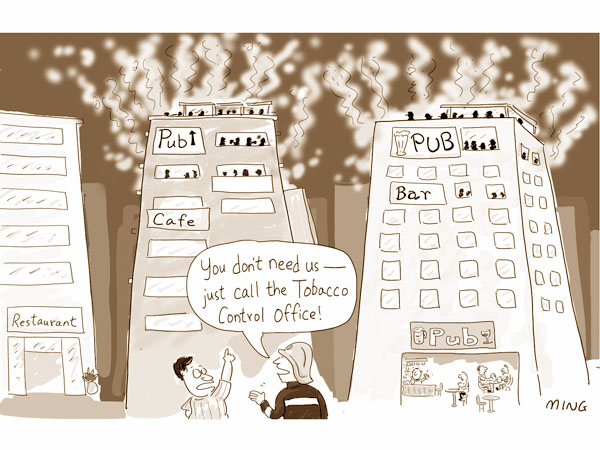
SCMP Cartoon on Smoking Ban

SCMP

scm_news_cartoon8

Many feel free to flout smoke ban

Amy Nip, Austin Chiu, Dan Kadison and Peter So – SCMP

Some venue operators turn a blind eye, while others help smokers bend the rules

Patrons of bars and entertainment venues are flouting the ban on smoking in such places a month after it took effect, with some operators saying they can’t stop them from doing so and others apparently providing ways for them to bend the rules.

While venues in popular entertainment areas open to the street are mostly smoke-free, the haze gets thicker in upstairs pubs and places away from busy tourist locations.

Operators of traditionally smoke-filled mahjong parlours in particular say they have a tough time persuading customers not to light up.

“We are stuck between the customers and the government. We are the men in the middle,” Hui Chak-man, manager of Sham Shui Po Ho Kong Mahjong, said, adding he had given up trying to stop customers smoking after fruitless attempts.

“Now I only remind them about the consequence of smoking and say `you might want to go to the back alley’,” he said, referring to a fixed fine of HK$1,500 for people caught smoking or carrying a lit cigarette, cigar or pipe in no-smoking areas that will come into effect in September. “If they don’t listen, I will just let them be – I have fulfilled my duty.”

Of 210 complaints received and 15 summonses issued by the Health Department’s Tobacco Control Office since July 1, 112 complaints and 15 summonses related to mahjong parlours. In addition, 20 complaints and four summonses went to designated mahjong rooms in clubs.

The office received 68 complaints and issued three summonses for offences in bars. Massage centres and bathhouses followed, with nine and one complaints respectively.

The manager of the Tung Cheuk Association mahjong parlour in Tsim Sha Tsui, Peter Wong, said he could not afford to lose his customers. “But at the same time I can’t do them a favour by offering ashtrays now. What we can do is place a bucket outside our shop in the corridor of the shopping mall. What they do out there is none of our business.”

Post reporters found smoking pub-goers in Causeway Bay were moving upstairs to dodge inspectors. They also noticed that the farther away the bars were from the busiest streets and tourist areas, the more customers were breaking the ban.

In Lan Kwai Fong, no customers were seen smoking in bars or clubs on the ground floor. But a table in the front of a bar in Wyndham Street had one end sticking out into the street with an ashtray on it.

Drinkers said they had seen people smoking inside and facing outside and using the ashtray.

At another pub on the same street in Central, once known for its hookahs, or water-pipes, customers were sitting inside the shop smoking a hookah on a table top, half of which was also outdoors. But the operators said they no longer provided the devices and customers had brought the hookah and moved the table themselves.

As the clock ticked past 1am, two men were seen smoking at a bar in SoHo, Central.

When asked why smoking was allowed, the bartender said: “We officially close at 1am. They were the only customers left so I let them smoke. Before 1am, no smoking is allowed.”

The smoking customers said they were not worried by the smoking ban and had no intention of refraining from smoking in bars. But they said they usually avoided ground-floor venues and instead visited upstairs bars, where they were less likely to be caught.

A check of the strip of trendy bars along Knutsford Terrace in Tsim Sha Tsui found most people were complying with the ban and lighting up in outdoor seating areas.

Only one person was seen smoking inside. He entered a bar with a lit cigarette and took a quick puff as he made a beeline for the washroom.

Medical sector legislator Leung Ka-lau was not sure if fewer people smoked after the ban. Nevertheless, he reminded smokers that they faced a higher risk than non-smokers of sudden death from heart attack.

High-rise pubs a draw for sneaky smokers

Amy Nip, Austin Chiu and Dan Kadison – SCMP

Smoke rises, and these days so do smokers.

As the month-old ban on smoking in all indoor entertainment venues takes hold at street level, smokers are moving to upstairs premises where managers either turn a blind eye or have given up trying to stop their patrons lighting up.

Pub checks by South China Morning Post reporters this week has found few people dare to smoke in bars on the ground floor in Central and Tsim Sha Tsui. But upstairs – including one high-rise building in Causeway Bay that has several pubs – it is a different story.

On Wednesday night, a handful of customers were seen smoking as they drank at one of the upper floor pubs where ashtrays were available.

Asked why smoking was allowed, the manager, who identified himself as Jaime, said staff could do little if customers insisted on smoking.

“We tried to advise regular customers not to smoke when the smoking ban came into force. But it was hard for us to keep pestering them … so if they don’t listen to us we give up,” he said, adding that ashtrays were not put out on tables but could be picked up from the bar.

The scene was similar at two other pubs on upper floors of the building.

“It is safe to smoke at upstairs bars, especially those high up in the building,” customer Man Cheung said. “The security guard on the ground usually tips off bar owners when Tobacco Control Officers arrive. Bars on first and second floors may not have enough time to act but those on higher floors are able to ask their customers to stub their cigarettes and take away the ashtrays.”

The ban is being felt elsewhere though, with operators saying more than 30 bars could close soon because of lost business. Massage centres say business has dropped by half and mahjong parlours report a drop of up to 40 per cent.

Sales ban may be only option

SCMP

Tracy Lam wrote in her letter “people uncomfortable about inhaling second-hand smoke can avoid designated smoking areas” (“Enough controls”, July 19). This is ridiculous. Are our streets designated smoking zones?

She claimed to be a non-smoker and then implied she is comfortable being a passive smoker.

If tighter controls over smoking are not possible, then the government should impose a total ban on tobacco sales for the sake of our health, not set out smoking areas.

V. Ang, Shau Kei Wan

Smokers banned by Welsh council from adopting or fostering children

Clare Hutchinson, Western Mail

A COUNCIL has become the first in Wales to impose a blanket ban on smokers adopting or fostering children.

Anti-smoking campaigners last night welcomed the move by Merthyr Tydfil council, but critics have pointed out there are already not enough foster parents in Wales.

They fear the changes might discourage potential carers from coming forward and could jeopardize the future of children already in the care of smokers.

Increasing numbers of local authorities, including Cardiff and Pembrokeshire, have banned smokers from fostering children under five but this is the nation’s first blanket no-smoking rule for foster carers and adopters.

Roslyn Rees, head of operational children’s services at Merthyr Tydfil council, said: “The health, safety and well-being of children and young people are at the heart of policies and practice related to children.

“We acknowledge that expecting all foster carers who currently smoke to give up immediately is not realistic and that it would be detrimental to remove children from stable foster homes because their carer smokes.”

Anti-smoking campaign group Ash Wales said the move was a step in the right direction. A spokesman said: “Children who are exposed to second-hand smoke are at serious risk of pneumonia, bronchitis, headaches and ear infections. Exposure to second-hand smoke has also been linked to the development and worsening of asthma in children.

“Young children are particularly susceptible to the effects of second-hand smoke because their lungs and airways are small and their immune systems immature. Being exposed to second-hand smoke during childhood may also increase the chance of developing chronic constructive pulmonary disease (COPD) and cancer as adults.

“It is however vital that in addition to protecting children from exposure to tobacco smoke, that smokers themselves are supported to quit. In introducing this measure we would urge the local authority to ensure that foster careers are given help and advice on how to quit smoking and how to take the necessary steps to make their home smoke free.”

But others have branded the move discriminatory.

Ex-smoker Pam Brown, 62, of Merthyr, is the adoptive mother of Independent councillor Adam Brown, who has distance himself from his council’s political group over the ban.

Mrs Brown said: “Would they rather a child stay in care than put them with a smoker? What about drinkers and recreational drug users? They can hide that, smokers can’t – it’s a very visible habit.

“I think it’s absolutely disgusting; our freedom on smoking was taken away when we were told we can’t smoke in pubs, but to be told we are not allowed to smoke in our own homes is ridiculous.”

Former Talksport presenter Jon Gaunt – who also spent time in care as a child – was famously sacked after branding a councillor who imposed a similar ban in England “a health Nazi”.

He told the Western Mail’s sister paper the Merthyr Express: “I was in care and the bottom line is the person who saved my life was my aunty Rosemary; she was a hospital matron and smoked like a trooper.”

The ban was condemning children to a life in care, he said. “Most kids who are in a care home, if they have the choice of passive smoking or the very real danger of abuse in a care home, they would choose a smoker every time.”

Tobacco ban spells end for smoky little Turkish cafes

TURKEY, Daren Butler, SCMP

Smokers in Turkey tempted to flout a new ban in cafes, restaurants and bars will be spared execution, as allegedly meted out in 17th-century Istanbul – but their prime minister has likened cigarettes to terrorism.

That’s a measure of how strongly Recep Tayib Erdogan feels about tobacco. Ottomann Sultan Murad IV is said to have roamed the streets ordering the execution of those who defied a smoking ban aimed at curbing coffeehouse sedition.

One of the world’s oldest prohibitions of smoking, Sultan Murad’s failed and, as tobacco’s popularity grew in Turkey, the saying “smoke like a Turk” took root in languages across Europe.

Mr Erdogan is the driving force behind the next phase of a widely popular ban that took effect yesterday. It aims to curb the habit in a country where 22 million people, including about half the adult male population, smoke.

But at a time of economic crisis, the prohibition – adding restaurants, cafes and bars to the places where smoking is not allowed – is viewed by a minority as a potential assault on their culture.

Mr Erdogan, who long since banned smoking in cabinet meetings, also faces opposition from owners of thousands of bars and cafes across the Muslim country, who see the ban as a threat to their business.

Some in the bar industry point out that the smoking ban coincides with the introduction of restrictions on alcohol advertising this month, but experts reject suggestions it is a stalking-horse for tighter controls on the sale of alcohol.

“Let’s keep alcohol and cigarettes separate. They are different things,” law professor Hayrettin Okcesiz of Akdeniz University said. “If there is a ban on alcohol, everyone should have the right to protest, but we shouldn’t see this is as step towards an alcohol ban.”

Among opponents are those who work in nargile, or water-pipe cafes, an ancient tradition that has enjoyed a revival in the past decade among locals and tourists. “This is the Ottoman culture that comes from our ancestors,” said cafe owner Ali Yogurtcu, 54. “We will protest if they try to ban this, but I don’t think they will try to destroy it.”

A meagre fine under Turkey’s ban – 69 lira (HK$350) against a ceiling of €500 (HK$5,475) in neighbouring Greece – masks fierce determination on the part of Mr Erdogan. His personal dislike of the habit may give the ban the momentum it needs to succeed in the world’s seventh-biggest cigarette market.

When the anti-smoking campaign was launched in 2007, he famously declared the struggle against cigarette use to be “as important as the struggle against terrorism”, words that resonate strongly in a country that has witnessed a bloody 25-year Kurdish guerilla insurgency.

In Turkey, 100,000 people are estimated by the Health Ministry to die annually from smoking-related illnesses – about 0.45 per cent of smokers. Globally, about 5.4 million die annually of smoking-related illnesses.

Surveys indicate about 90 per cent popular support for the smoking ban, which started last year in workplaces and shopping centres. The authorities say that has already lowered cigarette consumption slightly.

Support has been helped by a growing interest in healthy lifestyles as people enjoy greater prosperity (SEHK: 0803, announcements, news) and expect better standards of living. But there have been problems.

A group of convicts rioted at a prison in the southeastern province of Siirt, climbing on to the roof, lighting fires and throwing stones to protest at the ban on smoking in jail.

Smoking has also continued in some cafes in shopping centres, where retailers have complained about its impact on trade as the economy slumped nearly 14 per cent in the first quarter of the year.

These fuel doubts about whether the ban will be implemented in the thousands of smoky, male-dominated tea houses in towns and villages across Turkey where many men spend much of their free time, gossiping or playing backgammon.

Tea-house owners say more than 80 per cent of their patrons smoke.

Others say Mr Erdogan’s anti-smoking fervour reflects efforts to change society in a country where his Islamist-rooted Justice and Development Party (AKP) is accused by secularists of promoting a more conservative vision since it came to power in 2002.

“I think we have been heading towards a camouflaged alcohol ban,” said Tahir Berrakkarasu, who heads the Beyder association that represents cafes, bars and restaurants in Istanbul’s bustling Beyoglu district.

“Why is this happening? It means that alcohol isn’t wanted in this country,” he said, referring to what he says is a six-year government campaign targeting bars with a stream of taxes and bureaucratic obstacles.

The advertising restrictions on alcohol that take effect this month ban linking alcohol to food and cultural values: drink producers say they will severely curb their marketing ability.

Even though the authorities say implementing the smoking ban will be a challenge, they point out that Turks are receptive to change, citing the success of a 13-year-old ban on smoking in buses and the country’s adoption of the Latin alphabet in place of Ottoman Turkish script in 1928.

“We can see that the people who live in this land can adapt very quickly to change,” said Ubeyd Korbey, who chairs an anti-smoking association and played a role in drafting the ban. “And we now have a very decisive prime minister.”

Reuters

Enforcement Policy Forthe Regulation Of Smoking In Smoke Free Premises, Places And Vehicles

http://www.redcar-cleveland.gov.uk/main.nsf/5889bbc32b5b15ef8025729f00346179/$file/smoke%20free%20enforcement%20policy.pdf

Legal Responsibility of Bars and Nightclubs Owner

SCMP

Hong Kong is a world leader in environmental foot-dragging. From our toxic air to our mildly poisonous seas, we struggle to move our environmental-protection laws towards international standards. And that’s before you even talk about the environmental damage that is deliberately caused, such as the endless pouring of concrete into our country parks.

But there is one area in which Hong Kong seems to have been successful. In one short week we have managed to reduce substantially the number of plastic bags handed out in the city. I imagine that there are one or two people who aren’t in favour of reducing this environmental scourge, but that’s perhaps because none of these critics have accidentally inhaled one while swimming at Shek O.

In any case, our ingenious method of controlling the distribution of plastic bags is that if you want one at the supermarket you now have to pay for it. Some sources have estimated that this has resulted in an 85 per cent reduction in their use. I would guess that the average cost of my shopping at Wellcome or ParknShop is about HK$200 per visit. If I need three plastic bags to hold everything, I am looking at 0.75 per cent added to my bill. It has only been a bit more than a week, but I can guarantee that I have never and I will never pay that extra 0.75 per cent for the convenience of not having to stuff my briefcase full of mangoes or risk derision from my colleagues by carrying around a canvas bag.

And for one last comparison, look at the impact of the smoking ban. Under the rules, a smoker lighting up in the wrong place can potentially be fined HK$5,000. It’s no longer legal to smoke in bars and nightclubs and places like that, but it’s not the owner who gets fined, it’s the smokers themselves. Strangely, the owners don’t seem to have any legal responsibility at all.

A quick stroll through Lan Kwai Fong in the evening will reveal that there are plenty of smokers ready to risk the HK$5,000 fine to have the luxury of slowly poisoning themselves to death in a public area. But these same smokers can also be seen sporting environmentally friendly shopping bags when buying their air fresheners and anti-stain toothpaste.

When investing, we are all ready to give away the certainty of a small amount of money in favour of the possibility of some larger amount. But even the biggest risk-taker, who is prepared to lose hundreds of thousands of dollars on investment ideas or who will happily accept the near certainty of death from smoking, isn’t going to forgo that  50 cents at the supermarket.

Contact Alan Alanson at alan@alanalanson.com