Clear The Air News Tobacco Blog Rotating Header Image

India

Commerce ministry sacks Tobacco Board Chairman Kothati Gopal

http://articles.economictimes.indiatimes.com/2015-09-17/news/66642403_1_tobacco-board-tobacco-farmers-commerce-ministry

HYDERABAD: The commerce ministry has sacked the chairman of Tobacco Board, Kothati Gopal, after reviewing the instances of suicides by some tobacco farmers in Andhra Pradesh, one of the largest tobacco producers.

India is the third-largest global producer and second largest exporter of tobacco.

The ministry has on Tuesday asked the 1992 batch Tamil Nadu cadre bureaucrat to proceed on leave with immediate effect until further orders have been given.

In a tweet on Wednesday evening, the Union Minister of State for Commerce and Industry Nirmala Sitharaman, said she reviewed “the situation arising due to death of tobacco farmers.”

A statement issued by the ministry said the minister took a detailed review of the situation “consequent upon reported instance of some tobacco farmers having committed suicide on ac count debt burden”.

“The commerce and industry minister took cognizance of the absence of chairman, Tobacco Board, and his visit to Italy in the midst of this crisis, which shows lack of sensitivity to the farmers’ issues,” said the ministry in a statement.

Apart from asking Gopal to proceed on leave, the ministry has directed a senior officer to take additional charge as the chairman of Tobacco Board. The minister, through review, found that only 142.6 million kg of tobacco was lifted by the trade in Andhra Pradesh till Monday out of the 172 million kg and directed the Board to take immediate steps to facilitate disposal of the balance quantity of 30 million kg by month-end.

Haryana bans tobacco products: All the rules related to tobacco bans in India

http://indiatoday.intoday.in/education/story/ban-tobacco-products/1/468923.html

“Beacuse tobacco is responsible for an impressive one-third of cancers.” – Bernard Levin

Considering the harmful health effects of tobacco, the Haryana government on Tuesday, September 8, completely banned manufacture and sale of all the products containing tobacco in the state. State Food and Drugs Administration has also issued a notification regarding the same. Violation of the ban is punishable with imprisonment up to six months or fine up to 1 lakh rupees.

Here are some facts on the recent ban on the tobacco products in Haryana:

  • The ban includes manufacturing, distribution, storage and sale of the tobacco products
  • The tobacco products include gutka, pan masala, flavoured or scented tobacco, kharra and other similar products containing tobacco
  • The ban also includes mix of other ingredients such as heavy metals and anti-caking agents except the specifically permitted such as silver leaf, binders, flavours, scents, and fragrances
  • These substances were banned due to presence of Nicotine which already has been added by state government in the list of poisonous substances
  • Other tobacco products containing tobacco which are available in market are also included in it
  • Other items in the list are: Acetic acid, Sulphuric Acid, Hydrochloric Acid, Phosphoric Acid, Hydrofluoric acid, Perchloric acid, Formic acid, Hydrocyanic acid, Nitric Acid,
  • Oxylic Acid, Potassium Hydroxide, Sodium Hydroxide, Hydrogen Peroxide, Formaldehyde and Phenol.

Some facts on the tobacco ban in India:

1. Prohibition of sale of tobacco products in an area within 100 yards of any educational institution was brought into force on December 1, 2004.

2. In 2007, Chandigarh became the first city in India to become ‘smoke-free’. The architect of smoke-free Chandigarh, Hemant Goswami, was also awarded the Global Smoke-Free Partnership Award for the initiative.

3. Shimla also followed the Smoke-Free Chandigarh model to become smoke-free.

4. A rule to ban smoking in public places was instituted nationwide October 2, 2008 under the Prohibition of Smoking in Public Places Rules, 2008.

5. Places where smoking is restricted include auditoriums, cinemas, hospitals, public transport (aircraft, buses, trains, metros, monorails, taxis) and their related facilities (airports, bus stands/stations, railway stations), restaurants, hotels, bars, pubs, amusement centres, offices (government and private), libraries, courts, post offices, markets, shopping malls, canteens, refreshment rooms, banquet halls, discothèques, coffee houses, educational institutions and parks.

6. Rules mandating pictorial warnings on tobacco products were first notified on May 3, 2009 and came into force on May 31, 2009

7. The government began screening two anti-tobacco advertisements, titled “Sponge” and “Mukesh”, in movie theatres and on television from October 2, 2012

8. It is also mandatory for theatres to display a disclaimer on-screen whenever smoking scenes are depicted in the movie.

Tobacco is injurious to health. Say NO to tobacco.

India’s soft stand on tobacco draws fire

http://timesofindia.indiatimes.com/india/Indias-soft-stand-on-tobacco-draws-fire/articleshow/48863430.cms

DILI (TIMOR LESTE): Delay by India to implement larger pictorial warnings on packs of tobacco products came up for criticism at the World Health Organisation’s regional meet here as delegates assessed tobacco-control measures by countries in the region.

“We are going to emphasise on it (delay by India) at the roundtable. Even Indonesia which is not signatory to WHO’s framework convention on tobacco control (FCTC) has implemented 40% pictorial warning on both sides of packs. India, being an important member and such a large country, has only 40% on one side,” WHO Regional Director (South East Asia) Poonam Khetrapal Singh said.

India’s health minister J P Nadda Nadda was absent at 68th South East Asia Regional Committee meeting which is being attended by health ministers from nine countries of the region. Health ministry officials cited domestic engagements as reasons for Nadda’s absence. India was represented by a senior official of the ministry at the meeting of the highest decision-making body of WHO for the region. Thailand’s health minister also couldn’t attend the meeting.

Nadda though has maintained that the health ministry is determined to implement stricter tobacco control measures, including larger pictorial warnings on packets of tobacco products.

The health ministry had earlier notified to implement 80% pictorial warnings on packs of all tobacco products from April 1. However, the government deferred the move following an interim report by a parliamentary sub-committee asking the ministry to put the decision on hold till it consults all stakeholders and submits a final report.

unnamed (3)

The government’s decision to defer implementation of larger pictorial warnings had upset several public health groups.

“It requires political will. All other countries in the region have set example by prescribing warnings up to 90% on both sides. India being an important player in the region has shown poor performance,” said a senior WHO official advocating for stronger provisions to control advertising and marketing of tobacco products.

Emphasising that India is a signatory to FCTC which mandates tobacco control measures, Khetrapal Singh said, “We advise countries on what they should be doing for good health of their people and then leave it to them to either follow our advice or if they choose not to. These are countries which are signatories to a resolution that was adopted in the World Health Assembly. Respecting their sovereign right, we leave it to them to now implement whatever they themselves have adopted.”

She said tobacco use is an important “risk factor for non communicable diseases” and hence high on WHO’s agenda.

Dili, the capital of the host country, has the highest percentage of tobacco consumers in the region. Though the country, which earned its independence from Indonesia just about a decade back, has implemented several tobacco control measures, it proposed WHO to focus on the issue to be able to share experiences from other member countries, Khetrapal said.

Experts said delaying larger pictorial warnings is likely to have a serious impact on the health of those who are less educated and poor. Recently, a study by National Council of Applied Economic Research (NCAER) and University of Maryland revealed about 46% of illiterate men smoke, while only 16% of college graduates are hooked to tobacco. For the uneducated, larger pictorial warnings could be a way to create awareness about the dangers of tobacco use.

India’s $16 Billion Smoking-led Health Crisis

http://www.indiawest.com/blogs/india-s-billion-smoking-led-health-crisis/article_9d0956a8-52df-11e5-be1b-67e51a6e11de.html

New Delhi: In January, the government asked for public opinion on tougher new laws to curb smoking: To raise the minimum smoking age to 21 from 18, and to ban the sale of single cigarettes, which account for 70 percent of nationwide cigarette sales.

People responded enthusiastically; 45,000 emails and 100,000 letters poured in to the health ministry, as Reuters reported earlier this month. What they said, however, is not known because the government hasn’t yet read the messages, according to a health ministry representative quoted in the story.

Like those messages, the World Health Organization’s Report on the Global Tobacco Epidemic 2015 is largely ignored in India. Its single-line message: Raising tobacco taxes can help curb smoking.

Curbing smoking is very important to India for two reasons:

* About one million Indians die from smoking-related causes every year, which are among the top three ways to die.

* Smoking also saps Indians of money; more money, it emerges, than it earns for the government.

Indians aged 35 to 69 spent Rs.104,500 crore ($15.9 billion) in 2011 on diseases associated with tobacco-including cancer, respiratory diseases, tuberculosis and cardiovascular diseases. This figure is almost six times as much as central excise tax collections from all tobacco products that year, according to the Indian government, WHO and the Public Health Foundation of India.

To put the health cost of tobacco in further perspective, it exceeded the combined annual state and central government expenditure on health care by 12 percent in 2011.

Taxes on cigarettes rise – not enough – but they do. Bidis are the problem.

A 10 percent price increase on tobacco products could cut consumption between 2-8 percent in developing nations, according to the WHO. Tax hikes increase prices, which in turn lower demand and protect people from the ill-effects of tobacco.

“Raising taxes is a win-win situation,” said Arun Thapa, acting WHO representative to India. “It’s good for human health and for the country’s fiscal health.”

Over the last 19 years, taxes on cigarettes in India have risen 1,606 percent. That isn’t quite enough and the six-tier tax structure is so complex – based on stick lengths and filters – that companies manipulate it with relative ease to keep demand intact.

The biggest problem in curbing tobacco use lies with the influence wielded by those who make the humbler – but more damaging – cousin of cigarettes, the bidi.

Taxes on a pack of bidis are 7 percent of the retail price, less than a tenth of the WHO’s suggested level of 75 percent. A 20-stick pack of best-selling cigarettes is taxed around 60 percent of the retail price.

Bidi smokers make up 61 percent of the nation’s 120 million smokers, according to the Global Adult Tobacco Survey 2010. This is a conservative estimate. Some studies peg the numbers of bidi smokers higher, at 73 percent and even 85 percent.

Bidi smokers face a higher risk of developing potentially-fatal chronic obstructive pulmonary disease, among other illnesses, because tobacco is packed more loosely in bidis, requiring smokers to inhale more strongly.

But the bidi industry has consistently squeezed concessions from the government.

Millions of jobs and livelihoods at stake, so taxes must stay low, argue bidi barons.

Here are some concessions the government gives the bidi industry:

Handmade bidi units (98 percent of bidis are handmade) producing less than two million sticks in a year are exempt from excise duty.

Bigger bidi makers pay a duty of 1.6 paise per handmade stick and 2.8 paise per machine-made bidi. The duty on cigarettes varies between Rs.1.28 and Rs.3.37 per stick.

Some eight million people work as bidi rollers nationwide, said a representative of the All India Bidi Industry Federation.

“Imposing taxes on bidis and introducing pictorial warnings on bidi packs would lower demand,” said Sudhir Sable, secretary, All India Bidi Industry Federation. “Any fall in production would jeopardise the jobs of bidi rollers. It would also adversely impact tobacco farmers, as well as the thousands of corner shops selling the product.”

Increasing taxes on bidis would invariably increase the illicit trade in bidis, leading to the proliferation of fake bidis, Sable argued. It would also deprive states and the central government of tax revenue.

These arguments do not wash, say experts.

No socio-economic case for low bidi taxes, contend experts

In 2013, the bidi industry contributed less than three percent to the government’s central excise collection from tobacco products, not surprising, given the low excise duty it pays.

A Public Health Foundation of India study says there is indeed scope for taxes on bidis to be increased.

“Doubling bidi excise would help cut consumption by 40% and increase tax revenue by 22%,” said Monika Arora, director, Health Promotion and Tobacco Control Initiatives, Public Health Foundation of India.

Essentially, the argument goes, higher tax rates would offset any loss of excise from fall in consumption. In the bargain, spending on “useful” goods and services will grow.

“Money not spent on bidis or cigarettes will not disappear from the economy,” said Prabhat Jha, founding director of the Center for Global Health Research, University of Toronto. “It will be spent on other products which generate employment.”

Additional revenue could help the government meet the cost of transitioning bidi workers to other means of employment. The government has previously considered a cess on cigarettes to encourage farmers to switch from tobacco to other crops.

So, why not tax all segments of the tobacco-products industry, experts suggest, to fund a gradual transition? Bidi workers, among some of IndiaÂ’s most disadvantaged people, can only benefit.

(In arrangement with IndiaSpend.org, a data-driven, non-profit, public interest journalism platform. Charu Bahri is a freelance writer and editor based in Mount Abu, Rajasthan.)


‘In public interest’, Rajasthan slashes tax on cigarettes, gutka

http://indianexpress.com/article/india/india-others/in-public-interest-rajasthan-slashes-tax-on-cigarettes-gutka/

The move has come under severe criticism from health associations and the opposition.

The state government reduced VAT on “tobacco and its products excluding bidi” to 45 per cent, from the existing 65 per cent, saying it was “expedient to do so in public interest”.

Barely six months after being honoured by the World Health Organisation (WHO) for its strict tax regime — one of the highest in the country— on tobacco products, the Rajasthan government slashed taxes on tobacco products, like cigarettes and gutka, by as much as 20 per cent.

In an order passed on Friday last week, the state government reduced VAT on “tobacco and its products excluding bidi” to 45 per cent, from the existing 65 per cent, saying it was “expedient to do so in public interest”.

The move has come under severe criticism from health associations and the opposition, Congress, who claim it will translate into a direct rise in sale and consumption of tobacco products.

On pan masala too, VAT was reduced to 35 per cent from 65 per cent.

However, the existing 65 per cent VAT on bidis has been left unchanged.

“The massive cut in the tax on tobacco is directly playing with the health of the people of Rajasthan,” state’s former chief minister, Ashok Gehlot, said.

“It seems, the state government has joined the select group of BJP MPs, who said earlier this year that bidis and tobacco were not harmful,” he added.

In December last year, the Vasundhara Raje government received the World No Tobacco Day award from the WHO’s South-East Asia Regional Office (SEARO).

The award was given to the state finance department for its strict tax regime on tobacco.

“States like Rajasthan have taken significant steps to tax all tobacco products including bidis at 65 per cent (VAT). This has resulted in a concomitant increase in bidi prices in the state. In recognition of this initiative, WHO has conferred the World No Tobacco Day 2014 Award to the Government of Rajasthan,” the WHO had said in a statement issued last year.

The WHO advocates higher taxes — at least 70 per cent of retail prices — on tobacco products as a major deterrent to curb consumption and “leading to large reductions in the death and disease caused by tobacco use”.

“The high tax was getting the state government Rs 750 crore in revenues and was curbing consumption too. And the government itself had admitted in the Assembly, in March, that the expenditure on curing tobacco-related aliments — Rs 1,160 crore — was much higher,” said Satyen Chaturvedi, representative of the Rajasthan Voluntary Health Association.

However, Health minister Rajendra Rathore defended the government’s decision.

“High VAT does not mean low consumption, otherwise tobacco use would vary across states based on VAT. The government is committed to curbing tobacco use and we are doing it through various campaigns,” said Rathore.

How The Tobacco Industry Wins Friends And Influences Policy

http://www.newslaundry.com/2015/06/02/how-the-tobacco-industry-wins-friends-and-influences-policy/

It’s time for the Indian government to protect public health policies from vested interests in the tobacco industry.

Shyama Charan Gupta is one of the members of the parliamentary committee on subordinate legislation that had recently suggested a delay in the implementation of larger pictorial warnings on tobacco products. He owns the Shyam group of companies that produces the brand, Shyam Beedi, which has an annual turnover of around Rs 250 crores from beedis alone.

While the issue of conflict of interest is now entering public discourse, the tobacco industry has been operating more insidiously for some time now to subvert public health policies.

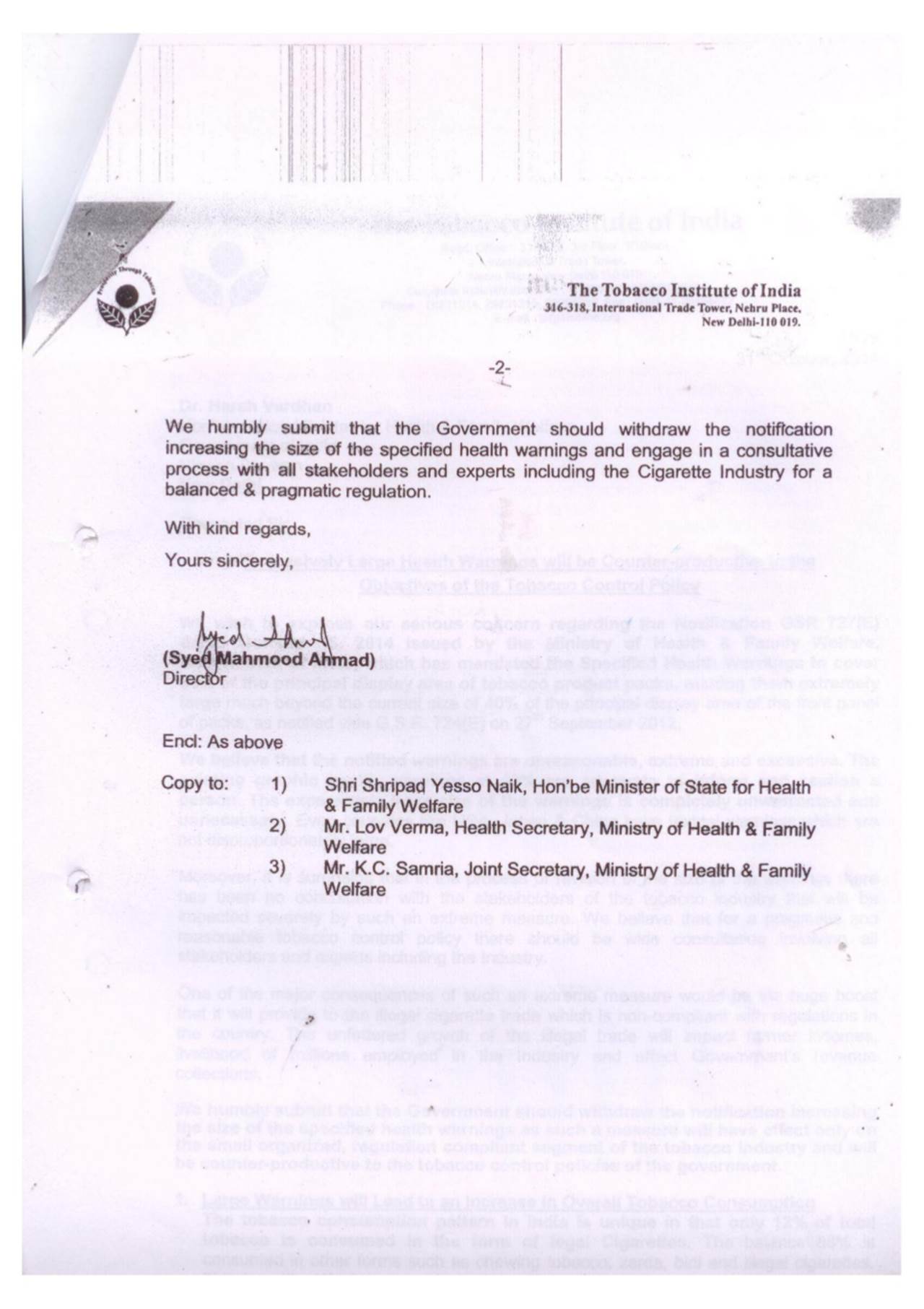
Information received under the Right to Information (RTI) Act has revealed that the Tobacco Institute of India (TII) sent repeated representations to the Union Ministry of Health and Family Welfare asking it to withdraw the notification mandating large-size pictorial health warnings.

TII has, in the past, resisted tobacco-control proposals, taking public positions against those measures in the media. The Federation of Indian Chambers of Commerce and Industry (FICCI) also sent representations to the health ministry as well as the commerce ministry arguing against the proposed amendments to the national tobacco control law, including the notification with regard to the large-size health warnings.

A similar representation was sent by the Associated Chambers of Commerce and Industry of India.

A closer look at some of these organisations might explain their pro-tobacco stand.

The present and the past directors, Sanjiv Puri, Syed Mahmood Ahmad and Udayan Lall, of the TII, which claims to be “a repository of reliable information on the industry and is privileged to be consulted by government, parliamentary committees for information and policy recommendations on tobacco issues” are employed by the ITC.

In the past, Anup Singh held directorship on the board of TII as well as tobacco companies including ITC, Asia Tobacco Company, and Surya Nepal Ltd, at the same time. Similarly, Sai Sankar and Raymond Noronha, who have been directors of TII, were simultaneously on board of the VST Industries, the third-largest cigarette manufacturer in India.

Tobacco industry representatives also hold prominent positions at FICCI. K K Modi, the Chairman of Modi Enterprises, which includes Godfrey Phillips, the second-largest cigarette manufacturer, is a current member of the FICCI steering committee and has served as the past president of FICCI.

Similarly, K K Modi, Samir Modi (Managing Director at Modi Enterprises), Sarthak Beharia (Group President of the Godfrey Phillips) and Deveshwar (Chairman of ITC) are all members of the FICCI executive committee.

FICCI has, in fact, given a corporate social responsibility award to ITC.

According to the World Health Organisation as well as Framework Convention on Tobacco Control, a United Nations treaty on tobacco control, which India ratified in 2004, there is an inherent contradiction in the tobacco industry doing CSR as the core functions of the industry are in conflict with goals of public health policies with regards to tobacco control.

In this context, it is ironical that the Confederation of Indian Industry (CII) in partnership with ITC formed a Centre of Excellence for Sustainable Development with an aim to help companies achieve social and environmental objectives along with economic ones. Chairman of advisory council Deveshwar of the center is the current chairman of ITC, who has also been a past president of CII.

Globally, it is a known tactic of tobacco companies to work through other groups. In fact, last month, the 12th annual Asia Pacific Tax Forum was held in Delhi (May 5 and 7) to discuss tax reforms in the region. Higher taxes on tobacco is a known effective strategy for tobacco control. However, the forum was co-organised by the International Tax and Investment Centre (ITIC). The website of ITIC mentions major tobacco transnationals among its sponsors, like Philip Morris International, British American Tobacco, Imperial Tobacco Limited and so on.

Its board of directors also include representatives of big tobacco companies. It has, in the past, held conferences to influence policy makers and subvert policies in the interest of tobacco industry. For example, on October 12, 2014, the morning before the sixth conference of the parties of the Framework Convention on Tobacco Control in Russia, ITIC hosted an exclusive event in Moscow for representatives of the Ministries of Finance in an attempt to derail the adoption of Article 6 tax guidelines. In a rare gesture, the secretariat of the UN treaty sent a note to all parties, including India, highlighting the link between ITIC and the tobacco industry.

In her opening address to the Conference of the Parties, Margaret Chan, Director-General of the World Health Organization, denounced ITIC’s effort to undermine the adoption of “robust, expert-driven proposed guidelines on tobacco tax and price policy”.

While, in a positive gesture, the World Bank decided to reject ITIC’s request for technical and financial support to the forum, some of the top-level government officers from finance participated in this forum. Interestingly, the manual brought out by ITIC (ASEAN Excise Tax Reform: A Resource Manual) clearly propagates tax measures with regard to tobacco that are of interest to the tobacco industry, like phasing out ear-marked taxes on tobacco.

Globally, over 30 countries have taken domestic measures to protect their policies from vested interests of tobacco industry, ranging from limiting interactions with tobacco industry and making them transparent to divesting from tobacco industry and tobacco cultivation. In our region, the Philippines has adopted a policy that prevents conflict of interests within government officials with regard to tobacco control.

The Karnataka High Court, in 2010-2011 as part of a public interest litigation, had ordered the government to withdraw its participation from a tobacco industry event in Bangalore and to adopt a code of conduct for public officials regulating their interactions with tobacco industry. We are yet to see any concrete measures in this regard.

India is losing one million lives every year from tobacco-related diseases and is duty-bound under the United Nations treaty to safeguard its health policies from tobacco industry interference. It is time the new government’s resolve for “good governance” translates into practice.

image010 image009 image008

Smuggling of tobacco persists despite efforts: WHO

http://timesofindia.indiatimes.com/life-style/health-fitness/health-news/Smuggling-of-tobacco-persists-despite-efforts-WHO/articleshow/47480550.cms

The World Health Organisation (WHO) on Friday said the smuggling of tobacco in southeast Asia was thriving despite stringent laws enacted by countries to control tobacco consumption.

WHO’s southeast Asia director Poonam Khetrapal said: “In the southeast Asia region, many countries have porous borders that provide easy opportunity for the smuggling of tobacco products.”

“All southeast Asian countries have enacted stringent laws to control tobacco consumption – both on pricing and sale of tobacco products in-country as well as against import of foreign brands – and despite these efforts, there is still a thriving trade in smuggled tobacco products,” Khetrapal said in a statement.

Her comments came two days ahead of the ‘World No Tobacco Day’ that falls on May 31.

Noting that the WHO Framework Convention on Tobacco Control was adopted by many countries in November 2012, Khetrapal urged all the member states to speed up their process of ratifying or acceding to the protocol.

She said there was a need to make a consolidated effort to put a break on these illegal transactions.

According to the WHO, tobacco kills nearly 6 million people each year globally and is likely to kill over 8 million people every year by 2030 if the situation is not brought under control.

It also said more than 80 percent of these preventable deaths would occur in low and middle income countries.

“Countries are constantly defining ways to curb tobacco consumption. Tax and price policies are widely recognised as most effective for reducing demand for and consumption of tobacco products. These measures together with strong pictorial warnings have brought substantial health care gains,” she said.

However, illicit trade undermines tobacco control efforts and facilitates increased intake of tobacco by youth and adults from low income groups by making tobacco products more affordable and accessible.

“Until products are not subject to legal restrictions and effective health regulations aimed at curbing tobacco use, such as pictorial warnings or banning sales to minors, this is fuelling the tobacco epidemic,” Khetrapal added.

‘Tobacco lobbying in India undermining public health’

http://www.hindustantimes.com/world-news/tobacco-lobbying-in-india-undermining-public-health/article1-1347517.aspx

Three medical experts have cautioned that there was ‘troubling evidence’ of the tobacco industry influencing governments in India and other countries in Asia, which is underming public health.

In a paper in the latest issue of the ‘British Medical Journal’, British experts Nicholas S Hopkinson Martin McKee, and K Srinath Reddy of the Public Health Foundation of India say that some governments in Asia were complicit in protecting the interests of the tobacco industry.

The paper titled ‘Tobacco industry lobbying undermines public health in Asia’ identifies India, Pakistan and Laos where the tobacco industry was reportedly targeting control policies.

It says: “The implementation of tobacco control measures is a political choice. Although tobacco control will improve the wellbeing of the populations that governments serve, the industry spares no attempt to deter, dilute, or delay effective measures for tobacco control, be it taxation or prominent pictorial health warnings”.

“There is troubling evidence that the tobacco industry is exerting undue influence in several Asian countries, in some cases with the complicity of governments, to thwart public health measures”.

The paper recalled that in October 2014 the Indian government had announced plans to mandate the use of pictorial health warnings covering 85% of tobacco product packaging, which was to come into effect from 1 April 2015.

“However, a committee of parliamentarians that had consulted tobacco industry lobbyists successfully recommended that these plans be suspended. Although tobacco is estimated to account for 40% of all cancers in Indian men, the committee chair, Dilip Gandhi, made the extraordinary assertion that no study in India had established that tobacco causes cancer”, the paper says.

It also noted that senior Indian tax officials were reportedly listed as participants in the 12th annual Asia Pacific tax forum, to be held in Delhi, sponsored by four of the global tobacco corporations.

“Understandably, these contacts have faced vigorous opposition from the Indian public health community”, the paper says.

Health groups want govt to act fast on larger pictorial warnings on tobacco products

http://timesofindia.indiatimes.com/india/Health-groups-want-govt-to-act-fast-on-larger-pictorial-warnings-on-tobacco-products/articleshow/47195738.cms

NEW DELHI: Public health groups have urged the government to expedite implementation of larger pictorial warning on packs of tobacco products. Over 65 such groups and developmental organizations have written to the health ministry to indicate a date for notification of the warning, saying delay will have consequences on public health.

“It is painful to see that the rules prescribing 85% pictorial health warnings on all tobacco products have been kept in abeyance for the last one month pursuant to an interim observation of the committee on subordinate legislation …The delay of each day is an opportunity lost for the health ministry and the government to save 3500 Indians dying and preventing 5500 youths from taking up tobacco use every day. The price of the status quo, thus, is way too high and the losses colossal,” said a letter addressed to Health Minister JP Nadda by Advocacy Forum for Tobacco Control.

While the government was to implement the larger pictorial warnings starting April 1, the health ministry deferred the notification after the parliamentary sub committee suggested to wait for the final report. Though the ministry has maintained that it will stick to its anti-tobacco stand, health activists are worried that the delay may send a wrong message.

India tobacco confab a ploy to sway policies, PH warned

http://globalnation.inquirer.net/122521/india-tobacco-confab-a-ploy-to-sway-policies-ph-warned?PageSpeed=noscript

MANILA, Philippines–Antismoking groups on Wednesday warned the government against participating in the three-day tax forum being held in India, saying it is a tobacco industry trap meant to sway government policies on public health and tobacco control in the Asia-Pacific region.

According to HealthJustice, New Vois Association of the Philippines (NVAP) and the Southeast Asia Tobacco Control Alliance (Seatca), the 12th annual Asia-Pacific Tax Forum, held from May 5 to 7 and organized by the International Tax and Investment Center (ITIC), received funding from giant tobacco companieshttp://images.intellitxt.com/ast/adTypes/icon1.png.

The groups identified these companies as Philip Morris International, Imperial Tobacco Ltd., British American Tobacco and JTI Group.

They also noted that the website of ITIC, described as a known tobacco industry front group, claimed that government delegations, including from the Philippines, have confirmed their participation in the forum.

“The forum serves as a venue for the tobacco industry front group to influence governments in the Asia Pacific region… a clear violation of the World Health Organization Framework Convention on Tobacco Control,” said Irene Reyes, managing director of HealthJustice.

Reyes added that the forum was also an infringement of a joint memorandum circular of the Civil Service Commission and the Department of Health issued in 2010, which requires government officials to protect public health policies from commercial and other vested interests of the tobacco industry.

“Philippine delegates must keep in mind their obligation to protect life-saving tobacco control measures against the interference of tobacco companies. Public health interests should always be prioritized over the commercial interests of the tobacco industry,” added NVAP president Emer Rojas.

The groups also pointed out that the World Bank and India’s finance minister had formally withdrawn their participation from the tax forum.

If traditionally conservative institutions like the World Bank “have seen through” the ITIC and its objectives, the government should not allow itself to be a party to the event, stressed Reyes.