Clear The Air News Tobacco Blog Rotating Header Image

India

Tobacco sale to minors: 7 yrs jail, ‘1 lakh fine

Mumbai : Anyone selling tobacco products to minors can now end up serving a seven year jail term and coughing up Rs one lakh in fine. This is one of the new provisions of the Juvenile Justice (Care and Protection of Children) Act 2015 which came into effect on Friday.

The law called Cigarette and Other Tobacco Products Act 2003 prohibits the sale of cigarettes or other tobacco products to people below 18 years and in areas within a 100-metre radius of educational institutions. The penalty for violation, however, is not stringent and entails a fine of Rs 200 and up to three months in jail.

Dr Pankaj Chaturvedi, professor and surgeon at Tata Memorial Hospital in Parel, said, “With this Act, India has become the only nation in the world to impose such a harsh penalty for selling tobacco to minors. It will save our future generations from this lethal habit. It is proven beyond doubt that tobacco kills every third user prematurely through cancer, heart disease and stroke.”

As per the Global Adult Tobacco Survey, the age of initiation of tobacco habits in India is 17 years. According to a Global Youth Tobacco survey, up to 20 percent of children

in India are users of tobacco. Further, nearly 27.5 crore Indians are using tobacco and a vast majority of them pick their habit in childhood and more than 5500 children /adolescents start tobacco consumption daily, informs Dr Chaturvedi.

Dr PC Gupta, Sekhsaria Institute of Public Health, Navi Mumbai, said, “Everyone in this world, including the tobacco industry, agrees that tobacco products are not meant for and should not be used by children. Yet most tobacco users started their tobacco use when they were children.”

Sanjay Seth, chief operating officer of Voice of Tobacco Victims, campaign said, “Almost every country, including India, has laws banning sale of tobacco products to minors. This law however, has been very difficult to enforce. In India, most points of sale do not even exhibit the notice about not allowing sale to minors along with a photo of mouth cancer patient as mandated by law. There are monetary fines for violations and they are miniscule. Also, offenders are very difficult to catch.”
HP cigarette, bidi sellers protest compulsory registration

http://timesofindia.indiatimes.com/city/shimla/HP-cigarette-bidi-sellers-protest-compulsory-registration/articleshow/50603009.cms

Summary: SHIMLA: Cigarette and bidi sellers in Himachal Pradesh today protested the government’s decision to make registration compulsory for vendors of tobacco products.

The Cabinet had yesterday decided to make registration of vendors for selling tobacco products compulsory but they alleged that the aim is to “bring the dealers under licensing system” which would harm their business.

“We have submitted a memorandum to the Chief Minister, protesting the proposed legislation as it would badly hit our businesses,” Sharma said. “The decision tantamount to enforcing the licensing system which would hurt their business interest, expose them to harassment and open the door for officials to extract money,” Surinder Sharma, a member of Bidi Cigarette Vikreta Sangh claimed.

Chief Minister Virbhadra Singh has asked the health department to draft legislation for registration of retailers of tobacco products.After banning the sale of loose cigarettes, the government would make licence mandatory for sellers of packed tobacco products, including cigarettes, an official spokesperson said.

A bill in this regard is expected to be tabled in the legislative Assembly during the Budget Session.

Panel’s questions will delay large cigarette packet warnings, says expert

http://www.bmj.com/content/352/bmj.i176?etoc

An Indian parliamentary panel has raised questions about whether the health ministry’s move to increase the size of health warnings on cigarette packaging would reduce tobacco use, Reuters has reported.

The panel also raised concerns about whether this move would affect the livelihood of farmers who cultivated tobacco or increase its illegal trade and asked the ministry to state which tobacco ingredients were harmful and could cause cancer and how many cancers were linked to tobacco use.

Health warnings must currently cover 40% of one side of the packet or 20% of both sides. The new recommendation, announced in October 2014, said that health warnings would have to cover 85% of each side of the packet, of which 25% would be text and 60% would be a picture. It was meant to be enforced from 1 April 2015, but implementation was delayed until 1 April 2016.

Pankaj Chaturvedi, a surgical oncologist at Tata Memorial Hospital and a member of the committee that recommended larger graphical warnings, told The BMJ that the 32 questions raised by the panel would only serve to further delay the ministry’s proposal. He said that the purpose of the panel was to monitor various legislations and suggest any possible concerns to the appropriate ministry—not to stop a public health move that would prevent millions of youngsters from picking up a habit that kills every third user prematurely.

Previous studies have estimated that in 2012 about 110.2 million Indians smoked cigarettes and that 18.3% of cancers among women and 42% of cancers among men in the country were linked to tobacco usage.

Chaturvedi said that the list of questions echoed the same illogical concerns that were expressed publicly by an earlier panel, which included members directly involved in the tobacco industry. “A picture can speak a thousand words,” Chaturvedi said, stressing the importance of pictorial warnings as the most effective way to educate people, many of whom could be ignorant, illiterate or partially literate, or very young.

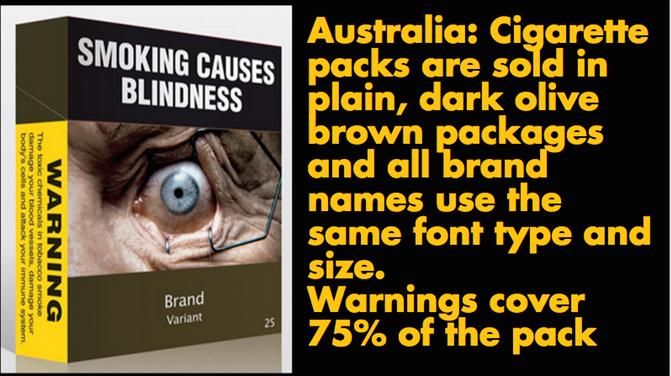
He cited the example of Australia, which has gone a step further to reduce tobacco use by allowing only plain packaging of cigarettes. “The expert committee constituted by ministry of health deliberated on several aspects of pictorial warnings—type of picture, size of picture, international best practices, public opinion, field research, etc—before their final recommendation,” he said.

Here Are The Indian States That Drink, Smoke And Smoke Up More Than Others

Download (PDF, 1.3MB)

A boost to global drive for stricter anti-tobacco laws

http://www.thehindu.com/sci-tech/health/a-boost-to-global-drive-for-stricter-antitobacco-laws/article8006059.ece

In a significant boost to stricter tobacco control laws, the Australian government on Friday won an international legal battle against tobacco giant Phillip Morris, which had challenged “plain packaging” laws.

Globally, the public health community has been demanding implementation of “plain tobacco packaging” — which means standardised packaging of tobacco products without any exclusive branding (colours, imagery, corporate logos and trademarks). The laws will only allow the manufacturers to print the brand name in a mandated size and font. Australia, the first country to implement these laws, had passed the plain packaging legislation in November 2011.

The Australian tribunal in the arbitration, based in Singapore, unanimously agreed with Australia’s position and gave a verdict against Phillip Morris. The verdict was awaited by many countries wanting to implement stricter tobacco control legislation. “The judgment in favour of Australia is a vindication of policy taken in public interest. It is important that judiciary everywhere in the world recognises the irrefutable evidence on the incalculable harm done by tobacco to the health of millions across the world. Law must prioritise societal interest over narrow corporate interests, while adjudicating on matters of public policy,” said K. Srinath Reddy, the president of the Public Health Foundation of India (PHFI) and one of the leading voices of India’s anti-tobacco campaign.

According to the Global Adult Tobacco Survey (GATS) India report, smoking kills over one million people in India annually and is the fourth leading cause of non-communicable diseases (NCD) such as cancer and heart diseases, which account for 53 per cent of all deaths in India. According to the Health Ministry, economic burden of tobacco consumption is around Rs.1,04,500 crore per annum.

Biju Janata Dal MP Jay Panda had introduced a private member’s Bill on plain packaging, demanding that pictorial warnings occupy at least 60 per cent of the front panel of the pack. He welcomed the verdict given by the Australian tribunal.

“This is an issue that is close to my heart. I have been fervently advocating this reform as a measure to control tobacco consumption in our country; especially since India is the second largest consumer of tobacco. Given the scale of the issue facing us, today’s verdict would offer us greater confidence to follow Australia’s lead towards a stronger public health policy. In this light, I urge all stakeholders to stick to the important April 1, 2016 notification for increased pictorial health warnings.”

In July 2014, the Allahabad High Court allowed a writ petition asking for implementation of plain packaging and directed the government to implement the scheme at the earliest.

The laws are to be implemented in India by April 2016.

Proposal of 40% GST on aerated drinks, tobacco could severely hit both sectors

http://economictimes.indiatimes.com/news/economy/policy/proposal-of-40-gst-on-aerated-drinks-tobacco-could-severely-hit-both-sectors/articleshow/50046110.cms

NEW DELHI| KOLKATA: Consumer prices of aerated drinks will rise as much as 20% and their sales will take a hit in case the government goes ahead with a proposal to levy a steep 40% goods and services tax (GST) on such beverages, two top industry officials said.

Acommittee headed by chief economic advisor Arvind Subramanian, on Friday recommended 40% “sin/demerit” GST for luxury cars, aerated beverages, paan masala, tobacco and tobacco products. This has alarmed officials in both aerated drinks and tobacco companies. “If this proposal goes through, it will kill the beverage industry,” said a top industry official, pointing out that the industry is already struggling with low single digit or negative growth. “It’s really unfair to club soft drinks with tobacco and tobacco products,” the person added.

Existing excise duty levied on the Rs 14,000-crore soft drink industry, comprising mainly of Coca-Cola and PepsiCo, is 18%. Tobacco industry officials said 40% GST would further increase the consumption of lightly taxed or tax-evaded tobacco products such as bidi, khaini, chewing tobacco, gutkha and illegal cigarettes, which already constitute over 89% of total tobacco consumption in India. The legal cigarette industry in India is already hit hard by recurrent increase in excise duty by the government.

This includes a cumulative increase of 115% on the entry level sub-65 mm length cigarettes. In the last three years, excise and VAT on cigarettes at per unit level has gone up cumulatively by 98% and 124%, respectively. As a result, cigarette sales volume are down by more than 15% for the last three quarters, a senior industry official said. The proposed GST rate if implemented will further impact sales of legal cigarettes and will trigger consumption to other forms of tobacco.

Already, India is the fourth largest market for illegal cigarettes in the world, according to a study by Euromonitor International.

The beverages industry official quoted earlier said high GST would impact established players because local unorganised players could sell at half the price. This could compromise quality as well, the person said. Slowing category sales and unseasonal rains have severely impacted soft drinks sales this year. In the last Union budget, finance minister Arun Jaitley had levied 5% excise on aerated sugary drinks.


Customs officials seize foreign cigarettes in raids

http://www.thehindu.com/news/cities/Vijayawada/customs-officials-seize-foreign-cigarettes-in-raids/article7938681.ece

Following the instructions of A.P. Customs Commissioner Shaik Khader Rahaman, the customs officials raided several shops in Guntur, Vijayawada, Eluru, Bhimavaram, Tadepalligudem, Kakinada, and Rajahmundry.

Officials of the Customs Department conducted raids at several places in the State on Tuesday, and seized huge quantity of smuggled cigarettes. The seized stocks were valued at Rs. 25 lakh.

Following the instructions of A.P. Customs Commissioner Shaik Khader Rahaman, the customs officials raided several shops in Guntur, Vijayawada, Eluru, Bhimavaram, Tadepalligudem, Kakinada, Rajahmundry, Ongole, Srikakulam, Vizianagaram, Visakhapatnam, Ananthapuram, Chittoor, Tirupati, Nellore, Kurnool and Kadapa and seized the foreign cigarettes.

“There are no manufacturing dates and warnings on the packs. Traders are resorting to smuggling of foreign goods in different ways and are evading taxes to the government in huge amount,” said Mr. Rahaman.

A total of 35 brands of cigarettes including Rothmans, Camel, Dunhill, Marlboro, Pine, Gurleen, King Edward, Dolphin, Manchester, Cleopatra, Dzire, Classic, Mars, Prince and other varieties were seized in the simultaneous raids.

Customs authorities suspect that traders smuggled the cigarettes from Malaysia, Singapore, Thailand, Korea, China, Bangkok, Hong Kong, Nepal, United Arab Emirates and other countries. With the seizure of huge stocks of smuggled cigarettes, the Customs Department has intensified vigil across the State, said the Commissioner.

Public may alert the Customs officials by dialling over 9885566233, 9849848060 or 9866632834 on smuggled gold, cigarettes, drugs, fake currency or on any other illegal products, Mr. Rahaman added.

Role of tobacco warning labels in informing smokers about risks of smoking among bus drivers in Mangalore, India

http://www.ncbi.nlm.nih.gov/pubmed/25339016

Abstract

BACKGROUND:

Smoking tobacco is considered as a leading cause of preventable death, mostly in developing countries like India. One of the primary goals of international tobacco control is to educate smokers about the risks associated with tobacco consumption. Tobacco warning labels (TWLs) on cigarette packages are one of the most common statutory means to communicate health risks of smoking to smokers, with the hope that once educated, they will be more likely to quit the habit.

MATERIALS AND METHODS:

The present survey was conducted to assess the effectiveness of TWLs in communicating health risks of tobacco usage among 263 adult smokers working as bus drivers in Karnataka State Road Transport Corporation (KSRTC), Mangalore, India. Information was collected on demographic details, exposure and response to health warnings on tobacco products, intention to quit and nicotine dependency.

RESULTS:

The majority (79.5%) of the respondents revealed negative intentions towards quitting smoking. Nearly half of the participants had a ‘low’ nicotine dependency (47.5%) and 98.1% of the respondents had often noticed warning labels on tobacco packages. These health warnings made 71.5% of the respondents think about quitting smoking. Respondents who noticed advertisement or pictures about dangers of smoking had better knowledge, with respect to lung cancer and impotence as a consequence of tobacco. A higher exposure to warning labels was significantly associated with lower nicotine dependency levels of smokers among the present study population. A significantly higher number of respondents who noticed advertisement or pictures about the dangers of smoking thought about the risks of smoking and were more inclined to think about quitting smoking. As exposure increased, an increase in the knowledge and response of participants was also observed.

CONCLUSIONS:

Exposure to tobacco warning labels helps to educate smokers about health risks of tobacco smoking. It may be possible to promote oral health among bus drivers by developing strategies to educate them about these risk factors.

Why India Drags its Feet on Pictorial Warnings in Tobacco Packs?

However bad you thought smoking was, it’s even worse.

Every cigarette you smoke makes it more likely for you to get a heart disease. Roughly 1 in 5 deaths from heart disease is directly linked to smoking. More than 2.5 million teenagers smoke everyday in India and tobacco kills 150 people every hour in the country. (Source: International Tobacco Control Project)

The World Health Organisation has been asking India for more graphic and gory warnings which cover 85% of the cigarette pack as against the present 40%. In April 2015, the Union Health Ministry had agreed to implement this but days before the deadline, the tobacco lobby had its way over the Modi government and the proposal was shelved indefinitely.

Pictorial Warnings Around the World

WARNING: Though real, some readers may find the images below disturbing.

smoking hero image Screen Shot 2015-09-29 at 4.09.25 pm Screen Shot 2015-09-29 at 3.49.14 pm Screen Shot 2015-09-29 at 3.39.09 pm Screen Shot 2015-09-29 at 3.43.09 pm Screen Shot 2015-09-29 at 3.58.48 pm

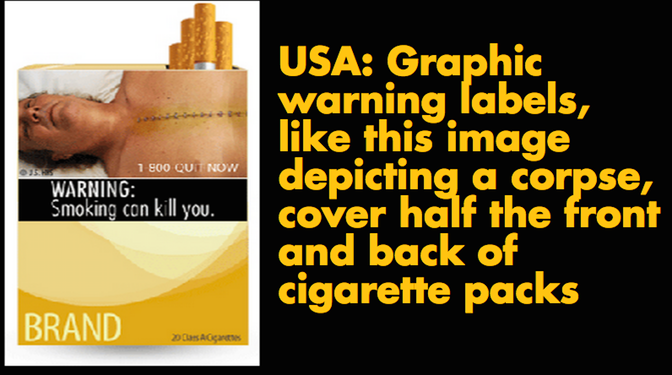
Even though India continues to buckle under the pressure of the tobacco lobby, world-over 80 countries have more than 60% graphic warnings on cigarette packs.

From puss-oozing, mouth tumours in Thailand to skulls in Romania, cigarette packs around the world vividly warn of the perils of smoking. Australia has the world’s toughest restrictions on cigarette packets. They sell tobacco in drab, brown boxes without distinguishing features other than brand and product name.

India, on the other hand, is ranked at 136 out of 198 countries that include pictorial health warnings on tobacco packaging. This is lower than the 123rd position that the country had in 2012.

Do Pictorial Warnings Work?

Yes. Big warnings plant the first seed of doubt. According to WHO, nearly 67% of smokers in Brazil and New Zealand and 44% in Canada and Thailand wanted to quit smoking as a result of graphic pictorial warnings.

Warnings act as intervention, perhaps why policymakers urgently need to make warnings larger and more graphic because noticing the warnings is the first step toward getting smokers to think about and attempt to quit.

Major Cardiologists Demand 85% Coverage

Heart diseases kill 26% people in India and tobacco is a huge risk factor. What’s worse, tobacco related diseases are easily preventable but they cost India two times more than the costs incurred to treat cancers.

People must realise the high stakes of using tobacco, not just for themselves but also their families. It is only through measures like the 85% pack warnings, that we can reach our national target of 30% relative reduction of current tobacco use.
– Prof. K. Srinath Reddy, President, Public Health Foundation of India.

Tobacco kills 10 lakh Indians every year.

Immediate steps should be taken to tackle tobacco use in India. Strong control measures are critical at this time and we demand 85% warnings on both sides of all types of tobacco packs.
– Dr KK Aggarwal,President, Heart Care Foundation of India.

At present, pictorial health warnings cover 40% of the principal display area of tobacco packages in India.

Recent studies show that up to 94% of users of both smoking and smokeless products have no intention to quit. This points to the fact that our tobacco control efforts are not adequately highlighting the heinous effects of tobacco use.
– Dr H.K. Chopra, President, Cardiological Society of India.

While tobacco companies exploit the entire cigarette pack, including the cigarette, as a sophisticated communications tool, policy makers are far less creative.

Why doesn’t the government exploit the same techniques to dissuade consumers which the tobacco companies use to attract smokers? Since the companies stamp their brand name on each cigarette, why not put a health warning there too?

Here, I’ve come up an example of a cigarette carrying the words “Smoking kills”. Anyone listening?

Would you fancy flaunting a cigarette if it looked like this death stick?

Economic burden from tobacco-induced heart diseases highest in Kerala amongst southern states

http://www.evartha.in/english/2015/09/28/economic-burden-from-tobacco-induced-heart-diseases-highest-in-kerala-amongst-southern-states.html

Thiruvananthapuram: Cardiovascular diseases (CVDs) account for a staggering Rs 226 crore economic burden annually, the highest among four major tobacco-induced ailments in Kerala, contributing to 51 per cent of total direct medical costs.

Significantly, the total direct medical costs from tobacco-induced CVDs in Kerala are the highest among south Indian states, says a latest report.

The report is based on study called ‘Economic Burden of Tobacco Related Diseases in India’ developed by Public Health Foundation of India (PHFI) with support from the Union Ministry of Health & Family Welfare and the World Health Organisation (WHO).

The study report covers both direct medical costs and indirect morbidity costs of four specific diseases – CVDs, cancer, tuberculosis, and respiratory disease.

The direct medical costs from tobacco-related heart diseases in neighbouring Tamil Nadu is 46 per cent, while those in Andhra Pradesh and Karnataka are at 48 and 40 per cent, respectively.

Smoking tobacco contributes to the highest economic burden among Kerala males with direct costs of Rs 123.5 crores, and indirect costs of Rs 62.7 crores.

The report estimated the economic costs on persons in the 35–69 age group in 2011.

Direct medical costs include direct healthcare expenditure for inpatient hospitalisation or outpatient visits such as medicines, diagnostic tests, bed charges, and surgeon’s fees. Indirect costs accrue from expenses on transportation and lodging for caregivers and loss of household income due to inpatient hospitalisation, besides costs from premature deaths.

According to the Global Adult Tobacco Survey (GATS) 2009-10, the global standard to systematically monitor adult tobacco use, 35.5 per cent of males use tobacco in some form, 27.9 per cent males smoke and 13.1 per cent use smokeless tobacco products.

The economic burden study has suggested a host of measures to deal with the tobacco menace. These include strengthening implementation of Indian tobacco control law, COTPA, 2003 and imposing uniform taxes on all tobacco products like cigarettes and bidis. It has also recommended prohibition of sale and manufacture of all forms of smokeless tobacco products/chewing tobacco and high visibility public awareness campaigns to consistently reach out to different target audiences