Clear The Air News Tobacco Blog Rotating Header Image

Cigarette Smuggling

SCMP letters: Tobacco tax hike deters young people from starting to smoke

by Lisa Lau, chairman, COSH

A recent report funded by the tobacco industry claimed that the illicit cigarette problem in Hong Kong is serious.

A spokesperson for the study said the key drivers included tobacco tax rises in 2009 and 2011 and strength of enforcement against smuggling by the government. Hong Kong Council on Smoking and Health (COSH) has expressed reservations on its findings and believes there is no causal link between tobacco tax rise and the surge in illegal cigarettes.

The tobacco industry always opposes increases in tobacco levies arguing that they intensify cigarette smuggling activities, but there is no evidence to support this. In fact, smuggling is also found in countries with a lower tobacco tax, like Malaysia (tax accounts for 53.7 per cent of the retail price) and Vietnam (41.59 per cent). Canada and Sweden attempted to combat cigarette smuggling in the 1990s by reducing tobacco tax, resulting in a hike of consumption and contraband cigarettes seizure.

The World Health Organisation believes the most effective measure against smuggling is tight control and aggressive enforcement. Hong Kong Customs and Excise Department is determined to undertake stringent enforcement against illicit cigarette activities. A total of 65 million sticks of illicit cigarettes were seized in the first nine months of this year, an increase of over 30 per cent compared to the same period last year. The most effective way to tackle the root of the problem is to strengthen law enforcement and publicity and educate the public on the illegitimacy of illicit cigarettes.

A significant tobacco tax hike deters young people from starting smoking and encourages smokers to quit. The World Bank claims every 10 per cent increase in the price of a packet of cigarettes results in a 4 per cent decrease in tobacco consumption in high-income regions like Hong Kong.

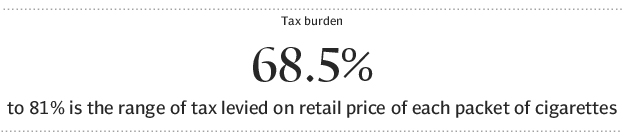
Hong Kong’s tobacco levy accounts for only 65 to 68 per cent of the retail price, which is below the standard suggested by the WHO (at least 70 per cent). Compared to Asia-Pacific countries like Singapore, and EU countries, whose tax is over 70 per cent, Hong Kong’s rate is lenient*.

Each year, smoking causes nearly 7,000 deaths in Hong Kong, including 1,324 non-smokers, as well as HK$5.3 billion economic loss.

To save lives, we want the government to implement a progressive and long-term tobacco tax increment policy and strengthen smoking cessation services.

28 Oct 2013

*A standard pack of Marlboro retails including tax for HKD50 in Hong Kong; in Singapore it costs HKD 76, London HKD 84, in New York HKD 85, Dublin HKD 93, Brisbane HKD 129; Hong Kong still has the highest cost of living among these cities, making tobacco a relatively affordable commodity in the city.

Protocol to eliminate illicit trade in tobacco products

Download (PDF, 1.11MB)

Tobacco firms oversupply in Europe for smugglers to return products into UK, avoids tax

Tobacco firms like to make loud calls to combat cigarette smuggling, while actively engaging in the highly profitable practice. A prime example has recently been reported in the UK: the strategy is to supply more than what is required to nearby low-tax countries such as Spain, Belgium, the Netherlands and Luxembourg, where individuals could purchase them and return to the UK for resale. Avoiding the high tobacco tax in the UK keeps the prices of the tobacco products low and affordable, allowing the tobacco industry to retain its market.

Click here to read the articles:

Speaking against illegal tobacco, for tobacco

Robin Jolly

One of the more vocal voices against the illegal tobacco trade is Robin Jolly, convenor of the organisation Hong Kong United Against Illicit Tobacco (HKUAIT). To a normal reader, Jolly’s position may seem like a strange and ambiguous one: he comments and speaks against cigarette smuggling, but it is always as if cigarette smuggling is a problem of its own; one would be hard pressed to hear him talk about smoking as the problem itself. Part of that is because Jolly’s work at HKUAIT is funded by tobacco giant, Philip Morris, but it would not be quite right to suggest that it is in the interest of the tobacco industry to fight the illegal tobacco trade. Rather, Philip Morris employs multi-pronged strategies for its business survival: genuine Philip Morris products are oversupplied into the black market to keep cigarettes within the purchasing power of consumers, while apparently independent organisations such as HKUAIT attacks cigarette smuggling to distract and confuse public views on the issue of smoking as a health hazard.

In July 2013, for example, Jolly announces his praise for police action on illegal cigarettes, highlighting the criminal aspects of the illegal trade to attract public attention. More recently, he plays with the alarm bells in a letter published in the SCMP, where he passively attacks the government for its increased tobacco control measures (claiming it ‘drives the whole market underground’) and speaks of the illegal cigarette trade as a ‘real problem’ and a ‘menace to society’. Clearer minds would, no doubt, recognize smoking itself as the real problem and the menace to society, although there can be little done about Philip Morris and other tobacco companies continuing to fund Jolly’s organization to send confusing messages to the general public.

Click here for more coverage:

Tough jail terms to curb illegal trade? Firms-supplied genuine goods account for majority of smuggled cigarettes though.

Concerned citizen Mr Lee Lung-wing of Tseung Kwan O sent in a letter to the SCMP, which was published on 10 Oct 2013, suggesting that the government can stem the growth of the illegal trading of cigarettes by making stronger deterrents for offenders. His letter runs as follows:

I refer to the report (“One in three HK cigarettes illegal: study [3]”, October 3).

The study that came out with this figure said that because of so much illicit tobacco the city is losing out on billions of tax revenue.

I do not think this study should prompt a debate about whether the government should lower the tax on cigarette so as to make smuggling unprofitable.

The most important issue should be how to fight the criminals involved in this illegal trade. At the end of the day, there is no public policy that can cure all social ills.

When the government raises tax to discourage cigarette consumption, it should consider thoroughly all the consequences of its action and plan ahead with corresponding solutions.

The problem of illicit cigarettes is not only about potential loss of government revenue but of funds going to criminal groups, which might create more social problems.

The SAR government should not make crime lucrative by turning a blind eye to the problem.

From a criminal justice point of view, the most cost-effective way to combat smuggling of illegal cigarettes is to establish [appropriate] sentencing guidelines in our courts. The administration should increase maximum sentences for buyers and sellers of illicit cigarettes.

Mr Lee’s idea is actually an excellent one, provided if it is understood that the ‘criminals’ in question would, in fact, be the tobacco firms themselves; of the 76 million cigarettes seized by Hong Kong customs last year, 60% were genuine products supplied in large amounts by tobacco firms, a global practice which brings volumes of unspoken benefits to them. The issue of funding criminal activity through cigarette smuggling is, in fact, part of a broad array of tactics aimed at confusing public opinion, as this letter shows, unfortunately, that has somewhat measured success.

IT: Drug gangs turn to tobacco smuggling as recession bites

from Conor Lally of the Irish Times:

When the MV Anne Scan was searched by Customs officers in Greenore port in Co Louth in October 2009, it yielded 120 million cigarettes with a retail value of about €50 million. The smuggled consignment was the biggest found in Europe. The ship’s 250m-long hold contained large bags of animal feed – into each one had been placed boxes of 100,000 cigarettes.

“When we took away the animal feed, it took 16 40ft containers to move to the cigarettes,” Liam Irwin of the Revenue Commissioners said.

“Tesco or somebody like that would find that [those logistics] hard to manage. We had to hire trucks to take them away and destroy [the cigarettes].”

Dockers on board the MV Anne Scan, which sailed from the Phillippines with a consignment of contraband cigarettes estimated to be worth about €50 million. (Irish Times)

Irwin is the most senior figure in Revenue with responsibility for trying to beat the smugglers. With seizures looking set to drop to a 15-year low this year, his job is getting harder.

Drug gangs hit hard in the recession as the demand for recreational drugs plummeted are turning to the booming demand for cheap cigarettes among consumers. The activities of cigarette gangs Irwin and his colleagues try to stop take various forms.

Some “ant” smugglers constantly travel on low-cost airlines to buy packets of cigarettes outside the EU for as little as €2 for a pack of 20. They are then smuggled back to Ireland for sale on the streets for €4.50 – half the retail price.

In larger operations, gangs source counterfeit cigarettes from illegal factories, mainly in China. These are made to look like major brands and can be bought for 50 cents for 20 and sold for €4.50 on the streets.

Other illegal factories abroad produce their own brand of cigarettes specifically for sale on the black market that are even cheaper than 50 cents a pack to buy wholesale. They can be sold here for €4.

Irwin said that with more 40ft containers than ever arriving at major ports being scanned by Revenue’s large X-ray machines, detections had been growing over the past 15 years.

However, smuggling gangs, frustrated at losing their hauls, have sought to combat Revenue’s success and more professional drug gangs are also involved in the trade.

Instead of booking full 40ft containers, they are booking smaller spaces in containers shared with several reputable businesses shipping legal goods.

Large orders of cigarettes sourced from illegal factories are then broken up and concealed before being packed into the containers that bring them to Ireland.

“At one time, concealment was barely done but now you’d suspect that the concealment of tobacco is getting as much attention as the concealment of drugs,” said Irwin. “We are seeing things like false ceilings [in containers] or something with lead on top of it to subvert X-ray scanning, that type of thing.”

He also believes large consignments are now being hidden in vans and driven into the State from ferries. To that end, Revenue has recently acquired a “van scan” that can X-ray vehicles. The scanners check if the consistency of the goods transported matches the description in the cargo’s paperwork.

Handheld X-ray devices are being acquired and four new tobacco sniffer dogs have been introduced.

Irwin said the increased sophistication in smuggling methods suggests the involvement of gangs previously involved in drug running, with profits just as big in cigarettes and sentences lower for those who are caught.

He accepted that Revenue needed to become better at mining local communities for information about the criminals that transport and sell the estimated 90,000 packets of black market cigarettes smoked every day in the Republic. This amounts to a daily loss to the State of excise duty and VAT running to €655,000.

“There was a survey done in the North a while back on how seriously people viewed a range of crimes. Illicit cigarettes were below speeding in the survey. It was regarded as not even being a misdemeanour. So that’s what we are up against.”

7 Oct 2013

Study funded by tobacco firms tries to link high tobacco taxes to lost revenues in unpaid taxes

The SCMP ran an article on 3 Oct 2013, by Samuel Chan, about a newly published study that finds 1 in 3 cigarettes smoked in Hong Kong is illegal. Since illegal cigarettes evade custom duty, it seems that the Hong Kong government is losing out on “HK$3.3 billion in potential tax revenue last year as a result of an estimated 1.8 billion illegal cigarettes smoked.” The study links the high number of illegal cigarettes to the “‘steep’ tobacco tax increases introduced in Hong Kong in 2009 and 2011 that further widened price differences with neighbouring countries, providing incentives for criminal groups to make gains.”

The article points out rather astutely that the study is funded by none other than tobacco giant Philip Morris, and the International Tax and Investment Centre, a lobbying group, jointly published it with Oxford Economics. Tobacco companies have long opposed high tobacco taxes, which have thus far been the most effective way of pricing out young potential smokers from purchasing their products, and so negates their efforts to find a renewable market to sell their products.

Marlboro cigarettes displayed in Montpelier, Vermont. (AP photo/Toby Talbot/Business Inquirer, 17 Jul 2012)

Less well-known, though, is the fact that tobacco companies deliberately supply their products into illegal distribution channels, creating the very problems that they use funded studies to highlight. The problems, ranging from lost revenues to funding criminal activity, are part of measured tactics aimed at pressuring governments to lower their tariffs on the legal tobacco trade, so that their products can reach youths and lower-incomes masses. This is not to mention the various other ways from which the companies benefit from supporting cigarette smuggling, the most obvious of which is that it is the easiest way to lower their product pricing and make it more affordable.

Below are some articles on this issue:

  • The British Medical Journal published an analysis in 2011 on the reasons behind the illicit tobacco trade. Read it here.
  • The National Center for Tobacco-free kids of the U.S. published a very in-depth study on the global smuggling movements of tobacco and how the tobacco companies are involved.
  • Kevin Maguire of the Guardian reported in 2000 about BAT admitting to their role in cigarette smuggling.
  • This is a paper prepared by lobbyists in the US House of Representatives that tries to link cigarette smuggling to terrorists funding, attempting to alarm and pressurize the government and public.

Below is the full article from SCMP:

Disputed report funded by tobacco industry giant claims contraband cigarettes cost the city billions in lost tax revenue last year

About a third of all cigarettes smoked in Hong Kong are illegal and the city is losing out on billions in tax revenue as a result.

Those are the findings of a tobacco industry-funded report on the consumption of illegal tobacco in 11 Asian countries last year.

The study has been disputed by the government and anti-smoking groups.

The report, funded by tobacco giant Philip Morris, was published by the UK-based research institute Oxford Economics and the International Tax and Investment Centre, a lobbying group.

It says Hong Kong lost HK$3.3 billion in potential tax revenue last year as a result of an estimated 1.8 billion illegal cigarettes smoked.

As part of the study, about 10,000 empty cigarette packets were collected across the city last year. Based on their markings, the packs were then classified as either legal domestic, duty-free, counterfeit or illegal imports.

Overall estimates of the number of illegal cigarettes smoked were then derived from the sample collected. Packets left by tourists were not counted, the study said.

The report says “steep” tobacco tax increases introduced in Hong Kong in 2009 and 2011 further widened price differences with neighbouring countries, providing incentives for criminal groups to make gains.

But Lisa Lau Man-man, chairwoman of the Council on Smoking and Health, disagreed.

“Contraband cigarettes have existed ever since taxes were placed on tobacco,” she said.

Lau saw no causal link between a high tobacco tax and the proliferation of illegal cigarettes.

Brunei had low tobacco tax but topped all the countries in the report in terms of prevalence of illegal cigarettes.

In response to the report, a senior customs official said measures combating illegal cigarettes at the source were effective and the situation was improving.

From January to August this year, customs officials seized 59.5 million illegal cigarettes, a 38 per cent year-on-year increase, and made 28 arrests in anti-smuggling raids.

During the same period, tax revenue from tobacco rose to HK$3.48 billion from HK$3.2 billion brought in over the same period the previous year.

SCMP’s Howard Winn follows up in his column (4 Oct 2013):

The recent survey by Oxford Economics and the International Tax and Investment Centre (ITIC) has raised eyebrows among anti-smoking groups.

The survey claims 35.9 per cent of the cigarettes consumed in Hong Kong in 2012 were illicit and resulted in a loss of HK$3.3 billion in government revenues. The main drivers for this, ITIC said, “include very steep tax increases in 2009 and 2011, which led to a further widening of the price disparity of legal cigarettes with those in the neighbouring countries”, which attracted the interest of criminal gangs.

But ITIC is hardly a detached observer in these matters. It is funded by international corporations, including all the big tobacco companies. The centre is involved in advising governments on the taxation of tobacco. Its advice is always for “moderate” taxes. But the evidence from the World Health Organisation and other bodies is that high taxation is the single most effective deterrent to smoking, particularly among children. This is recognised by the tobacco industry.

In recent years, millions of pages of internal tobacco company documents have been released as a result of litigation in the United States. A document from Philip Morris in 1985 notes: “Of all the concerns, there is one – taxation – that alarms us the most. While marketing restrictions and public and passive smoking do depress volume, in our experience taxation depresses it much more severely.”

Illicit tobacco seized during raids on Northampton shops

http://www.northamptonchron.co.uk/news/local/illicit-tobacco-seized-during-raids-on-northampton-shops-1-5510185

Illicit tobacco seized during raids on Northampton shops

Illegal cigarettes

Illegal cigarettes

· by Gemma Ellis

· gemma.ellis@jpress.co.uk

Published on the 19 September
2013
17:44

Published 19/09/2013 17:44

Illicit tobacco has been discovered in a series of raids at shops in Northampton.

Almost 6,000 packets of illicit cigarettes and over 200 packs of illicit hand rolling tobacco where uncovered in six raids in Northampton shops.

Some of the tobacco was hidden behind pipes in a stock room toilet and more was found hidden in the top of a fridge.

Northamptonshire County Council’s trading standards department, supported by Northamptonshire Police and customs officials targeted six shops in the raids with trained sniffer dogs.

Councillor Andre Gonzalez de Savage (Con, East Hunsbury & Shelfleys), the council’s cabinet member for public protection said: “Sales of illegal cigarettes are usually done under the counter, as the tobacco is often either smuggled or counterfeit and hasn’t been put through proper quality control processes.

“Sales of illegal tobacco harm the interests of honest businesses and can be vastly more dangerous than legitimate tobacco, with high levels of nicotine, tar and heavy metals such as lead and arsenic.

“Some samples have even been found to contain rat droppings and asbestos.” (CTA: probably improves the taste)

The smuggling of tobacco costs the UK economy nearly £3 billion and is often linked to organised crime.

Around 22 per cent of cigarettes smoked in the East Midlands avoid UK tax and the penalty for these offences could include fines and imprisonment

Customs smashes illicit cigarette smuggling case in Man Kam To

http://7thspace.com/headlines/443943/customs_smashes_illicit_cigarette_smuggling_case_in_man_kam_to.html

Customs smashes illicit cigarette smuggling case in Man Kam To

Hong Kong (HKSAR) – Hong Kong Customs yesterday (September 2) mounted a special operation to combat the smuggling of illicit cigarettes through the cross-boundary logistics network and seized about 0.43 million sticks of illicit cigarettes from a cross-boundary vehicle. The total market value of the cigarettes was about $1.1 million with a duty potential of about $0.73 million. In the operation, a 48-year-old male driver was arrested and the vehicle used for conveying the illicit cigarettes was seized.

Around noon yesterday, Customs officers at Man Kam To Control Point intercepted an incoming cross-boundary vehicle declared to have 463 boxes of assorted goods on board.

After X-ray examination and thorough inspection by Customs officers, about 0.43 million sticks of illicit cigarettes were found in 72 carton boxes, mix-loaded with other goods and concealed at the rear of the lorry.

The Divisional Commander (Man Kam To) of Land Boundary Command, Mr Fok Wing-siu, said at a press conference today (September 3), “The operation showed the effectiveness of our enforcement strategy, especially the stepped-up enforcement actions against smuggling activities at source. Customs will continue to undertake stringent enforcement against illicit cigarettes activities in order to protect government revenue.”

Under the Import and Export Ordinance, smuggling is a serious offence. The maximum penalty is a fine of $2 million and imprisonment for seven years.

Members of the public are urged to report suspected illicit cigarette activities by calling the Customs’ 24-hour hotline 2545 6182.

Source: HKSAR Government

Illicit trade of cigarettes costs exchequer Rs20 billion a year

Euromo­nitor and FBR offici­als say market is floode­d with smuggl­ed, non-duty paid brands in absenc­e of law enforc­ement.

Published: September 1, 2013

http://i1.tribune.com.pk/wp-content/uploads/2013/09/598334-table-1378048116-747-640x480.JPG

Study by Euromonitor and FBR official say market is flooded with smuggled, non-duty paid brands in absence of enforcement.

ISLAMABAD: http://tribune.com.pk/story/598334/economic-cost-illicit-trade-of-cigarettes-costs-exchequer-rs20-billion-a-year/

Pakistan has been ranked as one of top three countries in the Asia Pacific region where illicit trade of cigarettes has been increasing due to multiple reasons, including the Federal Board of Revenue’s preference for manual approach to digital mapping. This is causing roughly Rs20 billion a year loss to the national exchequer.

In absolute terms, the amount may not seem big enough to raise concern, but is significant when seen in the context of tax evasion going on under the (loose) noose of the authorities. In financial year 2011-12, the cigarette industry contributed about Rs66 billion to the exchequer on account of excise duties and sales tax, as it remains one of the highly-taxed industries.

https://pullquotesandexcerpts.files.wordpress.com/2013/09/41.jpg?w=625

Two studies by Euromonitor International – a global research agency – and Directorate of Intelligence and Investigation (I&I) of Inland Revenue Division of the FBR have estimated losses of around Rs20 billion per annum in tax revenue, where 85% is because of tax evasion, due to illicit cigarette trade.

The estimates are based on total production of tobacco, its consumption in cigarette manufacturing, evasion of duties on account of smuggled, counterfeit cigarettes and non-duty paid cigarettes.

https://pullquotesandexcerpts.files.wordpress.com/2013/09/5.jpg?w=625

In its report on cigarette industry of Pakistan, issued earlier this year, the Euromonitor estimated that Pakistan has lost Rs80 billion worth of duties and taxes in the last five years and is expected to lose another Rs100 billion in the next five years.

The study showed that cigarette sales continued to drop in 2011 as sales of illicit cigarettes rose. A lack of strong enforcement of laws on the part of the government has left the legal market defenceless against illegal players, it continued.

https://pullquotesandexcerpts.files.wordpress.com/2013/09/6.jpg?w=625

The study said markets across the country are flooded with smuggled cigarette brands, in the absence of any strict enforcement of laws and regulations.

According to Euromonitor International, Pakistan ranked third in illicit cigarette trade in Asia Pacific countries, behind Malaysia and Hong Kong last year.

Ansar Javed, former chairman of the FBR, who also worked to curb cigarette smuggling in his capacity as director general of Directorate of I&I of Inland Revenue, said lack of coordination and lack of transparency in FBR’s affairs was one of the main reasons behind the tax machinery’s inability to crack down on illicit cigarette trade.

https://pullquotesandexcerpts.files.wordpress.com/2013/09/7.jpg?w=625

He said according to a scientific study by the I&I, tax losses due to cigarette smuggling, counterfeit manufacturing and duty evasions were in the range of Rs18 billion to Rs20 billion per annum.

The solution to the problem was digital mapping of cigarette packaging instead of relying on manual methodologies, said Javed. Parliament has approved a law to allow the FBR to go for digital mapping, but much needs to be done before enforcing the act aimed at curbing the smuggling.

The Pakistan Peoples Party (PPP) government also worked on a proposal to paste stamps on cigarette packs to identify smuggled, non-duty paid packets for checking tax evasion. However, it could not be implemented.

According to the country’s laws, penalties for the sale of smuggled cigarettes include confiscation of such cigarettes, fine up to Rs50,000, recovery equal to 500% of unpaid taxes and imprisonment up to five years.

According to a top official of the Directorate of Intelligence and Investigations of Customs, both the domestic producers and multinational companies (MNCs) were involved in evading taxes on cigarettes. The MNCs were involved in technical evasion while the local producers were evading duties on counterfeit cigarettes, he added.

He said the Customs does not have the capacity to stop cigarette smuggling on international borders and was trying to curb the menace by raiding on retail shops and warehouses. He said the volume of smuggled cigarettes was less than 5% of the total cigarettes produced, but when compared with consumption of billions of cigarette sticks, the size of evasion becomes abnormally large.

During the second half of 2012, I&I of the Inland Revenue seized millions of untaxed cigarettes. The confiscated cigarettes included both locally manufactured and foreign brands.

———————————————————————————————————————————————

Do you smoke cigarettes?

· ( ) Yes

· ( ) No

[ Vote ]     View Results


Polls are non-scientific, reflect only the online audience and can be manipulated.