Clear The Air News Tobacco Blog Rotating Header Image

Plain Packaging

Perils Of Trans Pacific Partnership (And Other FTAs)

http://refocusing.blogspot.hk/2015/07/perils-of-trans-pacific-partnership-and.html

Why Free Trade

The total output of a group of countries is greatest when the output of each good is produced by the country that has the lowest opportunity cost (i.e., comparative advantage). Conversely, if a good is produced by a country that can be produced by another country at a lower opportunity cost, the first country is giving up more than necessary.

Even if any one country can produce more of every good with the same resources than the other countries (i.e., absolute advantage), all countries can still gain from reallocation of resources, specialisation and trade provided the relative cost of producing the goods differs among the countries.

Specialisation and freer trade are supposed to lead to lower prices and higher consumption.

So why has the World Trade Organisation not been able to conclude negotiations on the Doha Development Round after more than a decade? Nor 12 Asia-Pacific countries[1] on the Trans-Pacific Partnership (“TPP”)?

Protectionism

Many countries want to protect their domestic agricultural sector for political or food security reasons. (Singapore seemingly ignores the perils of not producing enough food domestically, believing that diversifying its sources of food is good enough even in extreme shortage.)

Structural Unemployment

When countries reorganise production based on comparative advantage, workers are supposed to move from higher opportunity cost sectors to lower opportunity cost sectors. However, the reality is that displaced workers typically find it challenging, if not outright daunting, to gain employment in another sector in which their skills are not right and they cannot easily learn new skills.

Thus, in the debate over whether to give the US president “fast track approval” to negotiate the TPP and other FTAs, many Democrats in the US Congress wanted an extension of the Trade Adjustment Assistance programme so as to soften the impact on workers who may be displaced by the FTAs by providing them with income support and training.

FTA Winners And Losers

The main winners from FTAs are the large businesses and their shareholders.

The main losers from FTAs are the unskilled and lower skilled people. FTAs add to downward pressure on wages and exacerbate income inequality. This is why the AFL-CIO, the umbrella federation for US unions, is fiercely opposed to the TPP.

BEYOND TRADE

Recent FTAs have moved beyond the basic goal of increasing cross-border trade.

The TPP is being negotiated as a single undertaking that covers all key trade and trade-related areas. In addition to updating traditional approaches to issues covered by previous FTAs, it includes new and emerging trade issues and “cross-cutting” issues, according to the Office of the US Trade Representative[2].

Foreign Nationals = Citizens

Under the US-Singapore FTA, Singapore must accord the nationals of the US similar tax treatment as Singapore citizens when they purchase residential properties in Singapore.

Under the Singapore-European Free Trade Association FTA, Singapore must accord the nationals and permanent residents of Switzerland, Norway, Liechtenstein and Iceland similar tax treatment as Singapore citizens when they purchase residential properties in Singapore.

In the period from 8 Dec 2011 to 31 Jul 2013, 252 property transactions by foreign individuals were granted Additional Buyer Stamp Duty remission because of these FTAs, costing the Singapore Government $81.2 million.

Deputy Prime Minister and Minister for Finance Tharman Shanmugaratnum says that the Singapore Government “will continue to seek a balanced package in our FTA negotiations to ensure that the FTAs provide meaningful benefits for Singapore, while taking into account the costs”[1].

Why was it necessary for the Singapore Government to accord the nationals of the US, and the nationals and permanent residents of Switzerland, Norway, Liechtenstein and Iceland similar tax treatment as Singapore citizens in the purchase of residential properties in Singapore? Was it an oversight or a lack of foresight?

Singapore citizens and permanent residents who purchase residential properties in the US, Switzerland, Norway, Liechtenstein and Iceland would also benefit, but not the vast majority of Singaporeans.

It is unclear if there will be a similar provision in the TPP.

Helping SMEs

The Singapore Government has programmes such as the Productivity and Innovation Credit Scheme to help Singapore’s small and medium-sized businesses.

However, businesses in FTA partner countries may allege that such programmes unfairly subsidise Singapore companies.

When this concern was raised in Parliament by Non-Constituency Member of Parliament Lina Chiam, Senior Minister of State for Finance Josephine Teo did not appear to address it[5].

Helping Singapore Companies

Singapore’s obligations under the World Trade Organisation’s Agreement on Government Procurement and various FTAs are legislated in the Government Procurement Act and its subsidiary legislation.

Any procurement by the Singapore Government that meets prescribed criteria is subject to these agreements and must be conducted in accordance with the Government Procurement Act and Regulations, which includes allowing foreign or domestic suppliers to compete freely.

Although the US is pushing for countries to limit their support for state-owned enterprises under the TPP, Singapore companies will likely not be put at much greater disadvantage because the Singapore Government already mostly procures goods and services through open tenders, even when the procurement is not covered by its international agreements.

Intellectual Property Protection

The US pharmaceutical industry is lobbying for strong intellectual property provisions to be included in the TPP. Such provisions could likely limit access to cheaper generic drugs in the TPP countries.

Companies Versus Governments

The TPP will likely allow companies in one country to sue governments of other countries if such governments violate TPP rules, and have the cases judged by partially privatised tribunals.

According to a New York Times report[6], the US tobacco lobby has requested the US Chamber of Commerce (“AmCham”) for help in the face of mounting anti-smoking legislation, including a World Health Organization global treaty which mandates anti-smoking measures and seeks to curb the influence of the tobacco industry in policy making. The treaty has been ratified by 179 countries, but not the US.

Tobacco lobbying by AmCham has been visible in the TPP negotiations[7].

AmCham maintains that while it does not support tobacco use, it believes that foreign governments should uphold intellectual property rights, adhere to international commitments, and promulgate rules that are sensible and effective. Such concerns have been the focus of its advocacy efforts on behalf of the tobacco and other industries. Public health policy aimed at curbing smoking can yield positive results, while still upholding intellectual property protection, honouring international agreements, and not singling out any specific industry for discriminatory treatment or destruction of company brands[8].

In the light of the challenge to the Australian government’s legislation on plain packaging for tobacco products, Member of Parliament Janil Puthucheary asked whether the TPP might place Singapore’s tobacco control measures at risk. Minister for Trade and Industry Lim Hng Kiang answered[9]:

Singapore’s current tobacco control measures do not contain such plain packaging requirements.… [They] include a comprehensive ban on tobacco advertising and the prohibition of misleading labels … to protect public health and are in line with World Health Organization standards … [and] have been implemented with full consideration of our international obligations.

Australia is the first country in the world to introduce such plain packaging requirements which have been challenged by tobacco firms on grounds of trademark rights infringement.… Negotiations for the [TPP] are currently ongoing. As with all FTA negotiations, MTI will continue to consult closely with all relevant agencies to ensure that Singapore’s interests, including the protection of public health, are secure.

…

[C]urrently, tobacco does not feature significantly in the TPP negotiations. As with many of the FTAs with the high levels of ambition, one with as complete a coverage of products as possible, it is unlikely that tobacco will be excluded.

Dr Puthucheary raised his concerns again the following year[10]:

I am aware that, in many of these agreements, health is an exception. And then there is an exception to the exception which does not cover investments in intellectual property, and trade interests use that as a way of challenging these types of regulatory decisions made by governments.

Minister for Health Gan Kim Yong replied[11]:

We are very mindful of our international obligations with regards to our obligation to WTO as well as our bilateral trade agreements. In crafting these tobacco control measures [relating to the removal of retail display], we have also been very careful with regard to the legal implications. Even in our negotiations of bilateral agreements, we are mindful of our own internal interests to protect the health of our citizens. These are all taken into account. As we roll out this tobacco controls, we are quite confident that we are on strong grounds, to introduce these measures, particularly in the interest of population health.

Not quite reassuring, in my view.

Human Rights And Environment

According to the White House, the TPP “is one that is not only good for American workers, good for the American economy, but is one that includes the strongest, boldest human rights protections, labor protections and environmental protections we’ve seen in a trade deal.”[12]

Can the Singapore Government stand up against US liberal activism?

Immigration

The US-Singapore FTA provides for the contracting parties to allow temporary entry to business visitors, traders and investors, intra-company transfers of managers, executives and specialists, and professionals, without requiring prior approval procedures, petitions, labour certification tests, etc. and generally without any numerical restriction.

It is not clear whether the TPP will have similar provisions.

According to the Office of the US Trade Representative, “TPP countries have substantially concluded the general provisions of the chapter [on Temporary Entry], which are designed to promote transparency and efficiency in the processing of applications for temporary entry, and ongoing technical cooperation between TPP authorities. Specific obligations related to individual categories of business person are under discussion.”[13]

CONCLUSION

The US and Japan are the dominant nations — economically and politically — in the 12-member TPP. The remaining countries have little bargaining power when negotiating the TPP.

Japan’s Minister for Economic and Fiscal Policy Akira Amari declared that a broad agreement on the TPP could be concluded at the ministerial-level meetings later this month; countries that were unwilling to reach an agreement (apparently Canada has not put forward any plans to lower its barriers to agricultural trade) could join the TPP later[13].

In the US-Singapore FTA negotiations, the Singapore Government capitulated after fierce lobbying by Wm Wrigley Jr Co and allowed the importation and sale of chewing gum with therapeutic value. Inasmuch as the value of chewing gum exports to Singapore was minuscule, it appears that the US simply wanted to make the point that it called the shots.

What has Singapore conceded in its desire to be part of the TPP?

What has Singapore conceded that it did not even know it has conceded in its desire to be part of the TPP?

Unfortunately, we will not know until it is too late.

—————
Notes

1. The 12 countries are Australia, Brunei, Canada, Chile, Japan, Malaysia, Mexico, New Zealand, Peru, Singapore, the US and Vietnam.

2. OFFICE OF THE UNITED STATES TRADE REPRESENTATIVE Outlines of TPP (viewed on 11 Jul 2015).

3. Broad TPP Deal ‘Still Possible Without Unanimous Agreement’ TODAY 15 Jul 2015.

4. SINGAPORE PARLIAMENT REPORTS (Hansard) 16 Sep 2013.

5. SINGAPORE PARLIAMENT REPORTS (Hansard) 21 Oct 2013.

6. DANNY HAKIM U.S. Chamber of Commerce Works Globally to Fight Antismoking Measures The New York Times 30 Jun 2015.

7. Ibid.

8. US CHAMBER OF COMMERCE Clearing The Smoke Around The Chamber’s ‘Tobacco Related’ Advocacy 1 July 2015.

9. SINGAPORE PARLIAMENT REPORTS (Hansard) 9 Jan 2012.

10. SINGAPORE PARLIAMENT REPORTS (Hansard) 12 Mar 2013.

11. Ibid.

12. PETER BAKER As Obama Visits, Nike Links Trade Accord To New Hiring New York Times 8 May 2015.

13. OFFICE OF THE UNITED STATES TRADE REPRESENTATIVE Outlines of TPP (viewed on 11 Jul 2015).

Global conference pushes plain cigarette packaging

http://www.news24.com.ng/World/News/Global-conference-pushes-plain-cigarette-packaging-20150720

Paris – Ministers from 10 countries gathered in Paris Monday to launch a common drive to introduce plain cigarette packaging with the aim of stubbing out high smoking rates among young people.

Representatives from nations as far afield as New Zealand, Australia, South Africa and Uruguay issued a joint statement saying that significant scientific proof justified plain cigarette packaging”.

The ministers said plain packaging had been shown to “reduce the attractiveness of the product for consumers, especially amongst women and young people” as well as increase the effectiveness of health warnings on packets. Hosting the conference, French Health Minister Marisol Touraine said the aim was “a world without tobacco” and that “the generation that is born today should be a generation without tobacco”.

She told French radio that smoking killed 78,000 people each year in France and that eight million smokers worldwide would die each year by 2030 if nothing were done. According to the World Health Organization, one person currently dies every six seconds due to tobacco nearly six million people each year. “My target, with plain packaging, is not long-term smokers but preventing young people from starting to smoke and for these people the plain packaging has an impact,” said the minister. Several countries have recently passed legislation to introduce plain cigarette packaging laws that have met with fierce opposition from the powerful tobacco lobby. Australia was the first to introduce plain packaging legislation in 2012 with Ireland, France and Britain following shortly afterwards. In Australia, some studies have shown that the rate of young smokers has dropped following the introduction of plain packaging. The tobacco industry counters that high tobacco excise duty is the reason for the decline. Britain and France are poised to introduce plain packaging from next year.

France has one of the highest rates of under-16 smokers in Europe and, in addition to the plain packaging measures, Touraine also announced last year that smoking would be banned in playgrounds and in cars with passengers under 12. Tobacconists in France staged protests in several regions against the measures.

– AFP

Big Tobacco Heads to Court Over Cigarette Plain Packaging Laws

http://www.ipwatchdog.com/2015/07/19/big-tobacco-heads-to-court-over-cigarette-plain-packaging-laws/id=59664/

By Brian Focarino

In late May, global tobacco giants Philip Morris International (PMI), British American Tobacco (BAT), and Japan Tobacco International (JTI) sued the British government over new legislation that will introduce plain tobacco packaging to the UK in May 2016. The British legislation, aimed at curbing demand for cigarettes, requires that all cigarettes be sold in uniform packs with all branding, including colors, logos and other trademarks, removed. Companies are only permitted to print the brand’s name, in a uniform font, size, and location, on the pack, alongside health warnings and deterrent images. Other tobacco companies, such as Imperial Tobacco, have indicated that they will “be left with no choice” but to challenge the regulations as well.

The tobacco companies allege that the government’s plain packaging rules deprive them of property in the form of trademarks, and seek compensation that could extend into the billions of pounds. Specifically, the tobacco companies’ assert: (1) the regulations unlawfully deprive tobacco companies of their trademarks, in contravention of English and EU law prohibiting depriving private entities of property without fair compensation; (2) the regulations violate the EU law that says community trademarks can be used by identical means throughout the EU, which would be impossible if the UK government bans their use in the UK; and (3) the regulations obstruct the free movement of goods through means that are neither necessary nor proportionate to achieving the UK government’s public health objectives.

In 2011, Australia became the first country to pass plain packaging legislation, which took effect in December 2012. At the time, BAT, which had 46% of the tobacco market share in Australia, challenged the decision, noting that “[t]he government can’t take away valuable property from a legal company without compensation.” BAT claimed that the company’s brands were worth billions of dollars, and that the legislation was unconstitutional on the grounds that BAT and other tobacco manufacturers were legal companies selling legal products to adults who assumed the risk of using the products.

Tobacco companies filed suit, but in October 2012 the High Court of Australia ruled against the plaintiffs and in favor of the Australian government, upholding the law even though the High Court recognized the impositions of plain packaging “may be said to constitute a taking in the sense that the plaintiffs’ enjoyment of their intellectual property rights and related rights are restricted.”
Since that time, the governments of Ukraine, Indonesia, and the Dominican Republic, joined by dozens of other countries, have challenged the measure before international tribunals, alleging that Australia’s Tobacco Plain Packaging Act of 2011 violates international property treaties and amounts to a technical barrier to trade in contravention of countries’ rights under World Trade Organization (WTO) agreements.

In March of this year, Ireland became the first European country to pass plain packaging legislation. At the time, Ireland’s Minister for Children and Youth Affairs hailed the legislation, noting that it would “strip away the illusions created by shiny, colourful cigarette packets and replace them with shocking images showing the real consequences of smoking.” JTI, on the other hand, called the plain packaging legislation “disproportionate, unjustified, and unlawful.”

The International Trademark Organization (INTA) passed a resolution in May calling for the repeal and rejection of plain packaging measures, saying such measures violate various international treaties and national laws, including the provisions of the Paris Convention, the Technical Barriers to Trade Agreement, and the Agreement on Trade-related Aspects of Intellectual Property Rights (TRIPS). Specifically, Article 20 of TRIPS requires that “[t]he use of a trademark in the course of trade shall not be unjustifiably encumbered by special requirements, such as use with another trademark, use in a special form or use in a manner detrimental to its capability to distinguish the goods or services of one undertaking from those of other undertakings.” Prohibiting companies from using trademarks to distinguish products vis-à-vis the end consumer for “products which are lawful to be placed on the market,” INTA argues, amounts to an unlawful confiscation of the private property rights of companies. Others, however, including Professors Andrew Mitchell and Tania Voon of the University of Melbourne Law School, are not so sure. The Australian measure is likely to pass muster under TRIPS Article 20 and other provisions, they claim, because “even if the scheme encumbers trademarks with special requirements, that encumbrance is justifiable and indeed justified by relevant evidence including the public health objectives of the Australian government.”

INTA’s resolution warned that tobacco plain packaging could result in a domino effect, encouraging countries to impose similar restrictions “on an expanding list of categories of products.” These might include alcohol or pharmaceuticals.

Notwithstanding these concerns, other European countries, such as France and Norway, are moving ahead with consultations aimed at potentially adopting plain packaging in their respective countries. In March of this year, the Swedish Minister of Public Health also chimed in, saying that Sweden has “an urgent need to investigate the possibility of requiring plain tobacco products packaging.”

Compounding the issue are recent studies, announced this spring, that purport to show that Australia’s plain packaging laws have been successful, resulting in a statistically significant increase in the number of Australians thinking about and making attempts to quit smoking. Study authors have indicated that in light of these findings, they expect more countries to follow Australia’s lead.

Tobacco companies, by contrast, have warned that a complete ban on trademark use would “distort the market,” resulting in competition only on the basis of collapsing prices. Australian study authors rejected this, however, finding “no evidence of either of [those] effects.” Although some of the studies focused more on the presence of more prominent health warnings and images, others found that “removing brand imagery from packs increased the focus on health warnings.”

Tobacco packaging litigation in the United States in recent years has concerned graphic warning labels and the First Amendment, with American courts siding with tobacco companies. Any attempts at plain packaging proposals like the recent UK legislation would almost certainly be constitutionally indefensible in the United States.

While government initiatives aimed at limiting the appeal and prevalence of smoking are laudable, recent proceedings initiated before the WTO and private lawsuits between big tobacco and government raise questions about the legality of plain packaging and trademarks’ place as a species of private property.

Proceedings in the coming months will instruct as to whether international governments may want to begin investigating other ways to achieve policy goals in ways that don’t burden, and potentially violate, international treaties and national laws concerning trademarks. As Marc Firestone, PMI’s senior vice president and general counsel put it, “[c]ountries around the world have shown that effective tobacco control can co-exist with respect for consumer freedoms and private property.”

Time to Quit: Australian health experts urge Hong Kong to adopt plain cigarette packaging

http://www.scmp.com/news/hong-kong/health-environment/article/1835736/adopt-plain-cigarette-packaging-cut-smoking-rate

Ben Westcott ben.westcott@scmp.com

Smokers in Hong Kong spend an average of HK$20,440 a year, a study found in May.

Australian public health experts have called on Hong Kong to follow their country’s example by introducing tougher restrictions on cigarettes, including larger warnings and plain packaging. Since Australia introduced plain packaging in 2012, sales of cigarettes have plunged and the number of smokers has dropped, as surveys show smoking becoming less attractive to consumers. “Most smokers don’t want to be smokers,” said Professor Simon Chapman, of the University of Sydney School of Public Health. “Plain packaging is a constant reminder, every time you take it out, with those massive health warnings, about what the consequences of smoking are.”

Australia introduced standardised plain packaging for cigarettes in 2012

Australia introduced standardised plain packaging for cigarettes in 2012

Hong Kong’s Food and Health Bureau is campaigning for larger health warnings on cigarette packets, increasing the amount of space covered from 50 to 85 per cent. The government already puts health warnings on packets and is planning to expand them, along with banning e-cigarettes. Tobacco companies and smokers have strongly opposed the new measures, which the Legislative Council is planning to vote on this year. But Australian experts have encouraged Hong Kong to go further, using mandatory, unattractive packaging to further discourage smokers.

“France has announced it is [introducing plain packaging],” Chapman said. “Ireland and the United Kingdom have announced they are doing it. I just saw Hungary is likely to do it. South Africa, Brazil, Chile are all talking about doing it.” Chapman said it was only a matter of time until the whole world adopted plain-packaging, as it had with health warnings on packets. According to the Australian Bureau of Statistics, total expenditure on tobacco and cigarettes in March this year fell to the lowest ever recorded, dropping by A$600 million (HK$3.46 billion) since the introduction of plain packaging, or 15 per cent.

In addition, smoking rates fell from 15.9 per cent to 13.3 per cent of the adult population in 2013.

“The evidence about the impact of plain packaging in Australia is extremely encouraging,” the president of the Australian Council on Smoking and Health, Professor Mike Daube, told the Post.

“Research reports in prestigious peer-reviewed journals show that attitudes to smoking and cigarette packs are heading in the predicted directions among adults and young people. “I would strongly recommend plain packaging to governments … as a key component of tobacco control strategies.”

U.S. Chamber Fights Smoking Laws While Hospitals and Insurers Sit on Its Board

http://www.nytimes.com/2015/07/02/business/international/many-board-members-fight-smoking-even-as-chamber-opposes-tobacco-laws.html?_r=0

By DANNY HAKIM

Anthem, one of the nation’s largest health insurers, wants its members to stop smoking.

It reimburses those who enroll in smoking-cessation programs or who buy products, like nicotine patches, intended to help people quit. It has even offered to arrange sessions with a coach who talks smokers through the process of quitting.

“Smoking is an unhealthy habit,” the insurer proclaimed in one of its publications. “It’s a smart business decision to urge your employees to quit smoking.”

But Anthem’s executive vice president, Wayne S. DeVeydt, serves on the board of the U.S. Chamber of Commerce, which is engaged in a worldwide campaign to block antismoking laws. These include taxes on cigarettes in the Philippines, graphic health warnings on cigarette packs in Jamaica and Nepal, a plan to prohibit the display of cigarettes by retailers in Uruguay and restrictions on smoking in public spaces in Moldova.

The chamber’s global opposition to antismoking measures, reported by The New York Times this week, poses a challenge for many of the members of the organization, particularly hospitals and health insurers. Four executives of leading health care organizations, including Mr. DeVeydt, are members of the chamber’s board. The other three executives come from the Health Care Service Corporation, an insurer based in Chicago, the Steward Health Care System of Boston and the Indiana University Health system.

Capture

Letters from the U.S. Chamber of Commerce in Washington to governments all over the world:

Australia
In a May 2011 letter, the chamber says it is “deeply concerned” about a plain packaging proposal, saying it would not improve public health.

Jamaica
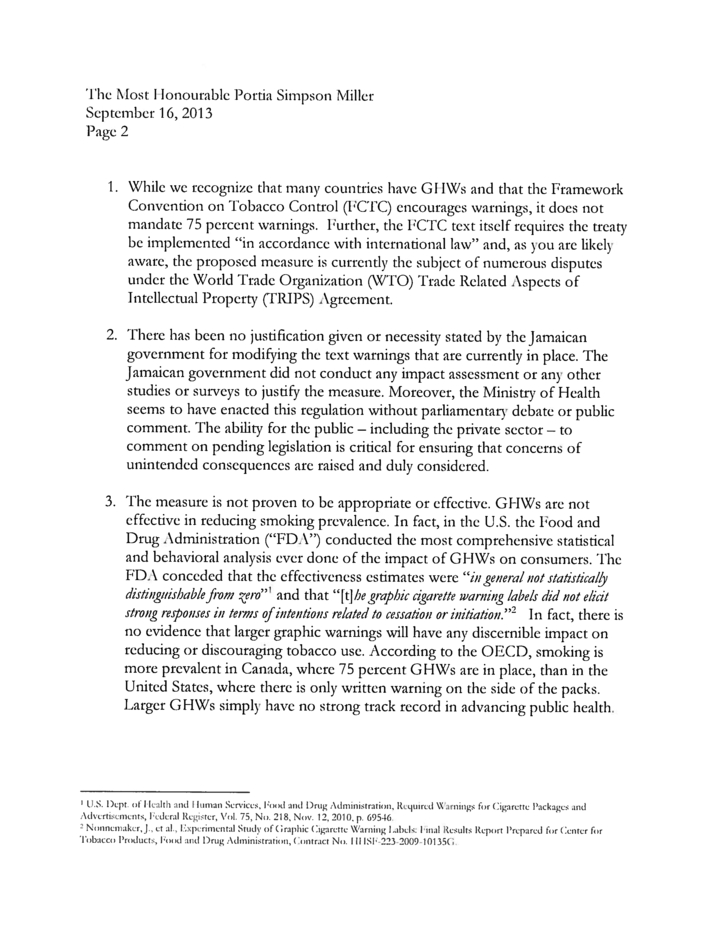
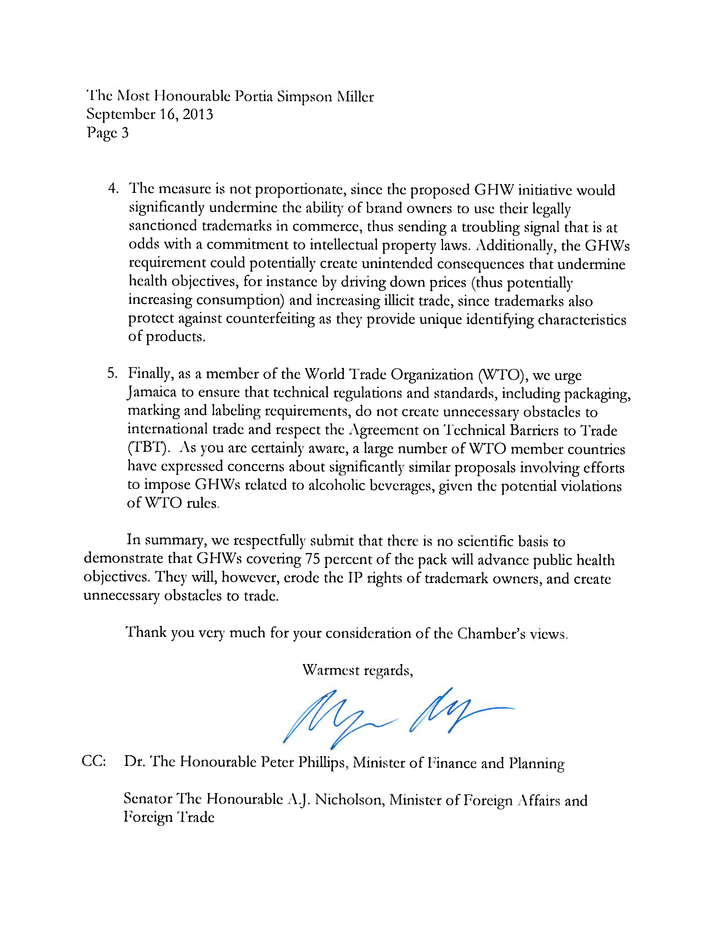
A September 2013 letter to the prime minister protests a new regulation, claiming graphic warning labels “are not effective” and create “unnecessary obstacles to international trade.”

Moldova
In a February 2014 letter, the chamber called a number of proposals “extreme measures” including bans on menthol and slim cigarettes, a ban on advertising at the point of sale and restrictions on smoking in public places.

Nepal
In a January 2015 letter, the chamber says a proposal to increase graphic health warnings on cigarette packs is “of concern to American companies,” and there is not “science-based evidence” it will have an impact.

Uruguay
In an April 2014 letter to the president of the Senate, the chamber expresses concern over new legislation that would bar retailers from displaying tobacco products, calling it “a serious threat to intellectual property.”

New Zealand
In a March 2014 letter, the chamber says new plain packaging legislation “sets a dangerous precedent” by violating trade laws.


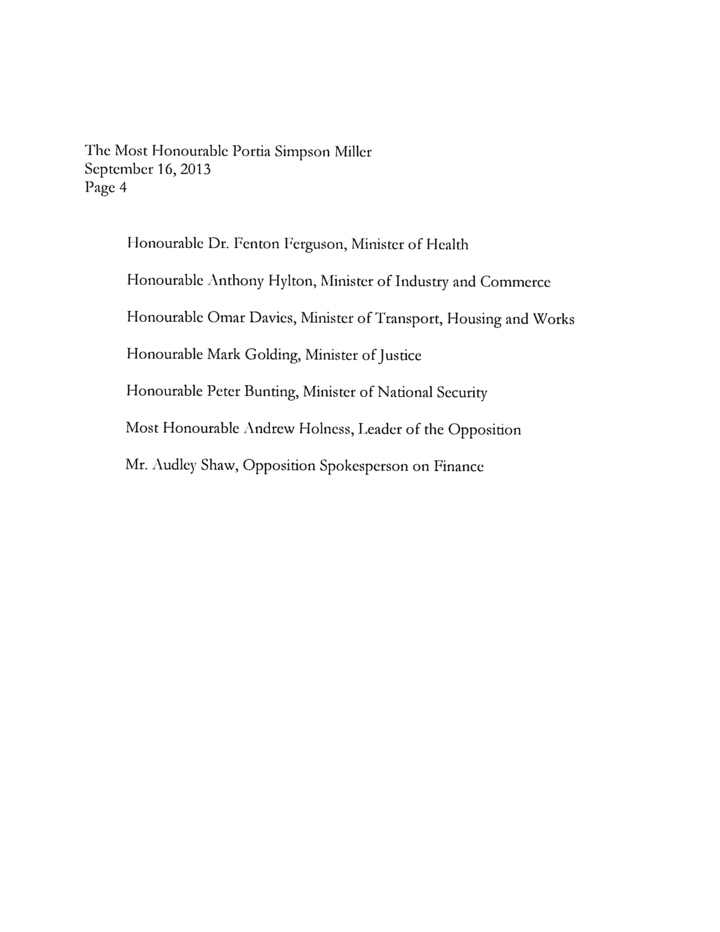
jamaica_1-720 jamaica_2-720 jamaica_3-720 jamaica_4-720

Letters and documents from the U.S.
Chamber of Commerce’s foreign affiliates

These generally refer to legislation within their own country, but not always.

New Zealand (and Indonesia)
In a March 2014 letter sent to the parliamentary health committee in Ireland, the American Chamber of Commerce in Indonesia objects to the plain package proposal, calling the evidence “questionable.”

Croatia
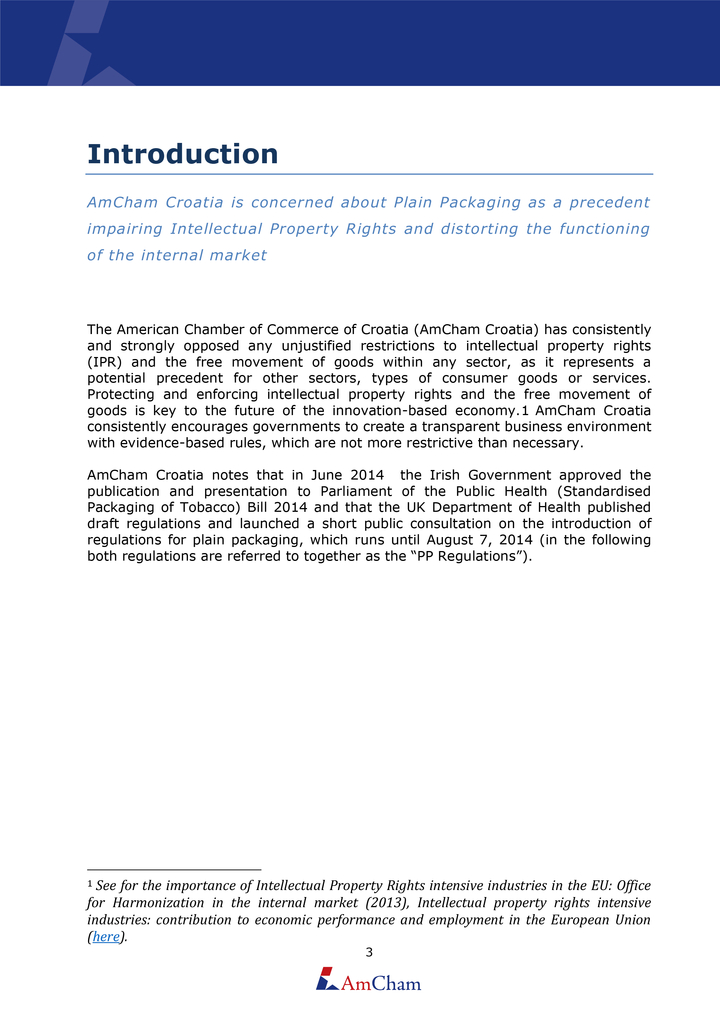
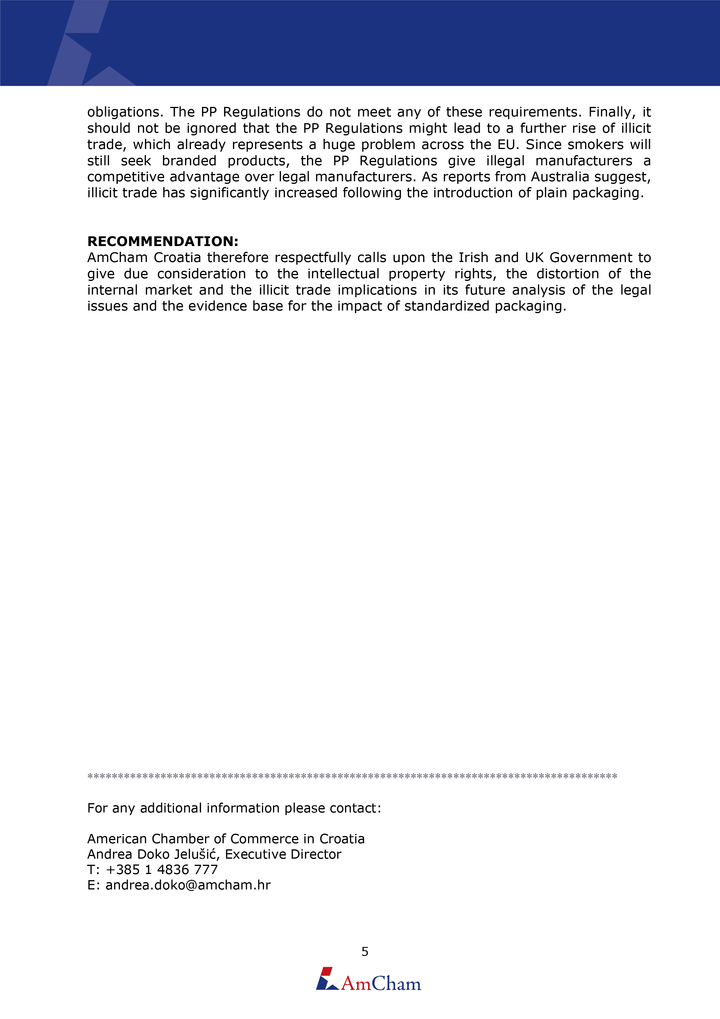
In a September 2014 position paper, the American Chamber of Commerce in Croatia outlined its opposition to legislation requiring cigarettes be sold in plain packages in other European Union member states.

Estonia
A paper outlining the policy priorities of the chamber affiliate quotes a Philip Morris executive who says protecting intellectual property in Estonia is crucial “to maintain its competitive position in the global economy.”

Ireland (and Poland)
In a July 2014 letter to the prime minister, the Polish affiliate says both countries “would all be losing out” if Ireland imposes plain packaging requirements.

Ukraine
In May, the prime minister, Arseniy Yatsenyuk, said that his country began a trade case against Australia’s plain packaging law in 2012 because of a complaint by the U.S. Chamber.

croatia_to_ireland_1-720

croatia_to_ireland_2-720

croatia_to_ireland_3-720

croatia_to_ireland_4-720

croatia_to_ireland_5-720


Letters from the U.S. Chamber with other business groups

European Union
In an April 2013 letter to the European Union’s ambassador to the United States, the U.S. Chamber joined other American business groups in opposing “arbitrary product prohibitions” in new tobacco legislation.

White House
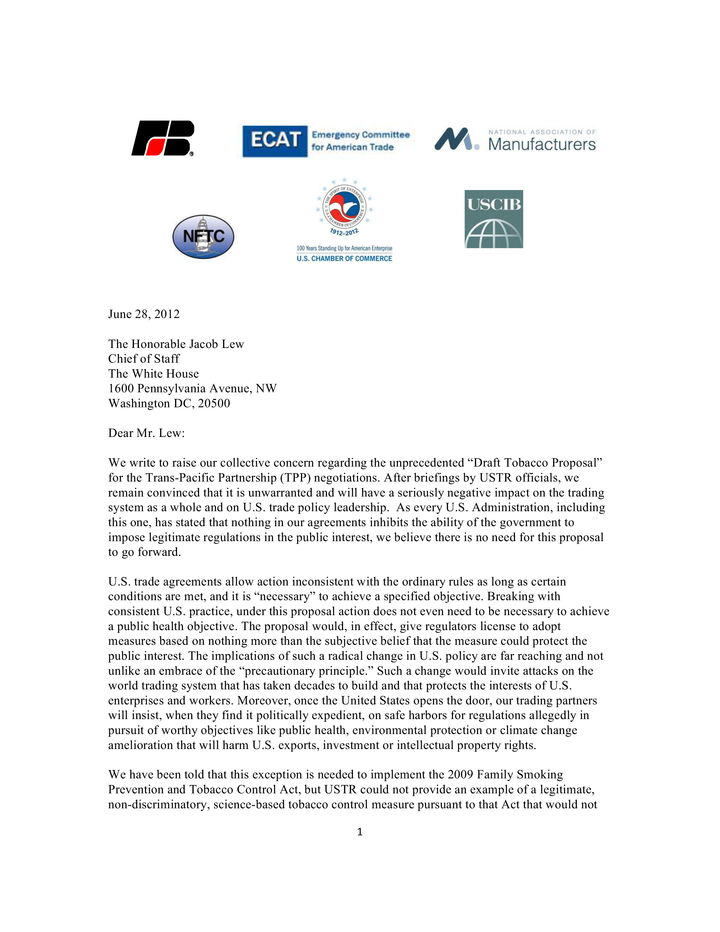
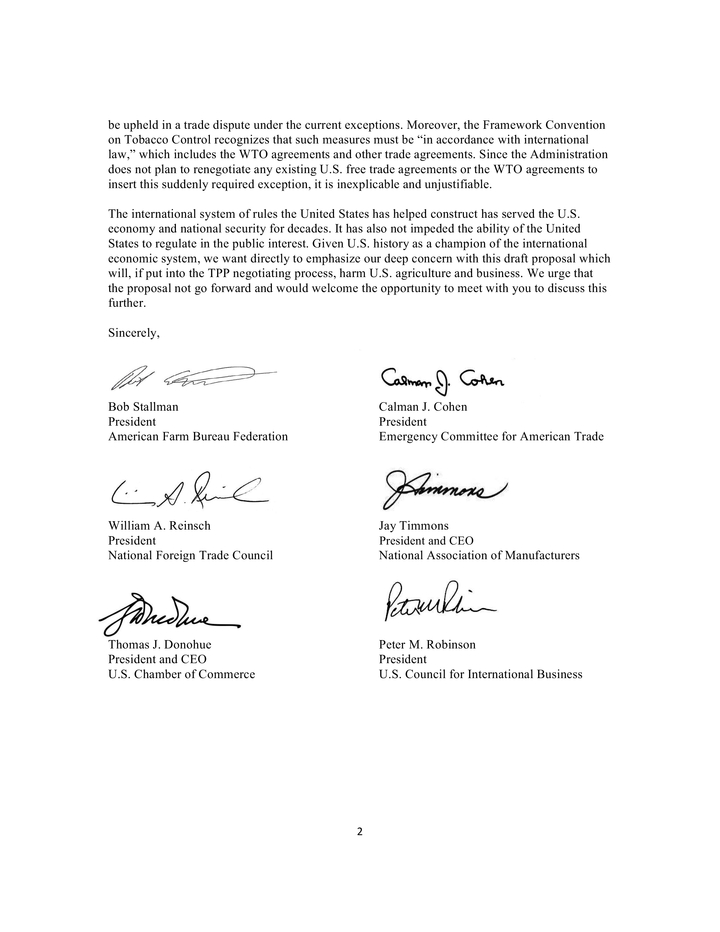
In a June 2012 letter to the then chief of staff, Jacob Lew, the chamber, with five other business groups, objects to the Draft Tobacco Proposal for the Trans-Pacific Partnership negotiations.

U.S. Trade Representative
The chamber, in August 2013 letter with more than 15 other business groups, objects to a “product-specific reference to tobacco or any other product” in relation to the Trans-Pacific Partnership negotiations.

white_house_1-720 white_house_2-720

“Smoking is one of the leading causes of death,” Brooke Thurston, a spokeswoman for Steward, said in a statement, adding, “If the chamber is in fact advocating for increased smoking we do not agree with them on this public health issue.”

The other three companies declined to comment.

Their silence stands in contrast to opposition to the chamber’s tobacco lobbying from a surprising source: the public relations firm Burson-Marsteller.

“It’s pretty obvious that you don’t want to be seen doing the bidding of an interest which is no longer legitimate,” said David Earnshaw, president of the Brussels office of Burson-Marsteller, a company that long worked for the tobacco industry. He tried unsuccessfully to prevent a major affiliate of the chamber, based in Brussels, from issuing a position paper targeting a European proposal on plain packaging.

In a statement Tuesday, the chamber said, “we know that smoking carries obvious health risks,” but added that “we are concerned that a number of governments have acted in ways that are inconsistent with their international obligations.”

The statement said the chamber had raised “substantive concerns” about “the destruction of intellectual property and the dangerous precedent of discrimination against a legal product possibly spreading to other sectors.” It added, “We make no apology for asking governments to keep their word.”

The chamber has not addressed why it has opposed health measures like restricting smoking in public places.

The Times reported this week that the chamber lobbies against antismoking laws in many countries, pits countries against one another on tobacco issues in trade forums, and, in Washington, defends the ability of the tobacco industry to sue under future trade deals.

The chamber, which claims more than three million members, previously encountered friction over its policies. Apple abandoned the chamber in 2009 over its rejection of climate change regulation. The construction giant Skanska left in 2013 after protesting the chamber’s resistance to green building codes.

Last year, when the branch of the American Chamber of Commerce in Brussels, known as AmCham EU, drafted its paper outlining opposition to plain packaging, the only inkling of dissent came from a footnote.

“This position paper does not represent the views of all members of AmCham EU,” it said, in an italicized note at the end.

Burson-Marsteller, which has had its share of controversial clients, was an unlikely rebel against the chamber’s position. The firm developed public relations and marketing campaigns for RJR Reynolds like “Project SPA,” the introduction of its failed Premier brand of cigarettes in the 1980s. Burson, a member of AmCham EU, also worked extensively for Philip Morris U.S.A., now part of Altria, developing campaigns that included a strategy to beat back criticism of the cigarette maker’s sponsorship of women’s tennis.

But in 2010 the firm renounced tobacco. Last year, Mr. Earnshaw raised objections with AmCham EU about aligning with tobacco interests, especially with many members in the cross hairs of European regulators and lawmakers facing concerns about privacy, the dominance of technology companies based in the United States and negotiations over a trans-Atlantic trade treaty.

“I tried to stop AmCham from shooting itself in the foot,” Mr. Earnshaw said. “It’s particularly crazy at a time when there are such big issues that American companies need to be involved in.”

“AmCham is extremely influential in public affairs,” he added. “If it starts producing position papers defending big tobacco on plain packaging, it’s going to make itself look ridiculous.”

The chamber’s E.U. branch proceeded with the position paper, arguing that plain packages unfairly harmed tobacco maker’s intellectual property and posed a broader threat to trademarks, representing “a potential precedent for other sectors and consumer goods or services.”

The chamber’s argument sounded as if it could have been written by the tobacco industry. An unpublished early version of the position paper, which was obtained by The Times, reveals that the rapporteur, or primary author, was Anne-Laure Covin, an executive of Philip Morris International, which is now separate from Philip Morris U.S.A. The company had no comment.

Philip Morris was not the only company involved. The paper came from a committee at the chamber’s European Union branch run by a Time Warner executive, Vincent Jamois, whose name and corporate affiliation are on the draft version of the paper, right above Ms. Covin’s name.

In other forums, Time Warner has expressed concern about cigarettes; in 2005 the company introduced a Tobacco Depiction Policy that sought to limit the number of times people were shown smoking in movies. The goal was “to reduce or eliminate the depiction of smoking and tobacco products/brands in their feature films, unless there is a compelling creative reason for such depictions,” the policy said.

Time Warner even undertook a detailed study of the effectiveness of the policy, finding that total depictions of smoking in its movies fell to 534 in 2013 from 1,346 in 2006.

The committee Mr. Jamois leads deals with intellectual property. The tobacco industry has attracted broader corporate support by framing opposition to plain packaging as a defense of intellectual property rights.


Other companies and institutions whose executives are listed on the U.S. Chamber’s board include Pfizer, which markets the smoking-cessation drug Chantix.

“Tobacco use is the leading cause of preventable death in the world,” Sharon Castillo, a spokeswoman for Pfizer, said in response to questions. But she continued, “Our membership of any group comes with the clear understanding that we may not always agree with all the positions of the organization.”

Part of the chamber’s campaign seeks to discredit antismoking efforts by claiming they lack scientific evidence of effectiveness, particularly requirements that cigarettes be sold in plain packages shorn of corporate logos, or that they be covered with graphic health warnings, or sometimes a combination of the two. A letter from the chamber to the prime minister of Jamaica in 2013 was typical, contending that graphic health warnings “are not effective in reducing smoking prevalence.”

But many studies have found that plain packaging and packages covered with diseased lungs and other disturbing images make smoking less palatable.

“Graphic warnings do work, they motivate people to quit smoking,” said Seth Noar, an author of an analysis by researchers at the University of North Carolina of 37 tobacco studies.

For health care companies, a prominent role in a group that antismoking advocates see as the tobacco industry’s biggest ally can be particularly awkward. Like Anthem, the Health Care Service Corporation encourages members to stop smoking.

One video on its website called “Da Couch Potato” features an overweight man who smokes, drinks beer and watches the Chicago Bears but wants to get back in shape. A news release highlights that “smoking one pack of cigarettes per day can add up to $1,825.00 each year and tobacco use accounts for more than $96 billion a year in medical costs.”

John Cannon, HCSC’s executive vice president and chief administrative officer, is a member of the chamber’s board.

Dr. Ralph de la Torre, a cardiac surgeon and the chairman and chief executive of the Steward health system, also is a board member. One of Steward’s hospitals advertises a smoking-cessation program by saying, “There are a million reasons to quit smoking but it only takes one.”

Daniel F. Evans Jr., chief of the Indiana University Health system, is another member of the chamber’s board. His health system offers a program called “Beat Tobacco” taught by “qualified tobacco educators” who “understand the struggles and side effects of tobacco cessation.”

Lisa Gilbert, who tracks the chamber for Public Citizen, a consumer advocacy group founded by Ralph Nader, said the health companies were conflicted.

“It’s interesting to think of a company giving money to another organization to lobby while publicly proclaiming the opposite policy position,” she said. Such companies either “have no idea what’s being lobbied on and would be appalled to learn that something is diametrically opposed to what they support,” or “there is some actual reason to invest in tobacco control publicly but work to keep laws just as they are in private.”

Making Tobacco’s Case

The U.S. Chamber’s work in support of the tobacco industry in recent years has emerged as a priority at the same time the industry has faced one of the most serious threats in its history. A global treaty, negotiated through the World Health Organization, mandates anti-smoking measures and also seeks to curb the influence of the tobacco industry in policy making. The treaty, which took effect in 2005, has been ratified by 179 countries; holdouts include Cuba, Haiti and the United States.

Facing a wave of new legislation around the world, the tobacco lobby has turned for help to the U.S. Chamber of Commerce, with the weight of American business behind it. While the chamber’s global tobacco lobbying has been largely hidden from public view, its influence has been widely felt.

Letters, emails and other documents from foreign governments, the chamber’s affiliates and antismoking groups, which were reviewed by The New York Times, show how the chamber has embraced the challenge, undertaking a three-pronged strategy in its global campaign to advance the interests of the tobacco industry.

In the capitals of far-flung nations, the chamber lobbies alongside its foreign affiliates to beat back antismoking laws.

In trade forums, the chamber pits countries against one another. The Ukrainian prime minister, Arseniy Yatsenyuk, recently revealed that his country’s case against Australia was prompted by a complaint from the U.S. Chamber.

And in Washington, Thomas J. Donohue, the chief executive of the chamber, has personally taken part in lobbying to defend the ability of the tobacco industry to sue under future international treaties, notably the Trans-Pacific Partnership, a trade agreement being negotiated between the United States and several Pacific Rim nations.

“They represent the interests of the tobacco industry,” said Dr. Vera Luiza da Costa e Silva, the head of the Secretariat that oversees the W.H.O treaty, called the Framework Convention on Tobacco Control. “They are putting their feet everywhere where there are stronger regulations coming up.”

Thomas J. Donohue, the head of the U.S. Chamber of Commerce, has defended the tobacco industry's right to sue under future international treaties.

Thomas J. Donohue, the head of the U.S. Chamber of Commerce, has defended the tobacco industry’s right to sue under future international treaties.

The increasing global advocacy highlights the chamber’s enduring ties to the tobacco industry, which in years past centered on American regulation of cigarettes. A top executive at the tobacco giant Altria Group serves on the chamber’s board. Philip Morris International plays a leading role in the global campaign; one executive drafted a position paper used by a chamber affiliate in Brussels, while another accompanied a chamber executive to a meeting with the Philippine ambassador in Washington to lobby against a cigarette-tax increase. The cigarette makers’ payments to the chamber are not disclosed.

It is not clear how the chamber’s campaign reflects the interests of its broader membership, which includes technology companies like Google, pharmaceutical giants like Pfizer and health insurers like Anthem. And the chamber’s record in its tobacco fight is mixed, often leaving American business as the face of a losing cause, pushing a well-known toxin on poor populations whose leaders are determined to curb smoking.

The U.S. Chamber issued brief statements in response to inquiries. “The Chamber regularly reaches out to governments around the world to urge them to avoid measures that discriminate against particular companies or industries, undermine their trademarks or brands, or destroy their intellectual property,” the statement said, adding, “we’ve worked with a broad array of business organizations at home and abroad to defend these principles.”

The chamber declined to say if it supported any measures to curb smoking.

The chamber, a private nonprofit that has more than three million members and annual revenue of US$165 million, spends more on lobbying than any other interest group in America. For decades, it has taken positions aimed at bolstering its members’ fortunes.

While the chamber has local outposts across the United States, it also has more than 100 affiliates around the world. Foreign branches pay dues and typically hew to the U.S. Chamber’s strategy, often advancing it on the ground. Members include both American and foreign businesses, a symbiotic relationship that magnifies the chamber’s clout.

For foreign companies, membership comes with “access to the U.S. Embassy” according to the Cambodian branch, and entree to “the U.S. government,” according to the Azerbaijan branch.

Members in Hanoi get an invitation to an annual trip to “lobby Congress and the administration” in Washington.

Since Mr. Donohue took over in 1997, he has steered the chamber into positions that have alienated some members. In 2009, the chamber threatened to sue if the Environmental Protection Agency regulated greenhouse gas emissions, disputing its authority to act on climate change. That led Nike to step down from the chamber’s board, and to Apple’s departure from the group. In 2013, the American arm of the Swedish construction giant Skanska resigned, protesting the chamber’s support for what Skanska called a “chemical industry-led initiative” to lobby against green building codes.

The chamber’s tobacco lobbying has led to confusion for many countries, Dr. da Costa e Silva said, adding “there is a misconception that the American chamber of commerce represents the government of the U.S.” In some places like Estonia, the lines are blurred. The United States ambassador there, Jeffrey Levine, serves as honorary president of the chamber’s local affiliate; the affiliate quoted Philip Morris in a publication outlining its priorities.

The tobacco industry has increasingly turned to international courts to challenge antismoking laws that countries have enacted after the passage of the W.H.O. treaty. Early this year, Michael R. Bloomberg and Bill Gates set up an international fund to fight such suits. Matthew L. Myers, president of the Campaign for Tobacco-Free Kids, an advocacy group that administers the fund, called the chamber “the tobacco industry’s most formidable front group,” adding, “it pops up everywhere.”

In Ukraine, the chamber’s involvement was no surprise to Hanna Hopko, the lawmaker who led the hearing in Parliament. She said the chamber there had fought against antismoking laws for years.

“They were against the tobacco tax increase, they were against placing warning labels on cigarettes,” she said. “This is just business as usual for them.”

Plain packaged tobacco products with health warnings in Sydney, Australia.

Plain packaged tobacco products with health warnings in Sydney, Australia.

Country-by-Country Strategy

More than 3,000 miles away, in Nepal, the health ministry proposed a law last year to increase the size of graphic warning labels from covering three-fourths of a cigarette pack to 90 percent. Countries like Nepal that have ratified the W.H.O. treaty are supposed to take steps to make cigarette packs less appealing.

Not long afterward, one of Nepal’s top officials, Lilamani Poudel, said he received an email from a representative of the chamber’s local affiliate in the country, warning that the proposal “would negate foreign investment” and “invite instability.”

In January, the U.S. Chamber itself weighed in. In a letter to Nepal’s deputy prime minister, a senior vice president at the chamber, Tami Overby, wrote that she was “not aware of any science-based evidence” that larger warning labels “will have any discernible impact on reducing or discouraging tobacco use.”

A 2013 Harvard study found that graphic warning labels “play a lifesaving role in highlighting the dangers of smoking and encouraging smokers to quit.”

While Nepal eventually mandated the change in warning labels, cigarette companies filed for an extension and compliance has stalled.

“Since we have to focus on responding to the devastating earthquake, we have not been able to monitor the state of law enforcement effectively,” said Shanta Bahadur Shrestha, a senior health ministry official.

The episode reflects the chamber’s country-by-country lobbying strategy. A pattern emerged in letters to seven nations: Written by either the chamber’s top international executive, Myron Brilliant, or his deputies, they introduced the chamber as “the world’s largest business federation.”

Then the letters mention a matter “of concern.” In Jamaica and Nepal, it was graphic health warnings on packages. In Uruguay, it was a plan to bar cigarettes from being displayed by retailers. The Moldovan president was warned against “extreme measures” in his country, though they included common steps like restricting smoking in public places and banning advertising where cigarettes are sold.

A proposal to raise cigarette taxes in the Philippines would open the floodgates to smugglers, the government there was told. Tax revenue has increased since the proposal became law.

“We are not cowed by them,” said Jeremias Paul, the country’s under secretary of finance. “We meet with these guys when we’re trying to encourage investment in the Philippines, so clearly they are very influential, but that doesn’t mean they will dictate their ways.”

Protecting tobacco companies is portrayed by the chamber as vital for a nation’s economic health. Uruguay’s president is warned that antismoking laws will “have a disruptive effect on the formal economy.” El Salvador’s vice president is told that “arbitrary actions” like requiring graphic health warnings in advertisements undermine “investment and economic growth.”

On the ground, the chamber’s local affiliates use hands-on tactics.

After Moldova’s health ministry proposed measures in 2013, Serghei Toncu, the head of the American Chamber of Commerce in Moldova, laid out his objections in a series of meetings held by a regulatory review panel.

“The consumption of alcohol and cigarettes is at the discretion of each person,” Mr. Toncu said at one meeting, adding that the discussion should not be about “whether smoking is harmful.”

“You do not respect us,” he told the health ministry at another. At a third, he called the ministry’s research “flawed from the start.”

His objections were not merely plaintive cries. The American chamber has a seat on Moldova’s regulatory review panel giving it direct influence over policy making in the small country.

“The American Chamber of Commerce is a very powerful and active organization,” said Oleg Chelaru, a team leader on the staff that assists the review panel. “They played a very crucial role in analyzing and giving an opinion on this initiative.”

Mr. Toncu, who has since left the chamber, declined to comment. Mila Malairau, the chamber’s executive director, said its main objective was to make sure the industry “was consulted” in “a transparent and predictable manner.”

Protesters displayed fake body bags at a tobacco trade show at Pasay, the Philippines, in 2013.

Protesters displayed fake body bags at a tobacco trade show at Pasay, the Philippines, in 2013.

After recently passing in Parliament, the long-stalled measures were subject to fresh objections from the chamber and others, and have not yet been enacted.

Fighting a Trade Exception

In Washington, the U.S. Chamber’s tobacco lobbying has been visible in the negotiations over the Trans-Pacific Partnership, a priority of the Obama administration that recently received critical backing in Congress.

One of the more controversial proposals would expand the power of companies to sue countries if they violate trade rules. The U.S. Chamber has openly opposed plans to withhold such powers from tobacco companies, curbing their ability to challenge national antismoking laws. The chamber says on its website that “singling out tobacco” will “open a Pandora’s box as other governments go after their particular bêtes noires.”

The issue is still unresolved. A spokesman for the United States trade representative said negotiators would ensure that governments “can implement regulations to protect public health” while also “ensuring that our farmers are not discriminated against.”

Email traffic shows that Mr. Donohue, the chamber’s head, sought to raise the issue in 2012 directly with Ron Kirk, who was then the United States trade representative. In email exchanges between staff members of the two, Mr. Donohue specifically sought to discuss the role of tobacco in the trade agreement.

“Tom had a couple of things to raise, including urging that the tobacco text not be submitted at this round,” one of Mr. Donohue’s staff members wrote to Mr. Kirk’s staff. The emails were produced in response to a Freedom of Information request filed by the Campaign for Tobacco-Free Kids, which provided them to The Times.

Mr. Kirk is now a senior lawyer at Gibson, Dunn, a firm that counts the tobacco industry as a client. He said in an interview that during his tenure as trade representative, he met periodically with Mr. Donohue but could not recall a specific conversation on tobacco.

He said trade groups were generally concerned about “treating one industry different than you would treat anyone else, more so than doing tobacco’s bidding.”

The chamber declined to make Mr. Donohue available for an interview.

A Face-Saving Measure

In Ukraine, it was Valeriy Pyatnytskiy who signed off on the complaint against Australia in 2012, which was filed with the World Trade Organization. At the time, he was Ukraine’s chief negotiator to the W.T.O. His political career has survived the revolution and he is now an adviser to the Ukrainian prime minister, Mr. Yatsenyuk.

In a recent interview, he said that for Ukraine, the case was a matter of principle. It was about respecting the rules.

He offered a hypothetical: If Ukraine allowed Australia to use plain packaging on cigarettes, what would stop Ukraine from introducing plain packaging for wine? Then Ukrainian winemakers could better compete with French wines, because they would all be in plain bags marked red or white.

“We had this in the Soviet times,” he said. “It was absolutely plain packaging everywhere.”

Some Ukrainian officials have long been troubled by the case.

“It has nothing to do with trade laws,” said Pavlo Sheremeta, who briefly served as Ukraine’s economic minister after the revolution. “We have zero exports of tobacco to Australia, so what do we have to do with this?”

Last year, he urged the American Chamber in Kiev to reconsider.

“I wrote a formal letter, asking them, ‘Do you still keep the same position?’ ” Mr. Sheremeta said. “Basically I was suggesting a face-saving way out of this.” But when he met with chamber officials, the plain packaging case was outlined as a top priority.

They refused to back down. After Mr. Pyatnytskiy, a tobacco ally, was installed as his deputy, Mr. Sheremeta resigned.

“The world was laughing at us,” he said of the case.

Shortly after The Times discussed the case with Ukrainian government officials, there were new protests from activists. Mr. Yatsenyuk called for a review of the matter. Ukraine has since suspended its involvement, but other countries including Cuba and Honduras are continuing to pursue the case against Australia.

Andy Hunder, who took over as president of the American Chamber of Commerce in Kiev in April, said the organization was moving on, adding, “We are looking forward now.”
Sofiia Kochmar contributed reporting from Kiev, Bhadra Sharma from Kathmandu and Palko Karasz from London.

Save lives and don’t buckle to tobacco industry on plain packaging

http://www.stuff.co.nz/business/industries/69744829/save-lives-and-dont-buckle-to-tobacco-industry-on-plain-packaging

Cigarette packaging is a battleground fought over by the anti-smoking lobby and the tobacco industry.

OPINION: In March 2011, the Government committed to becoming the first country in the world to be smokefree by 2025, an innovative goal to reduce the smoking prevalence to lower than 5 per cent.

To help achieve this the Government introduced tobacco plain packaging legislation in April 2012.

Australia became the first country to enact plain packaging in November 2011, taking 19 months to bring the legislation to completion.

It was followed earlier this year by Ireland (22 months) and the United Kingdom (35 months). The legislation in New Zealand is still awaiting its second reading, after more than 38 months, with no clear date from the Government on when it will proceed.

To understand the lack of progress in New Zealand it is imperative to recognise the importance of tobacco industry delay tactics.

These have been exposed through litigation in the United States and made publically available through the Legacy library – an archive that contains more than 80 million pages of previously secret tobacco industry documents.

My own research analysing these documents has revealed that, during the early 1990s, tobacco companies became increasingly worried about an innovative idea like plain packaging (first proposed in Canada and Australia) as it would severely regulate the branding and marketing of their products.

In response, they requested legal opinions on the legality of restricting and prohibiting use of their trademarks and were told privately that international treaties afforded little protection.

However, publically, the companies threatened to sue the Canadian and Australian governments for billions of dollars causing both governments to withdraw their proposals, which successfully delayed tobacco plain packaging for decades. The companies also recognised that they couldn’t let any future plain packaging proposal be treated as a public health issue. Instead the focus must remain on convoluted arguments surrounding the expropriation of trademarks and intellectual property.

Fast-forward to today and the New Zealand Government is facing the same trade threats from tobacco companies. In response it has repeatedly said it would have to “wait and see” what happens with two legal trade challenges by Philip Morris International against the plain packaging policy in Australia before proceeding.

I have spent the last couple of weeks in Auckland and Wellington interviewing health advocates, legal scholars, and Government officials to investigate New Zealand’s pending plain packaging legislation. While some interviewees recognised the lack of political will, an overwhelmingly number of interviewees cited the pending trade lawsuits against Australia as having a direct impact on the lack of progress in New Zealand.

My research suggests tobacco industry trade threats and challenges are having a chilling effect and attempt to pre-empt Government regulatory authority. However, early analysis also suggests the Government, and more importantly the media, continues to frame this issue around international trade instead of highlighting the impact of tobacco, which in New Zealand kills approximately 5000 people a year (about 13 people a day) and severely affects marginalised populations, especially Maori women.

If your Government continues to succumb to tobacco industry pressure and treat plain packaging as an international trade and investment issue they run the risk of breaking their own promise and commitment to become smokefree by 2025.

Eric Crosbie is a PhD student at the University of Arizona. He visited New Zealand in early June as part of his research into the influence of tobacco companies on political process.

Hungary Considering Introduction Of Australian-Style Uniform Packaging For Tobacco Products

http://hungarytoday.hu/news/hungary-considering-introduction-australian-style-uniform-packaging-tobacco-products-12763

Hungary is considering the introduction of uniform packaging for tobacco products, which would mean that all such goods would have identical packaging and advertising tobacco products would be prohibited. This system is already in place in Australia and authorities in France and Ireland are also planning its introduction. A proposal on the matter is expected to be tabled by Parliament in autumn.

According to plans, the construction of Budapest’s new hospital would be financed by a special tax levied upon tobacco companies.

In Australia, a law has been in place since December 2012 which obliges retailers to sell tobacco products in identical packaging, which is prohibited to carry insignia, colours or design elements which set a given brand apart other products on the tobacco market. The law was set in place with the explanation that some 15 000 people died each year in Australia alone from illnesses connected to smoking, costing the state a total of 31.5 billion dollars.

How much have retailers been affected by plain packaging legislation?

Download (PDF, 675KB)

What is happening to the prevalence of smoking in Australia?

Download (PDF, 904KB)