Clear The Air News Tobacco Blog Rotating Header Image

Plain Packaging

Aust Govt wins case against tobacco giant Philip Morris over plain packaging laws

http://www.abc.net.au/pm/content/2015/s4375556.htm

PETER LLOYD: Australia has won a long legal battle against tobacco giant Philip Morris over its plain packaging laws.

The company brought the case against Australia when the laws were introduced by the Gillard government back in 2011.

It’s a win for Australia that could have international ramifications as other countries too consider introducing plain packaging for tobacco products.

Imogen Brennan is speaking here to Professor Tania Voon, a specialist in trade at the Melbourne Law School.

TANIA VOON: Philip Morris was essentially arguing that this violated its investment protections, that it was contrary to Australia’s investment obligations under the Australia-Hong Kong bilateral investment treaty.

Really Philip Morris was concerned not so much about Australia, which has a relatively small population in world terms and a relatively low smoking rate which has got lower as the case has continued, but it was more concerned I would say with the impact globally because it’s very concerned, the whole tobacco industry is very concerned, about other countries following this kind of measure.

IMOGEN BRENNAN: So this could potentially set a precedent in other parts of the world?

TANIA VOON: Ah yes. So in, not necessarily in a formal sense, but certainly this will have an impact on any other case that relates to tobacco control measures, it will affect other countries’ decision making about what tobacco control measures to adopt and I would say that a significant component of the intention of this case on the part of the claimant Philip Morris was to stop other countries from adopting these kinds of measures or to delay other countries from doing that.

And it has. To some extent it may have succeeded, with some countries deferring their decision making or putting off pursuing these measures. For example New Zealand had said we will wait to see what happens with this dispute.

Other countries have nevertheless gone ahead. Today I saw another announcement that France was going ahead and was going to introduce plain packaging from May next year. Other countries include Ireland and the United Kingdom that also are pursuing similar measures.

IMOGEN BRENNAN: So this case has been going for years now and today Australia won in the investor-state dispute settlement. Can Philip Morris appeal this decision?

TANIA VOON: No. This was a decision based on the jurisdiction of the tribunal. The tribunal determined that it did not have jurisdiction to hear the case.

IMOGEN BRENNAN: In terms of further legal action against Australia in regards to its plain packaging laws, there’s a separate claim against Australia at the World Trade Organisation at the moment. What’s that case about and who’s brought that?

TANIA VOON: So the case is about the same thing. Again, it’s about Australia’s plain packaging laws. There are arguments in that case about a violation of intellectual property obligations for example. Again I think that Australia is very likely to win that case.

The case has been brought – it can only be brought by WTO members. It cannot be brought directly by companies. It’s being brought by Cuba, the Dominican Republic, Honduras and Indonesia. Originally Ukraine was also one of complainants but it has since suspended its complaint.

IMOGEN BRENNAN: This must be costing the Australian Government a lot of money in terms of defence.

TANIA VOON: So I’d say it has been a long process that would have used up a lot of Australian resources but in a sense that’s something that I think the tobacco industry is trying to shout loud and clear and the implication is for other countries to watch out because they will bring the same claims against these other countries.

And I think in this regard it is a significant win not just for Australia but for all other countries around the world that are facing these kinds of arguments from the tobacco industry where the industry is trying to stop them bringing in not just plain packaging but really any kind of tobacco control measure.

So any country that wants to increase for example their graphic health warnings will face these kinds of arguments. So it is continuing the tobacco industry tradition of bringing whatever legal actions the industry can domestically and internationally.

PETER LLOYD: That’s Tania Voon from the Melbourne Law School speaking to Imogen Brennan.

It’s Been A Bad Year For Big Tobacco

http://www.huffingtonpost.com/entry/big-tobacco-losses_5673f7e0e4b06fa6887cebe2

Cigarette companies found themselves the targets of tighter regulations and lawsuits.

Anti-smoking activists have for years targeted the global behemoths that control the tobacco industry — and this year they made headway. Some of the largest tobacco companies suffered financial and PR setbacks in a series of lawsuits, and anti-smoking initiatives worldwide are further curbing their power.

Here are the losses big tobacco suffered this year:

Packs of Philip Morris International Inc. Marlboro Menthol cigarettes in the new packaging are arranged for a photograph at a tobacco store in Melbourne, Australia, on Monday, Oct. 1, 2012. Tobacco products complying with the world?s first plain-packaging laws have started arriving in stores, as an Oct. 1 manufacturing ban on the country's A$10 billion ($10 billion) tobacco industry comes into force. Photographer: Carla Gottgens/Bloomberg via Getty Images

Packs of Philip Morris International Inc. Marlboro Menthol cigarettes in the new packaging are arranged for a photograph at a tobacco store in Melbourne, Australia, on Monday, Oct. 1, 2012. Tobacco products complying with the world?s first plain-packaging laws have started arriving in stores, as an Oct. 1 manufacturing ban on the country’s A$10 billion ($10 billion) tobacco industry comes into force. Photographer: Carla Gottgens/Bloomberg via Getty Images

Australia Can Keep Its Plain Cigarette Packaging

The Australian government won a major lawsuit against Philip Morris this week. It can continue using plain packaging — logo-less packaging that is the same for all tobacco brands — on cigarette packs sold across the country.

Australia introduced “the world’s toughest laws on tobacco promotion” in 2011, according to then-health minister Nicola Roxon. That year the government voted to implement packaging that, instead of logos, displays the frightening illnesses associated with smoking.

Philip Morris Asia unsuccessfully sued the Australian government in 2011, claiming that the law violated a trade agreement between Australia and Hong Kong.

The UK, France and Ireland Will Use Standardized Packaging, Too

Several countries have followed suit on Australia’s anti-smoking measures. Britain and Ireland approved plain packaging laws in March.

France’s parliament also approved a law Thursday that will place plain packaging on all cigarettes sold in the country starting in May 2016. The products’ brand name will only appear in small type.

The country has made several attempts to diminish its large number of smokers. In 2008, it prohibited smoking in enclosed public spaces like restaurants and bars. In October, the city of Paris also raised the fine for dropping a cigarette butt into the street to 68 euros.

Boston Raises Age For Buying Tobacco To 21

Boston’s board of health voted last week to raise the tobacco purchasing age from 18 to 21 in an effort to prevent teen smoking.

Boston followed the lead of many other cities and towns across Massachusetts that had already increased the age limit. “These changes send a strong message that Boston takes the issue of preventing tobacco addiction seriously,” Boston mayor Marty Walsh said.

New International Trade Laws Block Tobacco Companies From Suing Countries

The Trans-Pacific Partnership, a trade agreement between the U.S. and 11 countries in the Pacific Rim, ruled in October that tobacco is exempt from Investor-State Dispute Settlement rules. In other words, tobacco companies will no longer be able to challenge TPP member countries’ anti-smoking measures the way that Philip Morris did in Australia in 2011.

Anti-tobacco lobbyists and a few senators helped make it happen. “It was time to take action to get trade agreements to stop treating tobacco like it’s just another product and the tobacco industry like any other business,” said Gregg Haifley, federal relations director of the American Cancer Society Cancer Action Network.

The FDA Forced One Tobacco Company To Stop Selling Several Products

The Food and Drug Administration banned R.J. Reynolds from selling four different types of cigarettes in September — Camel Crush Bold, Pall Mall Deep Set Recessed Filter, Pall Mall Deep Set Recessed Filter Menthol and Vantage Tech 13 cigarettes.

The company changed the product ingredients so that they no longer complied with a 2007 federal health law, The Hill reported. The products “fail[ed] to meet the public health bar set forth under law,” explained Mitch Zeller, director of the FDA’s Center for Tobacco Products.

A Jury Imposed $35 Million In Damages On That Same Tobacco Company

R.J. Reynolds was also at the center of a lawsuit in Florida after Garry O’Hara, a U.S. Air Force sergeant who earned the Bronze Star, died of lung cancer in 1996, at the age of 50. O’Hara’s family’s lawyers argued that the company masked the risks associated with smoking for years.

A Florida jury awarded the family $34.7 million in damages in September.

The company tried to argue that the executives responsible for decisions at the time are no longer around. “The R.J. Reynolds leadership that you heard about, they’re gone. … Those people who stood up before Congress and raised their hand, they’re gone,” David Monde, a lawyer for R.J. Reynolds, said in court.

Shady Activity Uncovered Within A Big UK Tobacco Company

The BBC conducted an investigation into British American Tobacco and found that the company bribed politicians and civil servants in East African countries in an effort to “undermine anti-smoking legislation.”

One BAT employee, the BBC said, illegally paid a civil servant in Burundi in exchange for a copy of the country’s Tobacco Control Bill.

The BAT said it was the target of false accusations.

“Our accusers in this programme left us in acrimonious circumstances and have a vendetta against us, clearly demonstrated by the false picture they present of how we do business,” it said in a statement.

The company could face prosecution in the U.K. and the U.S.

Three Cigarette Companies Ordered To Pay CA $15 Billion To Canadian Smokers

Two separate lawsuits, filed by Canadians sickened from smoking and Canadians unable to quit smoking, culminated in the country’s biggest class-action lawsuit to date.

Three tobacco companies — Imperial Tobacco; Rothmans, Benson & Hedges and JTI-Macdonald — were accused of lying to consumers about the health risks associated with their products. They were ordered earlier this year to pay $15 billion (about $10.8 billion USD) to the plaintiffs.

All three companies said they planned to appeal the decision, claiming that Canadians are well-versed in the risks of smoking.

Australia wins court challenge to tobacco plain packaging

http://www.reuters.com/article/australia-tobacco-packaging-idUSL1N1470N520151218

A Singapore-based court has refused a challenge by Philip Morris to Australia’s landmark plain packaging legislation passed in 2011, which the tobacco giant had brought under a bi-lateral trade treaty with Hong Kong, the company said.

The Permanent Court of Arbitration declined on jurisdictional grounds to allow the case to proceed, effectively ending the challenge through this venue, which was based on claims that Australia was violating intellectual property laws.

The decision by the court not to hear the case is likely to be seen as a major victory for Australia, which is facing challenges in other forums such as the World Trade Organisation (WTO), and for other countries considering similar laws.

Australia was the first country in the world to force manufacturers to strip all branding from cigarette packets, most of which are now sold over the counter from blank fronted cabinets, although other countries have followed its lead.

The court said on its website that it would make its decision public once any potentially confidential material within it had been redacted.

Australian Minister for Rural Health Fiona Nash, who is responsible for government tobacco policy, welcomed the decision.

“Plain packaging is a legitimate public health measure which is consistent with Australia’s international legal obligations,” she said in a statement.

Philip Morris blasted the ruling, saying that Australia had exploited procedural issues to avoid an open discussion about the effectiveness of plain packaging in curbing tobacco consumption.

“There is nothing in today’s ruling that addresses, let alone validates, plain packaging in Australia or anywhere else,” Marc Firestone, Philip Morris International Senior Vice President, said in a press release.

“It is regrettable that the outcome hinged entirely on a procedural issue that Australia chose to advocate instead of confronting head on the merits of whether plain packaging is legal or even works.”

The World Trade Organisation (WTO) is currently considering a separate challenge to Australia’s legislation by four member states, and a flurry of challenges by tobacco companies are ongoing as more countries follow Australia’s lead.

The court’s decision would not have any bearing on the WTO case or any of the other legal challenges currently underway.

Companies including Philip Morris, British American Tobacco BATS.L, Japan Tobacco International 2914.T and Imperial Tobacco Group IMT.L took the British government to court earlier this month to challenge its plain packaging laws, which take effect next May.

The case will be heard in a six-day hearing at London’s Royal Courts of Justice.

AWARD ON JURISDICTION AND ADMISSIBILITY

Download (PDF, 4.86MB)

Ruling Does Not Address Legality of Trademark Ban Under International Law

http://investors.pmi.com/phoenix.zhtml?c=146476&p=irol-newsArticle&ID=2123843

Press Release

Philip Morris Asia Limited Comments on Tribunal’s Decision to Decline Jurisdiction in Arbitration Against Commonwealth of Australia Over Plain Packaging

Ruling Does Not Address Legality of Trademark Ban Under International Law

HONG KONG–(BUSINESS WIRE)–Dec. 17, 2015– Philip Morris Asia Limited (PMAL), a Hong Kong company that is the parent of Philip Morris Australia, said today that an arbitral tribunal has declined jurisdiction to hear the merits of PMAL’s case against the Commonwealth of Australia under Australia’s 1993 Investment Promotion and Protection Agreement (IPPA) with Hong Kong.

“There is nothing in today’s outcome that addresses, let alone validates, plain packaging in Australia or anywhere else,” said Marc Firestone, Philip Morris International Senior Vice President and General Counsel. “It is regrettable that the outcome hinged entirely on a procedural issue that Australia chose to advocate instead of confronting head on the merits of whether plain packaging is legal or even works”.

PMAL filed its claims under the IPPA on November 21, 2011, when the Australian government passed plain packaging legislation. PMAL asserted that the sweeping ban on trademarks breaches the foreign investment protections that the Australian government guaranteed in its IPPA with Hong Kong.

Firestone continued, “This case has never been about a government’s undeniable authority to regulate in the public interest. Nor has there ever been any question that tobacco products merit strict oversight. In our view, the real point is simply this: Even when pursuing tobacco control objectives, governments are still accountable if they choose to use unlawful means. This is the essence of the rule of law.”

The Australian government’s tobacco packaging policy remains the subject of international disagreement. The World Trade Organization (WTO) is currently considering challenges to Australia’s legislation by four WTO Members. Separately, courts in Europe are also assessing plain packaging under national and international law. The decision on jurisdiction under the Australia-Hong Kong IPPA has no bearing on any of these proceedings.

Australia’s former Labor government made bold promises regarding the public health benefits that its excessive, expropriatory trademark ban — which it labeled a policy experiment – would yield. Three years into the experiment, data from a range of sources consistently demonstrate that the promised outcomes are not being delivered.

PMAL is reviewing the Tribunal’s decision in detail and will determine any further course of action.

###

Philip Morris International Inc.

Philip Morris International Inc. (PMI) is the leading international tobacco company, with six of the world’s top 15 international brands, including Marlboro, the number one cigarette brand worldwide. PMI’s products are sold in more than 180 markets. In 2014, the company held an estimated 15.5% share of the total international cigarette market outside of the U.S., or 28.5% excluding the People’s Republic of China and the U.S. For more information, see www.pmi.com.

Philip Morris Asia Limited

Philip Morris Asia Limited (PMAL) manages PMI’s business in the Asia region. PMA is based in Hong Kong where the company was incorporated under the Hong Kong Companies Ordinance in 1994. PMAL owns the Australian affiliate, Philip Morris Limited (PML).

Philip Morris Limited

Philip Morris Limited (PML) began operations in Australia in 1954 as the first affiliate outside of the United States. Based in Melbourne, PML employs more than 500 people and is the second largest distributor of cigarettes in Australia. PML sells a number of well-known brands, including Marlboro, Alpine, Longbeach, Peter Jackson and choice. In 2014, PML held an estimated 34% share of the Australian cigarette market.

AUSTRALIA PREVAILS IN ARBITRATION WITH PHILIP MORRIS OVER TOBACCO PLAIN PACKAGING DISPUTE

https://www.iareporter.com/articles/breaking-australia-prevails-in-arbitration-with-philip-morris-over-tobacco-plain-packaging-dispute/

A tribunal at the Permanent Court of Arbitration has issued a decision dismissing a high-profile case between cigarette multinational Philip Morris and the Commonwealth of Australia.

The PCA website indicates that a Decision on Jurisdiction and Admissibility was issued on December 17, 2015. A source involved in the case has confirmed to IAReporter that the tribunal has dismissed the investor’s claims of breach of the Australia-Hong Kong bilateral investment treaty.

Subsequent to this, Philip Morris issued a press release confirming the result, and lamenting that the case was decided on the basis of “… a procedural issue that Australia chose to advocate instead of confronting head on the merits of whether plain packaging is legal or even works”.

Hearings occurred in February 2015; detailed legal arguments have remained confidential

The tribunal of Gabrielle Kaufmann-Kohler, Don McRae and Karl-Heinz Boeckstiegel had earlier determined in April 2014 that the proceedings would be bifurcated into a preliminary phase and, if necessary, a later merits phase. Hearings on Australia’s jurisdictional and admissibility objections were held in February 2015.

As we previously discussed (see here), Australia had filed the objections on several grounds, including a complaint that the claim represented an abuse of process due to corporate restructuring engaged in by Philip Morris, as well as a complaint that Philip Morris’ investment in Australia was not admitted in accordance with Australian law, and a complaint that the dispute between the investor and the state was already on foot when Philip Morris acquired its investment in Australia in February 2011.

The tribunal’s detailed reasoning for rejecting jurisdiction is not yet known. The award will not become public until the parties agree on the redaction of any confidential information contained in the award.

Although the broad contours of Australia’s jurisdiction and admissibility objections could be gleaned from an earlier “response” to Philip Morris’s request for arbitration (which we analyzed here), the more detailed subsequent legal arguments filed in the case have remained confidential.

As we’ve reported, Australia’s Attorney General’s office denied a request by Investment Arbitration Reporter under the country’s freedom of information law for access to a detailed defence pleading filed on jurisdiction and merits last year. IAReporter then requested an internal review of that decision, but that review failed to overturn the agency’s earlier rejection of our request.

The claimant has also declined to release its own briefs in the case.

It remains possible that the detailed briefs could be published now that the case has concluded.

Notwithstanding dismissal of the BIT claim, a separate claim against Australia at the World Trade Organisation remains pending, with a decision expected ‘not before the first half of 2016’, according to the WTO’s website.

Philip Morris Asia Limited Comments on Tribunal’s Decision to Decline Jurisdiction in Arbitration Against Commonwealth of Australia Over Plain Packaging

http://www.businesswire.com/news/home/20151217006627/en/Philip-Morris-Asia-Limited-Comments-Tribunal%E2%80%99s-Decision

Ruling Does Not Address Legality of Trademark Ban Under International Law

HONG KONG–(BUSINESS WIRE)–Philip Morris Asia Limited (PMAL), a Hong Kong company that is the parent of Philip Morris Australia, said today that an arbitral tribunal has declined jurisdiction to hear the merits of PMAL’s case against the Commonwealth of Australia under Australia’s 1993 Investment Promotion and Protection Agreement (IPPA) with Hong Kong.

“It is regrettable that the outcome hinged entirely on a procedural issue that Australia chose to advocate instead of confronting head on the merits of whether plain packaging is legal or even works”

“There is nothing in today’s outcome that addresses, let alone validates, plain packaging in Australia or anywhere else,” said Marc Firestone, Philip Morris International Senior Vice President and General Counsel. “It is regrettable that the outcome hinged entirely on a procedural issue that Australia chose to advocate instead of confronting head on the merits of whether plain packaging is legal or even works”.

PMAL filed its claims under the IPPA on November 21, 2011, when the Australian government passed plain packaging legislation. PMAL asserted that the sweeping ban on trademarks breaches the foreign investment protections that the Australian government guaranteed in its IPPA with Hong Kong.

Firestone continued, “This case has never been about a government’s undeniable authority to regulate in the public interest. Nor has there ever been any question that tobacco products merit strict oversight. In our view, the real point is simply this: Even when pursuing tobacco control objectives, governments are still accountable if they choose to use unlawful means. This is the essence of the rule of law.”

The Australian government’s tobacco packaging policy remains the subject of international disagreement. The World Trade Organization (WTO) is currently considering challenges to Australia’s legislation by four WTO Members. Separately, courts in Europe are also assessing plain packaging under national and international law. The decision on jurisdiction under the Australia-Hong Kong IPPA has no bearing on any of these proceedings.

Australia’s former Labor government made bold promises regarding the public health benefits that its excessive, expropriatory trademark ban — which it labeled a policy experiment – would yield.

Three years into the experiment, data from a range of sources consistently demonstrate that the promised outcomes are not being delivered.

PMAL is reviewing the Tribunal’s decision in detail and will determine any further course of action.

Philip Morris International Inc.

Philip Morris International Inc. (PMI) is the leading international tobacco company, with six of the world’s top 15 international brands, including Marlboro, the number one cigarette brand worldwide. PMI’s products are sold in more than 180 markets. In 2014, the company held an estimated 15.5% share of the total international cigarette market outside of the U.S., or 28.5% excluding the People’s Republic of China and the U.S. For more information, see www.pmi.com.

Philip Morris Asia Limited

Philip Morris Asia Limited (PMAL) manages PMI’s business in the Asia region. PMA is based in Hong Kong where the company was incorporated under the Hong Kong Companies Ordinance in 1994. PMAL owns the Australian affiliate, Philip Morris Limited (PML).

Philip Morris Limited

Philip Morris Limited (PML) began operations in Australia in 1954 as the first affiliate outside of the United States. Based in Melbourne, PML employs more than 500 people and is the second largest distributor of cigarettes in Australia. PML sells a number of well-known brands, including Marlboro, Alpine, Longbeach, Peter Jackson and choice. In 2014, PML held an estimated 34% share of the Australian cigarette market.

Canada, Hungary latest additions to global plain packs map

http://www.fctc.org/fca-news/opinion-pieces/1372-updated-2015-plain-packs-map

FCAs_2015_hot_spots_Plain_Packs_Updated_WEB

Much has happened since we published the first plain packs map in April 2015.

France has now adopted plain packaging, to start in May 2016, as in Ireland and the UK. Plain packages are free of colours and all other branding, except for the manufacturers’ name written in a uniform plain style.

Canada and Hungary have announced that they plan to adopt the measure, which was pioneered in Australia in 2012. That move provoked a swift reaction from the tobacco industry. Ultimately, the industry lost a lawsuit in the country’s highest court but its challenge of this public health measure, using an international trade agreement, is pending.

Industry lawsuits

Big Tobacco has already announced challenges to the Irish and UK law and we can expect the same in France.

Following are other countries that have announced they intend to adopt plain packaging:

  • Burkina Faso
  • Chile
  • New Zealand
  • Panama
  • Singapore
  • South Africa
  • Turkey

Tobacco firms challenge packaging law

http://www.bqlive.co.uk/2015/12/11/tobacco-giants-challenge-new-packaging-law/

Some of the world’s largest Tobacco firms have gone to the High Court to challenge the lawfulness of the government’s new packaging rules.

The case has been brought by four of the world’s biggest firms against regulations which come into force in May next year banning companies from using any logos or branding on packets of tobacco products.

Mr Justice Green, sitting in London, is being asked to rule on the legality of the new “standardised packaging” regulations in a judicial review action by Philip Morris International, British American Tobacco, Imperial Tobacco and Japan Tobacco International.

The challenge is being contested by Heath Secretary Jeremy Hunt, who argues that the regulations are lawful.

At the start of an estimated six-day case, David Henderson QC, for Japan Tobacco International (JTI) said the companies were “entitled to know” whether the regulations “are lawful or not.”

He told a packed court: “The claimants manufacture products which are lawful, which contribute approximately £10bn per year in excise duty alone for the UK exchequer, which are used by some 19% of the adult population, and which the secretary of state … has never sought to ban.”

Anderson, referring to written legal submissions before the court on behalf of the secretary of state, said he was “quite wrong when he says that we are trying to protect our ability to market unencumbered by legitimate legislation.”

The QC submitted that “on the contrary” the industry was “regulated in a way almost unprecedented in any other field.”

At the heart of the case are the Standardised Packaging of Tobacco Products Regulations 2015, which the companies argue will destroy their highly valuable property rights and render products indistinguishable from each other.

Under the regulations any part of tobacco packaging not covered by the health warning carried on it must be a dark brown or green colour, and brand names must be in small, non-distinctive lettering.

The government argues that the new measure will discourage more people from smoking.

As well as hearing arguments from lawyers for each of the companies and the Health Secretary, the judge will hear submissions from campaigning public health charity Action on Smoking and Health (Ash), which says it “works to eliminate the harm caused by tobacco.”

The firms are putting forward a number of grounds of challenge, including a claim that the regulations violate a number of UK and EU laws, and that they are “disproportionate.”

In written submissions to the judge, Philip Morris International (PMI) argues that the regulations are “disproportionate and so must be quashed.”

PMI QC Marie Demetriou said the defendant (the health secretary) has “failed to demonstrate” that the regulations are suitable or appropriate to meet the objective of “improving public health by reducing smoking” because “it has failed to establish that the regulations will cause a material decrease in smoking rather than an increase”.

PMI further submits that the health secretary has failed to demonstrate that the regulations “are necessary in that the same public health objective cannot be achieved through a less restrictive means, namely taxation.”

Demetriou said: “The defendant has failed to demonstrate that the regulations strike a fair balance between their public interest objectives and the interests of the claimants, given that the regulations will substantially interfere with the claimants’ fundamental rights and freedoms, and destroy their valuable, and often very long-standing, property rights.”

James Eadie QC, representing the health secretary, said in written submissions that the companies manufacture and sell tobacco products “which are the only legal consumer products in the world that cause half of their long-term users to die prematurely.”

He said: “At the heart of the claimants’ case is the assertion that the regulations will not be effective in achieving their public health objectives.

“In short, according to the claimants, standardised packaging will not reduce the appeal of smoking and will not achieve a reduction in tobacco consumption.

“To the contrary, standardised packaging is likely to increase tobacco consumption, and have other adverse consequences such as an increase in illicit trade in tobacco.”

Eadie added: “The secretary of state’s case is that none of the grounds of challenge are made out and the regulations are lawful.

“The claimants’ attack on the proportionality of the regulations is without substance.”

The QC said that “independent and systematic reviews of the evidence” concluded that branded packaging plays an important role in encouraging young people to smoke, and that “standardised packaging is highly likely to reduce both uptake and prevalence of smoking, and thus will have a positive impact on public health.”

He argued that if the tobacco industry “is prevented from using packaging to promote its products to consumers or potential consumers, the appeal of cigarettes is likely to diminish, with inevitable reducing effects on smoking itself.”

The data on plain cigarette packaging that tobacco companies don’t want you to see

http://finance.yahoo.com/news/data-plain-cigarette-packaging-tobacco-162940466.html

Four of the world’s largest tobacco companies are taking on the UK’s decision to require plain packaging for cigarettes, starting in May next year. The outcome of the six-day hearing that starts today (Dec. 10) and is likely to influence similar plans in more than 20 countries.

Big tobacco will make two main arguments: that forcing cigarettes to be sold in plain packages infringes on companies’ intellectual property rights; and that the change won’t lead to a reduction in smoking. On both counts, the UK government should have a robust counter argument.

Plain-packaging rules generally require green or brown boxes without any designs, apart from health warnings and the brand’s name in a plain font. Tobacco companies will struggle to convince the court that this infringes on their intellectual property. British law considers package designs and logos as trademarks, which give firms “the negative right to prevent others from exploiting their brand” explains Enrico Bonadio, a lecturer in law at City University. “This will still be there with the new rules: the government does not touch this right.”

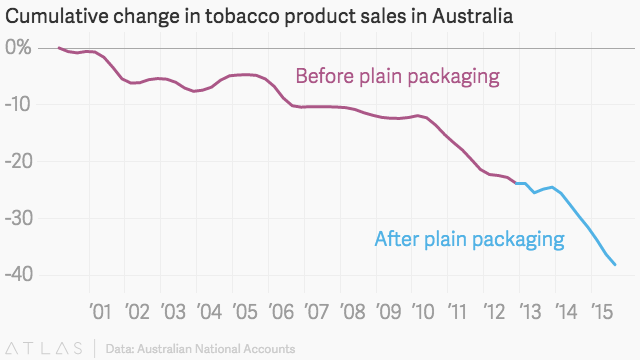
The point about plain packaging not discouraging smokers is also hard to support. Australia introduced plain-packaging rules in 2012, and the data clearly show that this can have an impact, speeding the decline of smoking that is already taking place in many developed countries:

74a7809314ccb49aabbb5c228d79f277


Not all tobacco-control measures work in the same way. Simon Chapman, professor of public health at the University of Sydney, explains how some are quick-acting, like raising taxes or taking cigarettes off shelves. Others are on-going, slow-burn measures like plain-packaging rules. These take longer to have an effect, which can nonetheless be long lasting.

The tobacco companies’ last-ditch court challenge in London will be watched closely by several other countries. (A ruling is likely to be announced early next year.) Apart from the UK and Australia, plain-packaging laws have been passed—but not yet implemented—in France, Hungary, Ireland, and Burkina Faso. A host of other governments are in the earlier stages of introducing similar rules.