Clear The Air News Tobacco Blog Rotating Header Image

Legislation

Australia seeks to remove logos from cigarette packs

backyLast updated: April 30, 2010

Source: Associated Press in Sydney via South China Morning Post

Canberra has announced a pioneering plan to force tobacco firms to sell cigarettes in generic packaging devoid of company logos.

The legislation, introduced yesterday, would take effect on July 1, 2012. It must be approved by both houses of Parliament.

Instead of logos, promotional text or colourful images on cigarette packets, graphic government health warnings would be prominently displayed instead. The brand name would be relegated to tiny, uniform type at the bottom.

“The new branding for cigarettes will be the most hardline regime in the world, and cigarette companies will hate it,” Prime Minister Kevin Rudd said.

The government also announced an increase in cigarette tax of 25 per cent, driving up the price of a pack of 30 cigarettes by about A$2.16 (HK$15.46) to around A$16.70. The tax comes into effect today.

“The big tobacco companies are going to go out there and whinge, whine, complain, consider every kind of legal action known to man – that’s par for the course,” Rudd said. “We, the government, will not be intimidated by any big tobacco company.”

As predicted, tobacco companies immediately blasted the packaging crackdown and vowed to fight it in court.

“Introducing plain packaging just takes away the ability of a consumer to identify our brand from another brand, and that’s of value to us,” Imperial Tobacco Australia spokeswoman Cathie Keogh told ABC radio.

The company planned to take legal action, she said.

Retailers said the tax increase would hurt their businesses and bolster the black market for cigarettes.

“It’s a lazy policy response being pushed by some health advocates,” Mick Daly, national chairman of Australian supermarket chain IGA, said. “That amounts to a direct attack on approximately 16 per cent of Australians who have made legal and legitimate lifestyle choices.”

Tim Wilson, director of intellectual property and free trade at Australia’s Institute of Public Affairs, said taxpayers could end up paying around A$3 billion a year in compensation to tobacco companies.

“Under Australia’s constitution, if the government basically takes someone’s property rights – including intellectual property such as trademarks – or devalues them to a significant extent, they have to provide compensation,” Wilson said.

“I’d be shocked if [tobacco companies] didn’t [pursue compensation], because if it happens here, it’ll happen all over the world,” he said.

Opposition leader Tony Abbott dismissed the tax increase as a cash grab, and said he wanted evidence that changing the packaging would reduce smoking. “I’m not in the business of defending smoking, I want to make that absolutely clear. But I also want to make absolutely clear that this is not a health policy – this is a tax grab,” Abbott said.

Australia has banned tobacco ads from print, television and radio for years. The new proposal would also restrict internet advertising.

Stripping packets of their logos would effectively stamp out tobacco companies’ marketing campaigns, said Professor Rob Moodie, chairman of the government’s National Preventative Health Task Force, which recommended the legislation.

“The thing that tobacco companies fear second after price increases is plain packaging because it takes away their last real avenue for branding their cigarettes,” Moodie said. “It also takes away their in-store presence.”

The number of Australians who smoke has more than halved in the past 20 years, the Organisation for Economic Co-operation and Development said in a report in December. About 16.6 per cent of Australians smoke daily, the third-lowest rate in the developed world behind Sweden and the US, according to the report.

New cases of lung cancer fell to 60.6 per 100,000 men in 2006 from 80.6 per 100,000 two decades earlier, according to the Australian Institute of Health and Welfare in Canberra. But the incidence in women jumped 46 per cent to 30.3 per 100,000.

Additional reporting by Bloomberg

Cigarettes up, and plain packaging compulsory to help stub out smoking

679px-cigarettes_health_warning_australiaLast updated: April 29, 2010

Source: Sydney Morning Herald

THE Rudd Government will launch a twin assault on smoking today by announcing steep increases in tobacco excise and laws requiring cigarettes and other tobacco products to be sold in plain packaging from 2012.

The excise increase, which will help fund the government’s health reforms, will be short of that required to lift the price of a packet of cigarettes to A$20, as recommended by the government’s Preventative Health Taskforce.

There was speculation last night that the excise increase would add at least $2-$3 to a pack of 25.

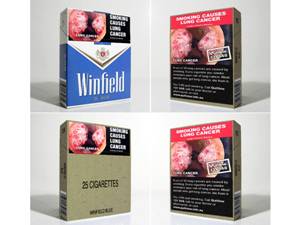
How the generic pack of cigarettes will look.

In what the Rudd government is hailing as a world first, it will also announce legislation to mandate standard packaging for all tobacco products, a move likely to incense the $9-billion tobacco industry. From January 1, 2012, all brands of cigarettes will be sold in plain boxes. The boxes will be the same colour and carry large, graphic health warnings. The brand of the cigarette will appear in a small font. The font style and size, as well as the position of the brand will be uniform.

The laws will ban the use of any colours, logos, brand imagery or promotional text that would in any way distinguish one brand of cigarettes from the other.

The government is trying to shift the policy emphasis to health after its decision to shelve its emissions trading scheme until at least 2013 has been roundly condemned by all sides.

The changes to tobacco packaging are based on research which found packaging is a subtle form of advertising that significantly influences smoking rates and habits. The government will test various packages before settling on a final design.

Labor is anticipating a nasty fight with the industry. The party does not accept donations from the tobacco industry, whereas the Liberal Party does.

Smoking kills 15,000 Australians a year despite the proportion of the population aged over 14 which still smokes having dropped from 30.5 per cent in 1988 to 16.6 per cent in 2007.

The government wants to reduce the rate of smokers to 10 per cent by 2018.

KOHL BILL TO STOP BLACK MARKET CIGARETTE SMUGGLING SIGNED INTO LAW BY PRESIDENT

obama-signingLast updated: April 1, 2010

Source: Tradingmarkets

Today U.S. Senator Herb Kohl’s bill, the Prevent All Cigarette Trafficking (PACT) Act, was signed into law by President Barack Obama. The PACT Act cracks down on black market tobacco selling by closing loopholes in current tobacco trafficking laws, enhancing penalties for violations, and providing law enforcement with new tools to combat the innovative methods being used by cigarette traffickers to distribute their products. In 1998, the Bureau of Alcohol, Tobacco, Firearms and Explosives (BATFE) had six active tobacco smuggling investigations. Today there are more than 400 open cases.

“The cost of tobacco smuggling to Americans is not merely financial. Internet tobacco sales have been used by terrorist and organized crime groups to raise millions of dollars to support their illicit activities. This new law will help us ensure that we no longer continue to enable terrorist organizations to exploit the weaknesses in our tobacco laws to their advantage, allow states lose tax revenue, and provide children with easy access to tobacco products sold over the Internet,” Kohl said.

Hezbollah, al Qaeda and Hamas have all generated significant revenue from the sale of counterfeit cigarettes. Hezbollah is estimated to have earned $1.5 million between 1996 and 2000 through tobacco smuggling. That money is often raised right here in the United States, and then funneled back to these international terrorist groups.

Kohl noted that cigarette trafficking, including the illegal sale of tobacco products over the Internet, costs states billions of dollars in lost tax revenue each year. It is estimated $5 billion of tax revenue is lost, at the federal and state level, each year. As lost tobacco tax revenue lines the pockets of criminals and terrorist groups, states are being forced to increase college tuition and restrict access to other programs because of these lost revenues.

The Internet represents a new obstacle to enforcement. Illegal tobacco vendors around the world evade detection by conducting transactions over the Internet, and then shipping their illegal products around the country to consumers. Just a few years ago, there were less than 100 vendors selling cigarettes online. Today, approximately 500 vendors sell illegal tobacco products over the Internet.

The PACT Act will:

* Strengthen the reporting requirements for interstate cigarette sellers.

* Increase the criminal penalty from a misdemeanor to a felony and create a substantial civil penalty for violations, including violations of the reporting requirements and state tobacco tax laws.

* Grant federal and state law enforcement officials more powers to investigate and prosecute violators.

* Prohibit the United States Postal Service from delivering tobacco products

The PACT Act (S. 1147) was passed under unanimous consent by the Senate on March 11, 2010. On March 17, the House of Representatives passed identical legislation (H.R. 1676) by an overwhelming majority, 387 to 25.

Smokers may pay A$20 a pack

1311Last updated: April 14, 2010

Source: Nine MSN News

Smokers could pay up to $6.50 more for a packet of cigarettes under a new tobacco tax being considered by the federal government.

The proposed tax hike would see the price for a packet of 30 cigarettes rise from an average $13.50 to $20 within a three-year period, News Limited newspapers report.

The plan is being considered as a way to fund the federal government’s landmark $18 billion health reforms and could be included in next month’s budget.

The government believes the tax could provide almost two-thirds of the $3 billion in extra revenue it needs to help convince the states to support the reforms.

The government’s National Preventative Health Taskforce believes a $6.50 rise for the average pack of cigarettes could reduce the number of smokers by one million within 10 years.

Australia currently has one of the lowest tobacco taxes in the developed world, at 68 percent.

The proposed changes would bring the nation in line with the 75-80 percent benchmark in place in most other countries.

Polls have shown the public is overwhelmingly in favour of a rise in the tobacco tax so long as the revenue is spent on health.

Bus drivers want signs for no-smoking zone

508475767_e7c70e8079_oLast updated: April 13, 2010

Source: South China Morning Post

Bus drivers have urged the government to clearly define no-smoking areas when the smoking ban is extended to all outdoor bus terminuses later this year.

New World First Bus Company Staff Union chairman Chung Chung-fai said bus drivers would have to move to nearby pedestrian areas to smoke, but the boundaries of outdoor transport interchanges were not as clearly defined as covered areas.

“The government should state clearly – such as with banners – where exactly the no-smoking areas are. Otherwise it may be easy for us to break the law,” Chung said.

About 60 per cent to 70 per cent of bus drivers are smokers, Chung said.

The smoking ban will be extended to 128 outdoor transport interchanges in the city by December, including the Star Ferry Pier terminus in Tsim Sha Tsui and the Wan Chai Pier terminus.

But five terminuses will be exempt – those at the Central Ferry Piers, the airport, Ocean Park, Nam Cheong Station and Hong Kong Convention and Exhibition Centre.

Undersecretary for Food and Health Professor Gabriel Leung said these terminuses would undergo major renovation later this year.

“The layout and bus routes may change after the renovation. It will be meaningless if we assign certain areas to be non-smoking now,” he told the Legislative Council health panel yesterday.

Lawmakers also expressed concern over the boundary issue during the panel meeting.

Fred Li Wah-ming of the Democratic Party said as outdoor terminals had no obvious boundary, tobacco control officials might have difficulties prosecuting.

Leung said the government would make sure that the signs would be “clear and everywhere”.

Kwai Tsing district councillor Lam Siu-fai said there were a number of bus terminuses in the district that had “dubious boundaries”.

“Some terminuses do not have fences,” he said. “When prosecuted, smokers can say they just unknowingly stepped into the area.”

Sha Tin district councillor Chan Kwok-tim agreed with Lam and urged the government to recruit more tobacco control inspectors, otherwise the smoking ban would just “remain on paper”.

“I always receive complaints from residents that many people are  still smoking in restaurants, but it has been more than three years  since the indoor smoking ban,” Chan said.

Written by Ng Yuk-hang

Comprehensive smoke-free legislation and displacement of smoking into the homes of young children in Hong Kong

ibchildhealthLast updated: April 10, 2010

Source: http://tobaccocontrol.bmj.com/content/19/2/129.abstract

Objective To investigate the effect of comprehensive smoke-free legislation in 2007 on the exposure of children to secondhand smoke (SHS) in Hong Kong.

Methods Two cross-sectional questionnaire surveys were conducted, before (2006) and after (2008) the implementation of smoke-free legislation, among primary 2–4 students (equivalent to US grades 2–4) from 19 and 24 randomly selected schools, respectively. Adjusted ORs for SHS exposure at home and outside home post-legislation compared with pre-legislation were calculated. The strength of the association between SHS exposure and respiratory symptoms in each survey was used as an indirect indicator of the intensity of exposure.

Results Among 3243 and 4965 never smoking students in the 2006 and 2008 surveys, the prevalence of SHS exposure in the past 7 days increased both at home (from 10.2% to 14.1%) and outside home (from 19.8% to 27.2%). Post-legislation, students were 56% more likely (p<0.01) to report SHS exposure at home coupled with an insignificantly stronger association between SHS exposure and respiratory symptoms. Similarly, students were 60% more likely (p<0.001) to report SHS exposure outside home in 2008, but the association between SHS exposure and respiratory symptoms became insignificantly weaker. Parental smoking rates were similar before and after legislation.

Conclusions The prevalence of exposure to SHS at home and outside home have both increased among primary school students in Hong Kong post-legislation. Comprehensive smoke-free legislation without strong support for smoking cessation might have displaced smoking into the homes of young children.

Malaysia: Days of puffing away definitely numbered

taknakLast updated: April 9, 2010

Source: New Straits Times

If there is a strong indication that cigarette smoking in Malaysia is steadily being transformed into a strict taboo, just like pre- or extra-marital sex, drug abuse and public boozing, take a look at pictures of people holding a cigarette or cigar in imported magazines like Time, Newsweek, Rolling Stone, GQ, Esquire and Vanity Fair.

Notice how the offensive lighted object has been blackened out by censors the same way women showing generous cleavage is annoyingly marker-penned, though mercifully better than the impertinent page being ignominiously torn off.

Cigarette smoking is among a few final but legal vices available without fear of police intervention, unless you are the wholesaler smuggling in a boatload of duty-free cartons and retailing them at premium prices.

For cigarette smokers nationwide, your days of congenital puffing are breathtakingly numbered, first by being chased out of restaurants, air-conditioned shopping malls and government buildings, followed by stiffer imposition of sales tax and duties, and now the ban on the ubiquitous 14-pack, announced on Monday by Health Minister Datuk Seri Liow Tiong Lai in the Dewan Rakyat.

Ironically, Liow’s declaration of the ban is generations too late. Whatever the health authority or the anti-smoking lobby had sternly pronounced, smoking is still an act of cool savagery, at least to the impressionable taken in by pop culture icons lighting a fag in stylish whiffs.

But tell that to teenagers who picked up the habit as easily as their pop culture icons. Then see their eyes rolled and their lips debouching a boorish “whatever” when you caution them on the fatal ill-effects smoking can cause.

Or tell that to the unrepentant chain smoker who will posit this tenuous allegory: put non-smokers in a pub full of smokers and the worst that will happen is mild suffocation or headache. But put an automobile belching carbon monoxide in the same pub, everyone dies. So, why don’t the authorities ban automobiles?

Let’s make this absolutely clear: smoking will eventually kill or incapacitate, depending on how strong your lungs are. If not now, then much later when your addiction to caffeine (or pig haemoglobin if one report is to be believed) is beyond redemption.

The authorities must be prepared for the ban’s seedy side-effect — illicitly secured cigarettes would be the prime activity, the same way drugs are trafficked. Might a regular health issue escalate into criminalisation?

Nonetheless, teenagers, targets of this push for a healthy lifestyle and eradication of social ills agenda, will learn to adapt, notwithstanding the exorbitant 20-pack prices now.

To pay for their smokes, they will cut down on other exorbitant costs — luxury apparel and cellphone texting and yakking.

They will budget themselves because it is in the youngsters social DNA to smoke, at least in public.

The only hope is that they will quit the killer habit before they hit middle age and hope they survive smoking’s debilitating symptoms.

But know this: smoking is also playing Russian roulette. If you are fortunate, you’ll be puffing away until you roll into your octogenarian years, your lungs intact but your other body parts diseased.

Or you could be coughing blood one day in your forties, fifties or sixties, lung cancer the inevitable diagnosis, followed by the dreary treatment of radio therapy and chemotherapy before you waste away and die.

Written by Asmi Anshar

Lighting up for the sake of the economy

is_cigarettes_money_070830_msLast updated: April 10, 2010

Source: South China Morning Post

One of the main battlegrounds between China’s giant State Tobacco Monopoly Administration (STMA) and the public health advocates who campaign against it is implementation of the WHO Framework Convention on Tobacco Control, which Beijing ratified in 2005.

Under the rule on labelling of cigarette packages, which took effect in January last year, warnings are supposed to cover 50 per cent of the package’s display area. But mainland regulations cover only 30 per cent of the package and the warnings are in tiny characters.

“The STMA has hampered the best way for the public to learn about the harm caused by tobacco,” anti-smoking lobbyist Yang Gonghuan said. “We lobbied hard for the separation of government and the tobacco industry, the use of pictorial warnings on packaging, tax increases and legislation to control secondary smoking. But the tobacco forces remain all-powerful. They once accused us of acting against the national interest by threatening economic growth.”

Another dispute is over advertising. Mainland law bans tobacco advertising but the firms get around this by advertising their brands, with no reference to cigarettes. Most readers know the product; companies are not punished.

In May 2008, for example, the Shanghai Hong Shuang Xi (Red Double Happiness) launched a campaign in the passenger terminals of 11 airports with the slogan “Shanghai Red Double Happiness, Always Bringing You Good Fortune”. The companies also give money to schools, which are named after them.

In December 2008, the Ministry of Civil Affairs was to award six tobacco companies with National Charity awards, because of their donations to schools; in some cases, the names were printed on the school uniforms. Anti-tobacco campaigners persuaded the ministry to drop the firms from the list. The Shanghai government also declined an offer of 200 million yuan (HK$227.34 million) in sponsorship from the city’s tobacco company for the World Expo.

In 2008, the tobacco industry accounted for 7 per cent of national revenue. Such is the power of the industry that the battle against it is difficult and long-term.

The risks of tobacco to health are rarely discussed in the mainstream media and millions of people have no idea that it is harmful. No consumer would ever win a lawsuit against a state tobacco company.

“It is wasteful to spend money on tobacco control,” said Wang Hong, a Zhuhai schoolteacher. “Smoking is too ingrained in the culture and daily life of Chinese. It is a cheap source of pleasure for the poor. The number of smokers who die and fall ill is only a small percentage. They should spend the same money on improving the health system. Spending on new hospitals and higher wages for nurses will be better than spending on anti-cigarette advertisements.”

Written by Mark O’Niell

Doctors urge full car smoking ban

harbutt_smokingLast updated: March 24, 2010

Source: BBC News

Smoking should be banned in all cars as well as in public places where young people congregate, doctors are urging.

The Royal College of Physicians wants England’s imminent review of anti-smoking laws to consider such measures to protect the young.

It says passive smoking results in 300,000 extra child visits to GPs in the UK every year for problems such as asthma and bacterial meningitis.

But driving and smoking lobby groups say cars are a “private space”.

Wheezing

A number of medical bodies have supported a ban on smoking in cars transporting children, but the RCP goes a significant step further, urging a blanket ban on anyone lighting up in a vehicle – regardless of whether children or indeed any other passengers are inside.

“ This report isn’t just about protecting children from passive smoking, it’s about taking smoking completely out of children’s lives ”
Professor John Britton RCP

It is calling for a two-pronged approach which would see children protected from second-hand smoke and shielded from the sight of adults smoking – whether in the playground or on the TV.

The RCP’s report – Passive Smoking and Children – is being released ahead of the three-year review of the ban on smoking in enclosed public spaces in England. Similar bans have been introduced across the UK, with Scotland having led the way.

Drawing on a series of studies, the report suggests that in the UK, tens of thousands of youngsters are falling ill as a result of exposure to cigarette smoke.

Exclusion zones

These calculations include 20,000 chest infections, some 22,000 new cases of asthma and wheezing, as well as 200 cases of bacterial meningitis and 40 cases of Sudden Infant Death Syndrome – or cot death.

Each year it claims these account for more than 300,000 visits to a GP – some of which end up in hospital – costing the NHS £23.3m.
“ The car is a private space and it crosses a line to start interfering in it, however much one disapproves of smoking ”
Nigel Humphries Association of British Drivers

The report does concede that these figures are only estimates, but says it is confident they give an “indication” of the number of children who become ill.

The doctors acknowledge that a ban on smoking in the home, however desirable it believes this to be, would be neither politically or practically possible, but sees the car as an intervention in the private sphere which the public would tolerate.

But it argues that the only way to make it practically enforceable would be to introduce it as a blanket ban on all private vehicles – regardless of their passengers, as exemptions would prove too complex.

In addition, it wants to see smoking banned in places frequented by children, such as parks and outdoor swimming pools – and exclusion zones outside school gates.

Campaigns to explain to parents the importance of a smoke-free home, price hikes and generic cigarette packaging are also among the recommendations issued.

“This report isn’t just about protecting children from passive smoking, it’s about taking smoking completely out of children’s lives,” says Professor John Britton, head of the college’s Tobacco Advisory Group and lead author of the report.

Parental responsibility

A Department of Health spokesman stressed the role that anti-smoking legislation had played in curbing exposure, but added: “The government is looking at ways to go further to reduce the 9,500 children admitted to hospital every year as a direct result of exposure to second-hand tobacco smoke.

“Parents have a responsibility to protect their children by stopping smoking around them in enclosed spaces like their cars and in their homes.”

The Welsh Assembly Government said it had commissioned a tobacco control group to advise specifically on how to protect children, while a Scottish Government spokeswoman said it was conscious smoking in cars was a source of exposure that needed highlighting but had no plans for a ban. Northern Ireland is to conduct its own review.

The driving and smoking lobby groups expressed their anger at the recommendations, arguing that adults did not needs laws regulating every aspect of their behaviour.

Simon Clark, of Forest, which campaigns for smokers’ rights, questioned the figures used in the report, noting that cases of asthma had been rising as the number of smokers had fallen.

“It’s unacceptable to single out smokers and imply that they are solely responsible for the cost of asthma treatments, hospital admissions and asthma drugs for children up to the age of 16.

“We want smokers to be considerate towards those around them, especially children, but changing people’s behaviour should be achieved by education and encouragement not by legislation and enforcement.”

Nigel Humphries, spokesman for the Association of British Drivers, said the car should be seen as an extension of the home and treated as such.

“The car is a private space and it crosses a line to start interfering in it, however much one disapproves of smoking.”

Written by Clare Murphy

Indonesia’s fatwa against smoking

jihadLast updated: March 17, 2010

Source: Radio Australia

Indonesia suffers some of the heaviest health impacts from smoking in Asia – and now it’s become a religious target. The country’s second-largest Muslim organisation, Muhammadiyah, has issued a fatwa or ruling, saying that smoking is prohibited under Islamic law. But other religious groups say Muhammadiyah has gone too far.

The full story and audio are after the jump.

(more…)